






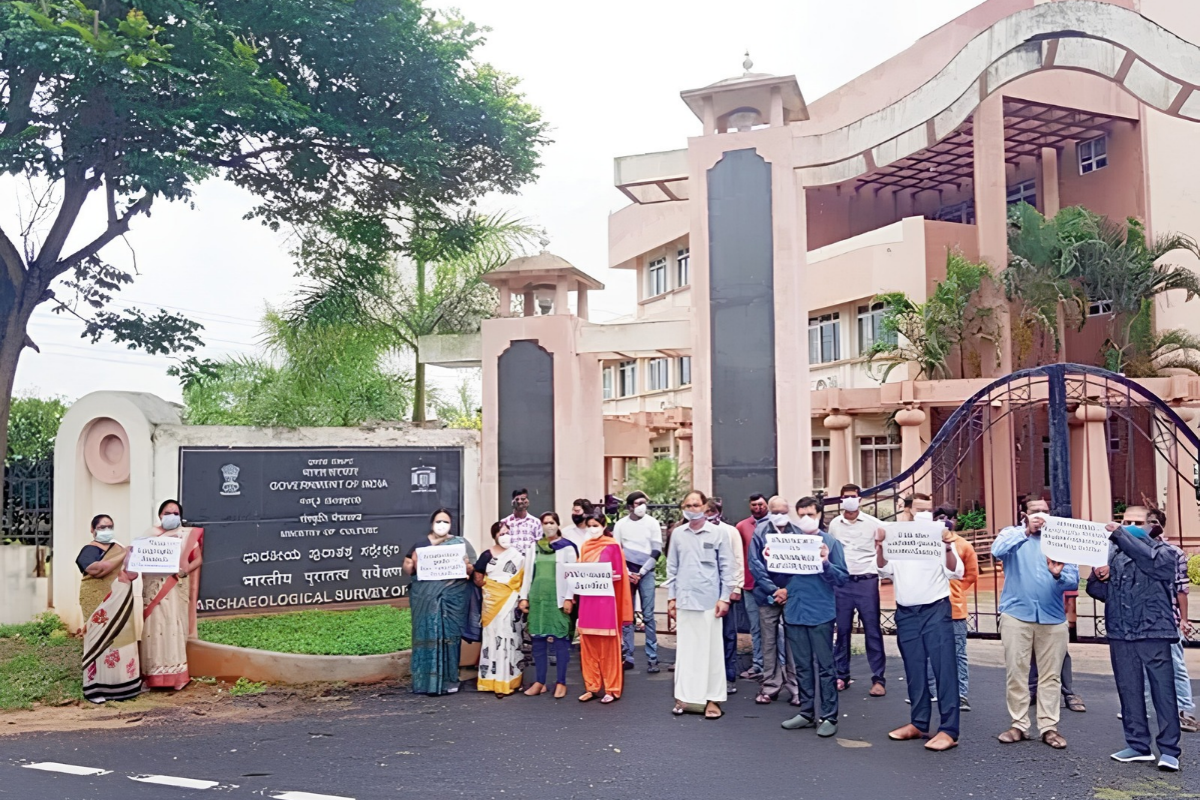
While the government rewrites National Council of Educational Research and Training (NCERT) textbooks to emphasize the medieval temple economy, the ASI epigraphy branch operates with severe staffing deficits. The state’s push for this historical narrative contrasts sharply with stagnant funding, leaving thousands of primary temple inscriptions untranslated.
Despite the state mandate to teach this history, the Archaeological Survey of India (ASI) currently operates with 191 vacant posts in its scientific branches, crippling the translation of medieval records.
How severe are the ASI epigraphy branch vacancies?
According to August 2026 parliamentary data, the Archaeological Survey of India’s specialized scientific branches operate with a severe staffing deficit, leaving 191 out of 440 sanctioned posts currently vacant.
The state’s educational policy mandates teaching the economic history of temples, but the agency responsible for uncovering that history lacks the manpower to read it. Epigraphy, the study of identifying, reading, and interpreting ancient inscriptions, is directly impacted by this shortage.
A Comptroller and Auditor General (CAG) of India report identified a massive, decades-old backlog of estampages deteriorating at the ASI Epigraphy Branch in Mysuru. Estampages are exact ink impressions lifted directly from stone inscriptions, which researchers use for translation without damaging the original site.
How does the NCERT temple economy curriculum describe medieval sites?
The newly revised NCERT curriculum explicitly describes medieval temples as “financial institutions” that functioned as major landholders and employers by extending credit to village assemblies.
Media coverage treats this curriculum update as an ideological clash. Commentators debate whether the revisions represent a political rewrite of history or a necessary correction to colonial narratives.
Why is there a translation backlog for medieval temple inscriptions?
The translation backlog exists because the specialized talent pipeline has dried up, leaving the ASI unable to recruit scholars capable of reading 10th-century stone records.
The primary source material for the textbook’s economic thesis lies in these exact records. Translating these texts requires specialists trained to read ancient Tamil, Telugu, or Kannada scripts detailing devadana, tax-free land grants gifted by rulers to temples.
Official ASI recruitment circulars demand that candidates hold a Master’s degree in Sanskrit or Dravidian languages alongside ten years of experience deciphering medieval inscriptions. The sheer difficulty of mastering these classical scripts has left the specialized applicant pool nearly empty.
Government administrators attribute the vacancy rate to an educational shortfall rather than deliberate defunding. They cite a persistent lack of university graduates possessing the classical language skills required to pass the stringent Union Public Service Commission (UPSC) recruitment screenings.
How does the Archaeological Survey of India budget compare to the curriculum goals?
According to parliamentary oversight reports, the ASI allocates approximately 40 percent of its total expenditure to general heritage protection and monument conservation, while spending less than one percent on exploration, excavation, and scientific publications.
The government’s high-profile educational push for temple history contrasts directly with its stagnant budget allocation for specialized archaeological research. The exact funding needed to translate and publish South Indian temple inscriptions, which falls under the scientific publications budget line, remains heavily suppressed compared to the capital spent on physical tourism infrastructure.
Frequently Asked Questions
Why are medieval temple inscriptions important for the new NCERT syllabus? Medieval temple inscriptions, particularly in South India, are the primary historical records proving that these religious sites operated as financial institutions. The new NCERT curriculum relies on the translation of these stone records to teach students how temples issued credit and managed land grants.
What is the current vacancy rate at the ASI epigraphy branch? According to August 2026 parliamentary data, the Archaeological Survey of India’s scientific branches, which include the epigraphy department, operate with 191 vacant positions out of 440 officially sanctioned posts.
Why can’t the ASI hire more epigraphists to translate the backlog? Government recruitment mandates require candidates to hold a Master’s degree in classical languages like Sanskrit or Dravidian languages, plus ten years of specialized experience reading ancient scripts. Administrators cite a severe lack of qualified university graduates capable of passing these stringent Union Public Service Commission requirements.