






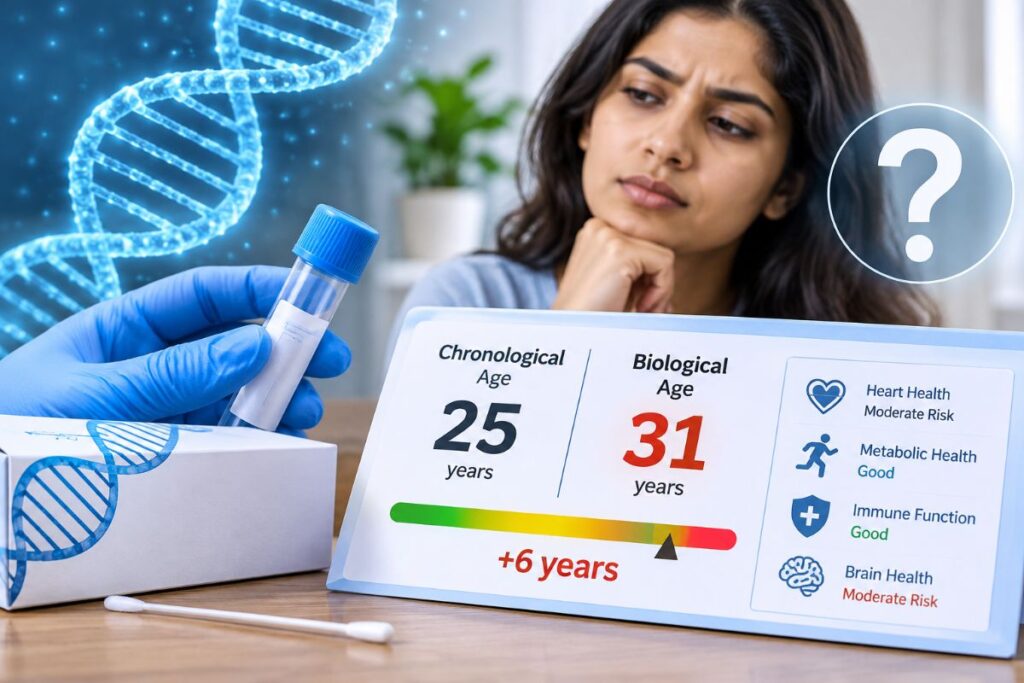
Epigenetic biological age tests work well for detecting health trends across large clinical trials, but they lack the stability to reliably track a person’s progress. According to Yale researchers’ own companion studies, traditional clocks deviate by up to 8.6 years on the exact same blood sample, while meals, stress, and time of day shift scores within hours.
Why Can the Same Blood Sample Produce Different Biological Ages?
Testing the same DNA sample twice on traditional epigenetic clocks produces a median discrepancy of 0.9 to 2.4 years and a maximum swing of 4.5 to 8.6 years, a laboratory error margin larger than the 1- to 3-year gains reported in most clinical trials.
While a recent 51-study benchmark from Yale School of Medicine found that diet, exercise, and certain metabolic drugs can lower biological age scores across groups of patients, the same researchers’ concurrent technical and biological reliability audits reveal a major hurdle for personal testing: measurement noise.
In a Nature Aging reliability study (DOI: 10.1038/s43587-022-00248-2) and a 2026 follow-up in Aging Cell (“Biological Versus Technical Reliability of Epigenetic Clocks and Implications for Disease Prognosis and Intervention Response,” Aging Cell 25(8), e70635), Yale School of Medicine researchers Raghav Sehgal and Assistant Professor Albert Higgins-Chen tested what happens when the same DNA sample is analyzed twice. On traditional epigenetic clocks, computer models that estimate biological age by measuring chemical tags called DNA methylation on a person’s genes, identical blood samples produced a median discrepancy of 0.9 to 2.4 years and a maximum swing of 4.5 to 8.6 years. According to the Yale team’s reliability dataset, PhenoAge showed the widest single-sample spread at a median of 2.4 years and a maximum of 8.6 years, while the Horvath multi-tissue clock showed a median deviation of 1.8 years and a maximum of 4.8 years.
That laboratory margin of error sits directly atop the actual biological shifts reported in human intervention trials. According to an independent statistical review by Longevity Science Daily, the largest verified shifts produced across the 51 longitudinal studies harmonized in the Yale team’s Nature Medicine benchmark (DOI: 10.1038/s41591-026-04562-9) are smaller than that 8.6-year replicate spread, typically amounting to modest shifts of 1 to 3 years or fractional changes in standardized effect size.
For a single person ordering an at-home blood kit before and after starting a new supplement or diet, a 2-year drop in biological age is mathematically indistinguishable from random assay variation inside the lab.
Why Do 51 Clinical Studies Show a Clear Signal When Individual Tests Are Noisy?
Clinical trials average blood results across dozens or hundreds of participants, cancelling out random laboratory errors that an individual consumer ($N=1$) absorbs in full across two tests.
Mainstream news coverage of the Nature Medicine paper portrayed the findings as proof that blood DNA tests can tell consumers which anti-aging therapies work. That framing overlooks the mathematical difference between studying a crowd and testing one person.
Clinical trials overcome measurement scatter through sample size. In the Nature Medicine TranslAGE dataset, researchers evaluated 51 longitudinal intervention studies, 20 of which significantly reduced epigenetic age across multiple biomarkers, by running paired t-tests across entire participant groups. When statisticians average blood test results across 100 participants in a randomized trial, random laboratory fluctuations cancel each other out, shrinking the group standard error by the square root of the sample size ($\sigma / \sqrt{100}$, or a tenfold reduction in random error).
A consumer taking a single test at Month 0 and a second test at Month 6 ($N=1$) has no group average to absorb the scatter. That individual absorbs 100% of the single-assay measurement variance on both blood draws.
Even if laboratory equipment introduced zero technical error, the human bloodstream itself changes too quickly over a single day to offer a static baseline.
How Do Time of Day, Meals, and Immune Shifts Skew Epigenetic Biological Age Tests?
Meals, acute stress, and daily circadian oscillations alter white blood cell ratios and DNA methylation tags within hours, shifting biological age readings even when no long-term aging has occurred.
In their 2026 Aging Cell analysis, Sehgal and Higgins-Chen drew a sharp distinction between technical reliability (getting the same number when running one vial twice) and biological reliability (getting a stable reading from the same person across hours or days). Their data show that even when laboratory machines are highly precise, biological instability limits personal tracking.
Analyzing repeated blood samples collected within a single day or across short intervals, including 34 participants measured four times in one day following a standardized meal and 34 participants measured four times across a day during acute psychosocial stress, alongside cohorts exposed to air pollution ($N=16$) and altitude changes ($N=21$), the Yale team found that the stability of most epigenetic clocks dropped substantially. According to a technical breakdown by Longevity Protocols, meals, acute stress, and diurnal time-of-day shifts alter calculated biological age within hours.
Shifts in white blood cell subtypes drive much of that daily drift. Because different immune cells carry distinct baseline methylation profiles, a meal, a poor night of sleep, an intense workout, or a mild infection temporarily alters the mix of circulating leukocytes, the white blood cells measured in whole-blood DNA assays, and pushes an epigenetic clock score up or down.
On top of biological fluctuations sits hardware variance. Standard Illumina Infinium MethylationEPIC microarrays, the glass chips labs use to read roughly 850,000 to 900,000 methylation sites, exhibit measurable batch effects across different physical slide positions and processing runs when a patient’s baseline sample and follow-up sample are analyzed months apart.
Which Epigenetic Clocks Reduce Measurement Noise, and What Do Consumer Reports Show?
Newer Principal Component clocks and DunedinPACE push technical repeatability above 0.90 to 0.99, but direct-to-consumer dashboards still display single-point scores without printed confidence intervals.
Not all biological age algorithms suffer from the same level of test-retest scatter. To measure repeatability, biostatisticians use the Intraclass Correlation Coefficient (ICC), a scale from 0 to 1 where 1.0 indicates identical results every time a sample is retested.
In their Nature Aging reliability study and 2026 Aging Cell paper, Higgins-Chen and Sehgal showed that traditional clocks rely on a few hundred individual DNA sites, making them vulnerable to single-probe glitches. By retraining those models using Principal Component (PC) analysis, a statistical method that pools information across tens of thousands of correlated DNA sites, the Yale researchers pushed technical test-retest ICC scores above 0.99 and reduced median technical replicate variation to 0.3 to 0.8 years (cutting PCPhenoAge‘s maximum error from 8.6 years down to 1.6 years). Newer algorithms such as Yale’s Systems Age and the pace-of-aging clock DunedinPACE, a blood test estimating how fast a person is aging per calendar year that achieves technical ICC values above 0.90, also show stronger repeatability than first-generation clocks.
Yet commercial direct-to-consumer dashboards rarely display individual error bars next to a customer’s headline score. On TruDiagnostic’s sample report and provider education portal, results are presented as clean point values, such as a biological age shift of “-1 yr” or a DunedinPACE rate moving from “0.97” to “0.81”, accompanied by a general footnote advising clinicians that biomarkers can be sensitive to recent illness or stress, rather than printing a specific confidence interval around the customer’s result.
Without a printed margin of error on the report, a consumer seeing their biological age move from 44.2 to 42.8 years cannot tell whether their new routine worked, or whether their sample simply reflected normal biological or assay variance.
How Can Labs and Consumers Make Biological Age Tracking More Reliable?
Using Principal Component clocks, collecting fasted morning blood samples at the same hour, and running pre- and post-intervention samples on the same laboratory chip cut down technical and daily noise.
The Yale authors emphasize that their reliability audit is designed to improve longitudinal tracking, not dismiss epigenetic clocks as scientific tools.
In Aging Cell and their Nature Medicine framework, Sehgal and Higgins-Chen note that Principal Component clocks and Systems Age were built specifically to eliminate the multi-year replicate swings found in older algorithms. In controlled clinical trials, investigators further suppress noise by collecting blood at the exact same morning hour after an overnight fast, and by storing baseline and follow-up samples to run them side-by-side on the same Illumina array chip.
From a regulatory standpoint, direct-to-consumer epigenetic tests operate under different oversight than clinical diagnostic assays. According to the National Institutes of Health Regulatory Knowledge Guide for Laboratory Developed Tests and the National Human Genome Research Institute’s genomics policy overview, laboratories certified under the federal Clinical Laboratory Improvement Amendments (CLIA) must verify analytical validity, confirming that their lab equipment accurately reads the chemical methylation signals, but direct-to-consumer wellness tests do not undergo Food and Drug Administration (FDA) premarket review for clinical utility in guiding personal medical decisions.
Until direct-to-consumer testing companies pair noise-resistant algorithms with strict blood-draw timing rules and transparent confidence intervals on every customer report, an individual before-and-after biological age score remains a rough estimate, not a precision speedometer for aging.
Frequently Asked Questions
How much can an epigenetic biological age test vary on the same blood sample?
According to Yale researchers Raghav Sehgal and Albert Higgins-Chen’s reliability studies in Nature Aging and Aging Cell, testing the same blood DNA sample twice on traditional epigenetic clocks produces a median discrepancy of 0.9 to 2.4 years and a maximum swing of 4.5 to 8.6 years, with PhenoAge showing the widest single-sample deviation at up to 8.6 years.
Can eating a meal or feeling stressed change my biological age test result?
Yes. In their 2026 Aging Cell study measuring 34 participants four times in a single day after a meal and 34 participants during acute psychosocial stress, the Yale team found that meals, acute stress, and time-of-day shifts alter circulating white blood cell subtypes and DNA methylation tags within hours.
Which epigenetic clocks have the highest test-retest reliability?
Principal Component (PC) clocks developed by Yale researchers achieve technical test-retest Intraclass Correlation Coefficients (ICCs) above 0.99 and reduce median replicate variation to 0.3 to 0.8 years, while newer pace-of-aging algorithms such as DunedinPACE maintain technical ICCs above 0.90.
Are direct-to-consumer epigenetic biological age tests approved by the FDA for medical decisions?
No. While testing laboratories certified under the federal Clinical Laboratory Improvement Amendments (CLIA) verify analytical validity in reading DNA methylation signals, direct-to-consumer biological age wellness tests do not undergo Food and Drug Administration (FDA) premarket review for clinical utility.