






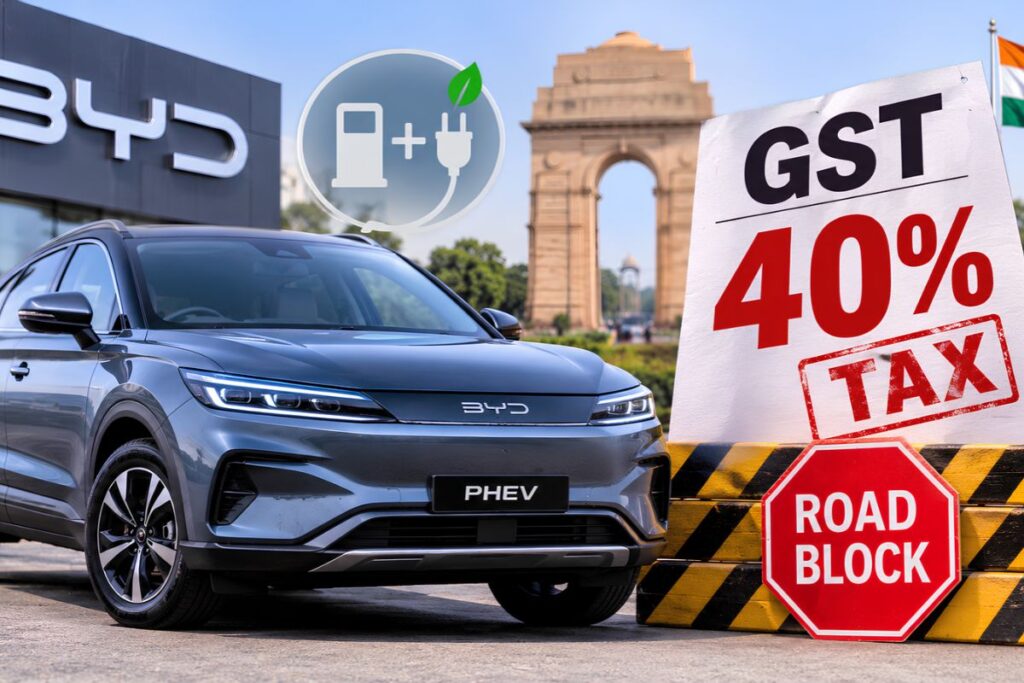
BYD plug-in hybrids in India remain absent from showrooms because Indian tax law levies a 40% Goods and Services Tax on full-size hybrids compared to 5% on pure electric vehicles. On a luxury import, that 35-percentage-point tax gap adds roughly ₹25 lakh to ₹35 lakh in tax penalties alone, making imported plug-in hybrids commercially unviable.
Why Hasn’t BYD Launched Plug-In Hybrids Alongside Denza in India?
BYD delayed plug-in hybrids during its November 13, 2026 Denza launch because full-size hybrids are taxed at 40% GST in India, eight times the 5% rate applied to battery-electric vehicles.
At the debut of its luxury marque Denza in India, attended by BYD India senior vice president Rajeev Chauhan and vice president Shrirang Joshi, BYD introduced only all-electric models: the D9 multi-purpose vehicle (MPV) at ₹90 lakh ex-showroom and the Z9 GT shooting brake at ₹1.56 crore ex-showroom. In its official launch statement, BYD India stated that consumer awareness of different hybrid technologies needs to improve before the company expands beyond its current electric vehicle portfolio.
India’s Goods and Services Tax (GST) schedule points to a fiscal barrier rather than a marketing one. Under the revised rate structure notified by the Central Board of Indirect Taxes and Customs (CBIC) via Notification 9/2025-Central Tax (Rate) and effective September 22, 2025, any passenger vehicle propelled solely by an electric motor (classified under Harmonized System of Nomenclature, or HSN, code 8703 80) carries a 5% GST rate with zero compensation cess, regardless of vehicle length, battery capacity, or price.
Plug-in hybrids, vehicles that combine an internal-combustion engine with a battery pack rechargeable from an external power outlet, are classified under Customs Tariff Chapter 87, headings 8703 40 and 8703 60, and are excluded from that 5% concession. Per the 56th GST Council rate revision, only compact hybrids measuring under 4,000 millimeters in length with petrol engines up to 1,200 cc (or diesel engines up to 1,500 cc) qualify for an 18% GST slab. Every hybrid above those dimensions, including full-size models like the international Denza D9 DM-i and Z9 GT DM-i, faces 40% GST, identical to a large petrol or diesel luxury car.
How Much More Expensive Would a BYD Plug-In Hybrid Be Than an EV in India?
Importing a luxury plug-in hybrid into India incurs roughly ₹29.4 lakh more in GST alone than importing an identically priced all-electric vehicle, because the 40% tax compounds on top of a 110% effective customs duty.
BYD imports its Indian lineup as Completely Built-Up (CBU) units, vehicles manufactured and assembled entirely overseas before shipment, rather than assembling them domestically. Under India’s customs rules for CBU passenger vehicles with a Cost, Insurance, and Freight (CIF) value above $40,000, importers pay a 70% Basic Customs Duty plus a 40% Agriculture Infrastructure and Development Cess, creating a 110% combined customs tariff.
In China, the all-electric Denza D9 retails between 3,19,800 and 4,69,800 yuan (roughly ₹45.9 lakh to ₹67.5 lakh), while the Denza Z9 GT EV starts at 2,69,800 yuan (about ₹38.8 lakh). Because India calculates GST on the post-customs assessable value, a 40% tax rate multiplies that 110% import-duty burden far more steeply than a 5% rate.
Based on India’s post-September 2025 GST slabs, on a baseline post-customs taxable value of ₹84 lakh (derived from an assumed ₹40 lakh CIF import price plus 110% customs duties):
- A 5% GST rate on an all-electric CBU adds ₹4.2 lakh in GST, bringing the pre-margin landed cost to ₹88.2 lakh.
- A 40% GST rate on an identically valued plug-in hybrid CBU adds ₹33.6 lakh in GST, a ₹29.4 lakh tax penalty before dealer margins or state registration fees are added.
State road taxes widen the on-road price gap further. In major luxury markets such as Delhi and Maharashtra, where the all-electric Denza D9 lands between ₹94.76 lakh and ₹97.85 lakh on-road, battery-electric vehicles receive full or substantial state road-tax waivers, whereas full-size plug-in hybrids are billed at standard internal-combustion slabs.
Why Can’t BYD Assemble Plug-In Hybrids Locally to Cut the Tax Bill?
BYD cannot lower its customs base through local assembly because New Delhi’s Press Note 3 foreign investment rules block Chinese-owned manufacturing plants, and India’s electric-vehicle import incentive excludes plug-in hybrids.
Automakers such as Toyota and Maruti Suzuki reduce India’s CBU customs duties on strong hybrids by assembling vehicles locally from Completely Knocked-Down (CKD) kits. That route remains closed to BYD.
Under DPIIT Press Note 3 (2020 Series), issued by the Department for Promotion of Industry and Internal Trade, any foreign direct investment from an entity based in a country sharing a land border with India, including China, requires prior government security clearance. New Delhi previously rejected BYD and Megha Engineering’s $1 billion proposal to build an electric-vehicle manufacturing plant in Telangana, keeping the company restricted to CBU imports. While the Union Cabinet amended land-border FDI guidelines in March 2026 to establish a faster clearance track for select sectors, that window applies only where majority shareholding and control remain permanently with resident Indian citizens or entities.
Even if BYD secured local assembly approval, India’s dedicated electric-vehicle manufacturing incentive, the Scheme to Promote Manufacturing of Electric Passenger Cars in India (SPMEPCI), offers zero tariff relief for plug-in hybrids. Under the Ministry of Heavy Industries scheme guidelines notified on June 3, 2025, the scheme’s concessional 15% import duty window applies strictly to pure battery-electric passenger vehicles.
Are Other Automakers Skipping Plug-In Hybrids in India for the Same Reason?
Yes, rival luxury brands with unrestricted local manufacturing access, including Volvo Car India, have also skipped plug-in hybrids in India because of the 40% versus 5% GST disparity.
Speaking at the launch of the electric EX90 on October 12, 2026, Volvo Car India managing director Jyoti Malhotra flagged higher taxes as the primary obstacle to introducing plug-in hybrids in India, pointing directly to the 35-percentage-point tax gap between large hybrids and pure EVs. Volvo committed to launching one pure electric model per year over the next three years rather than importing its global plug-in hybrid range.
Registration data tracked on the Ministry of Road Transport and Highways’ VAHAN public analytics dashboard shows how sharply tax policy has tilted buyer demand toward pure EVs: India recorded 3,04,701 electric passenger-vehicle registrations between January 1 and November 9, 2026, up 66% from the same period in 2025 and surpassing the full-year 2025 total of 1,95,571 units. By contrast, plug-in hybrids remain limited to ultra-niche performance models such as the Mercedes-AMG E 53, priced above ₹1.45 crore ex-showroom.
While India’s Corporate Average Fuel Efficiency (CAFE III) norms, notified on September 29, 2026 for the 2027–2032 compliance period, grant plug-in hybrids a fleet emission super-credit multiplier alongside pure electric vehicles, manufacturer compliance credits do not lower showroom sticker prices for retail buyers.
What Would Have to Change for BYD Plug-In Hybrids to Reach India?
BYD plug-in hybrids would require at least one of three regulatory changes, a GST rate cut for long-range hybrids, ASEAN free-trade tariff qualification, or Press Note 3 FDI approval, before they could compete on price in India.
BYD has noted, and industry analysts acknowledge, that plug-in hybrids also face a product-positioning challenge in a market split between zero-tax city EVs and self-charging strong hybrids (such as the Toyota Vellfire and Innova Hycross) that require no external charging. From a policy standpoint, Indian regulators have maintained the 40% GST slab on large hybrids to prevent automakers from using small-battery hybrids to claim green tax subsidies while operating primarily on petrol.
Without a shift in consumer behavior, three concrete policy triggers could unlock BYD plug-in hybrids in India:
- A GST Council rate reclassification: The GST Council would need to create a lower tax slab for long-range plug-in hybrids exceeding 4,000 millimeters, an item absent from the Council’s published rate schedule following its September 2025 reset.
- An ASEAN tariff concession: BYD would need to source plug-in hybrids from its manufacturing facility in Rayong, Thailand, and qualify them under India-ASEAN Free Trade Agreement (AIFTA) rules of origin, which require at least 35% regional value content plus a change in tariff sub-heading under the AIFTA legal framework.
- Press Note 3 FDI clearance: New Delhi would need to approve local CKD assembly for BYD in India, reducing the customs base on which the 40% GST is calculated.
Until at least one of those regulatory walls moves, no consumer education campaign will make a 40%-taxed plug-in hybrid competitive against a 5%-taxed electric car in Indian showrooms.
Frequently Asked Questions
Why hasn’t BYD launched plug-in hybrid cars in India yet?
While BYD stated at its November 13, 2026 Denza launch that Indian buyers need more awareness of hybrid technology, Indian tax law is the primary barrier. Full-size plug-in hybrids are taxed at 40% Goods and Services Tax (GST) compared to 5% for pure electric vehicles, creating a 35-percentage-point tax disadvantage.
What is the GST rate on plug-in hybrids in India?
Under the Central Board of Indirect Taxes and Customs rate schedule effective September 22, 2025, plug-in hybrids longer than 4,000 millimeters or with petrol engines above 1,200 cc are taxed at 40% GST. Only compact hybrids under 4,000 millimeters with petrol engines up to 1,200 cc (or diesel engines up to 1,500 cc) qualify for an 18% GST slab.
How much does the 40% GST add to an imported luxury plug-in hybrid in India?
On a Completely Built-Up (CBU) import with a ₹40 lakh Cost, Insurance, and Freight value and 110% combined customs duties (yielding an ₹84 lakh taxable base), a 40% GST rate adds ₹33.6 lakh in tax compared to ₹4.2 lakh at the 5% EV rate, a ₹29.4 lakh tax penalty before dealer margins or state road taxes.
Can BYD assemble plug-in hybrids in India to avoid CBU import duties?
No, because India’s Press Note 3 (2020) foreign direct investment rules require prior government security clearance for investments from China, and New Delhi previously rejected BYD’s $1 billion local plant proposal. Even if approved, India’s 15% concessional import duty scheme (SPMEPCI) applies only to pure battery-electric vehicles, not plug-in hybrids.