






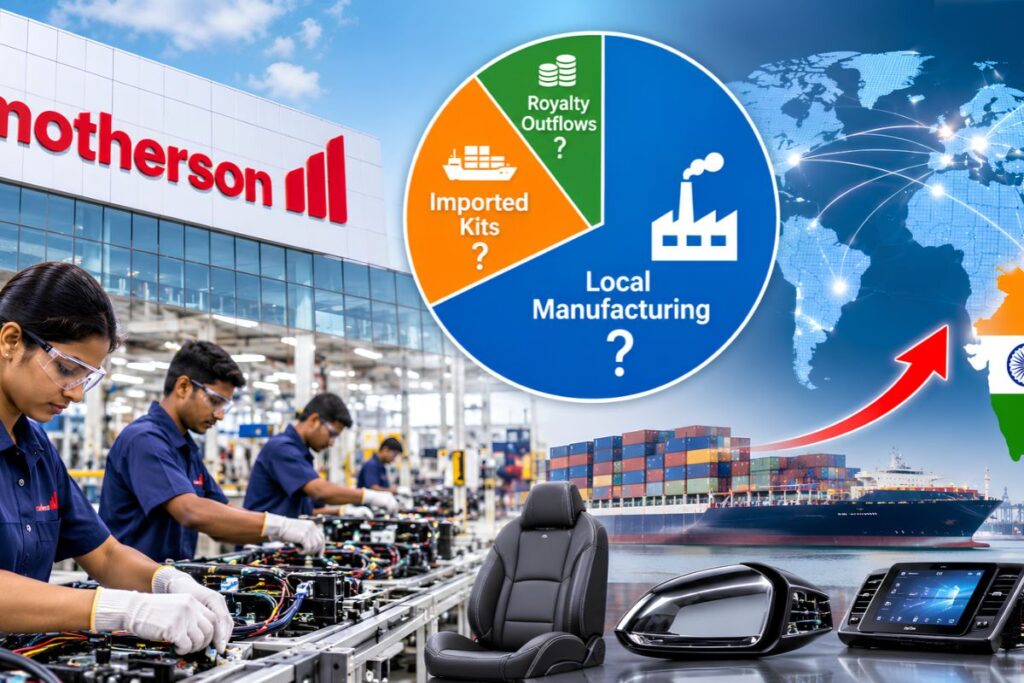
Motherson India Localization: Local Output vs. Imported
Samvardhana Motherson International Limited (SAMIL) markets its overseas acquisitions as an immediate Motherson India localization engine, yet corporate filings and plant schedules show a slower reality. Domestic execution still depends on phased assembly, specialized foreign intellectual property, and multi-year capital commitments, while local Tier-2 supply chain integration lags behind headline expansion announcements.
Why Has Motherson’s Kanchipuram Electronics Plant Faced Timeline Adjustments?
Motherson’s Kanchipuram electronics plant shifted its start-of-production schedule from Q3 FY27 to Q4 FY27 as capital equipment and tooling installation timelines adjusted, even with central government subsidy backing.
In January 2026, India’s Ministry of Electronics and Information Technology (MeitY) approved Motherson Electronic Components Private Limited (MECPL), a wholly owned subsidiary of Samvardhana Motherson International Limited, under the third tranche of the Electronics Components Manufacturing Scheme (ECMS), a federal incentive program supporting domestic electronics hardware manufacturing. According to SAMIL’s Bombay Stock Exchange (BSE) disclosure, the approval covers a proposed ₹1,900 crore investment over six years in Kanchipuram, Tamil Nadu, to manufacture consumer electronics enclosures and create over 5,000 jobs, with fiscal incentives running from FY26 through FY31.
Despite that policy backing, commissioning schedules at the Kanchipuram facility moved from Q3 FY27 to Q4 FY27. Operational updates and commissioning milestones for the plant are detailed in SAMIL’s Q2 FY27 earnings disclosures and analyst call transcripts.
Elsewhere in India, Motherson has brought smaller internal electronics lines online. The group initiated commercial production at a Pune electronics facility with an initial installed capacity of roughly 1.5 million pieces a year for printed circuit boards and electronic control units aimed primarily at internal group consumption.
How Much of Motherson’s Acquired Foreign Tech Is Imported Into India vs. Sourced Locally?
Owning foreign manufacturing intellectual property on paper does not immediately translate into local component sourcing, because precision cores and high-voltage connectors must still be imported during early production phases.
In July 2026, Samvardhana Motherson International Limited completed the acquisition of an 81% stake in Japan’s Yutaka Giken Co., Ltd. for approximately JPY 27 billion (nearly ₹1,580 crore), while Honda Motor Co. retained the remaining 19%. Yutaka Giken manufactures precision metal components, including rotors and stator assemblies, the rotating and stationary electromagnetic cores inside electric and hybrid vehicle motors, alongside brake and drive systems.
That same month, SAMIL closed its €207 million acquisition of Nexans Autoelectric (Nexans Autoelectric GmbH and Elektrokontakt GmbH), expanding its low- and high-voltage powertrain wiring harness portfolio. Bringing those product lines onto Indian factory floors requires specialized electrical steel, progressive stamping dies, and high-voltage connectors that domestic Tier-2 sub-suppliers rarely produce at commercial scale on day one.
Across India’s broader component sector, data from the Automotive Component Manufacturers Association of India (ACMA) reflects the same structural gap: while India’s auto-component exports reached USD 24 billion (₹2.13 lakh crore), component imports rose to USD 25.4 billion (₹2.25 lakh crore) due to demand for specialized sub-assemblies, with non-battery electric vehicle components accounting for 4.6% of domestic automaker supplies. Bill-of-entry import records under Harmonized System of Nomenclature (HSN) headings 8708 and 8536, logged via the Indian Customs Electronic Gateway (ICEGATE) and the Directorate General of Foreign Trade (DGFT) TradeStat, provide the primary trade audit trail for tracking foreign sub-assembly shipments into Indian plants during initial ramp-ups.
How Do Related-Party Royalties and Technical Fees Affect Indian Value Addition?
Even when final assembly takes place inside Indian factories, domestic value retention is offset by recurring cross-border payments to overseas group entities and joint-venture partners for technical assistance and intellectual property licensing.
Regulatory disclosures show how closely Motherson tracks cross-border intellectual property charges across its global subsidiaries. In September 2026, SAMIL disclosed to Indian stock exchanges that Jakarta tax authorities disallowed partial royalty and license fee expenses at an Indonesian subsidiary, resulting in a tax penalty of IDR 14.94 billion.
Within India, separated entity disclosures show distinct financial profiles between consolidated global holdings and domestic operating units. According to the Motherson Sumi Wiring India Limited (MSWIL) FY26 Annual Report, the group’s listed domestic wiring harness arm reported FY26 revenue of ₹11,478 crore, up 23.2% from ₹9,317 crore in the prior year, and EBITDA of ₹1,061 crore, up 6.4% from ₹997 crore, operating without debt while funding greenfield ramp-ups such as Navagam.
At the parent level, SAMIL’s Q2 FY27 financial results show the divergence between consolidated global turnover and standalone Indian operations: consolidated quarterly revenue reached ₹38,280 crore (up 26.9% from ₹30,173 crore a year earlier), whereas standalone revenue stood at ₹4,041 crore and standalone net profit fell 38.3% year-on-year from ₹732 crore to ₹451 crore. Outflows for technical assistance fees, functional support services, and cross-border royalties paid by Indian entities to overseas affiliates are itemized in the Related-Party Transaction (RPT) schedules of SAMIL’s FY26 Annual Report and MSWIL’s statutory filings.
Why Does Automotive Engineering Take 18 to 30 Months to Localize in India?
Translating Japanese or European component specifications onto Indian shop floors requires 18 to 30 months of die re-engineering, raw-material qualification, and automaker safety testing before domestic sub-suppliers can replace imports.
In recent interviews, SAMIL Whole-time Director Pankaj Mital and Group Chief Financial Officer Gandharv Tongia pointed to stricter Indian emission norms, vehicle premiumisation, and rising content per vehicle as drivers allowing Motherson to deploy its global portfolio in India. Those domestic plans sit inside SAMIL’s Vision 2030 roadmap, which targets USD 108 billion in consolidated gross revenue by FY29–30, up from USD 25.3 billion reported gross revenue in FY25, alongside a 40% return on capital employed (ROCE) and its “3CX10” rule capping any single customer, component, or country at 10% of turnover.
Per the SAMIL FY25 Annual Report, the group closed its previous Vision 2025 cycle at USD 25.7 billion in gross revenue against a USD 36 billion target, with consolidated ROCE at 17.2%. To support ongoing expansion, SAMIL invested ₹59.1 billion in capital expenditure during FY26 and guided for ₹6,000 crore (plus or minus 10%) in FY27 capex.
On the factory floor, however, converting overseas blueprints into local output follows strict engineering gates. Re-engineering progressive stamping dies, qualifying Indian electrical-grade steel or specialty polymers, and completing the Production Part Approval Process (PPAP), a standardized automotive quality verification protocol aligned with Society of Indian Automobile Manufacturers (SIAM) and IATF 16949 standards, typically spans 18 to 30 months before a foreign-designed part can be sourced entirely from domestic Tier-2 vendors.
What Determines Whether Indian Automakers and Tier-2 Suppliers Localize Parts?
Localization speed in India depends on annual vehicle batch volumes, because automakers require proven zero-defect parts at vehicle launch and defer local tooling investments until order volumes justify upfront die costs.
In global automotive manufacturing, importing precision sub-assemblies and licensed tooling during the first 18 to 36 months of a new vehicle program is standard industry practice. Automakers require zero-defect certification from established overseas production lines first so domestic models can launch on schedule, postponing local Tier-2 tooling capital until annual production runs grow large enough to recover upfront tooling expenses.
Until domestic electric and hybrid vehicle platforms scale past the batch thresholds needed to amortize multi-crore progressive tooling in India, Tier-1 suppliers face a commercial trade-off: absorb higher upfront import and licensing costs on specialized cores and connectors, or delay local vendor onboarding until automaker order books lock in multi-year domestic volumes.
Frequently Asked Questions
How much is Motherson investing in its Kanchipuram electronics plant, and when does production start? Motherson Electronic Components Private Limited received Ministry of Electronics and Information Technology (MeitY) approval under the Electronics Components Manufacturing Scheme (ECMS) for a proposed ₹1,900 crore investment in Kanchipuram, Tamil Nadu, with incentives running from FY26 to FY31. According to SAMIL’s Q2 FY27 disclosures, start-of-production at the Kanchipuram plant shifted from Q3 FY27 to Q4 FY27 as equipment installation timelines adjusted.
Which foreign technologies did Samvardhana Motherson acquire in July 2026 for EVs and wiring harnesses? In July 2026, Samvardhana Motherson International Limited acquired an 81% stake in Japan’s Yutaka Giken Co., Ltd. for approximately JPY 27 billion (nearly ₹1,580 crore), adding electric and hybrid motor rotors, stators, and brake systems, and closed its €207 million acquisition of Nexans Autoelectric for low- and high-voltage wiring harnesses.
Why doesn’t Motherson immediately manufacture all acquired foreign components locally in India? Translating foreign blueprints into Indian manufacturing requires re-engineering progressive dies, qualifying domestic electrical steel and polymers, and passing automaker Production Part Approval Process (PPAP) quality audits, which takes 18 to 30 months. Until domestic electric and hybrid vehicle volumes reach thresholds that justify upfront tooling costs, Tier-1 suppliers rely on phased assembly and imported sub-assemblies.
How does Samvardhana Motherson’s standalone Indian profit compare to its consolidated global revenue? In Q2 FY27, SAMIL’s consolidated global revenue rose 26.9% year-on-year from ₹30,173 crore to ₹38,280 crore, while standalone Indian revenue stood at ₹4,041 crore and standalone net profit declined 38.3% from ₹732 crore to ₹451 crore. Meanwhile, its listed domestic wiring harness subsidiary, Motherson Sumi Wiring India Limited, generated ₹11,478 crore in FY26 revenue.