






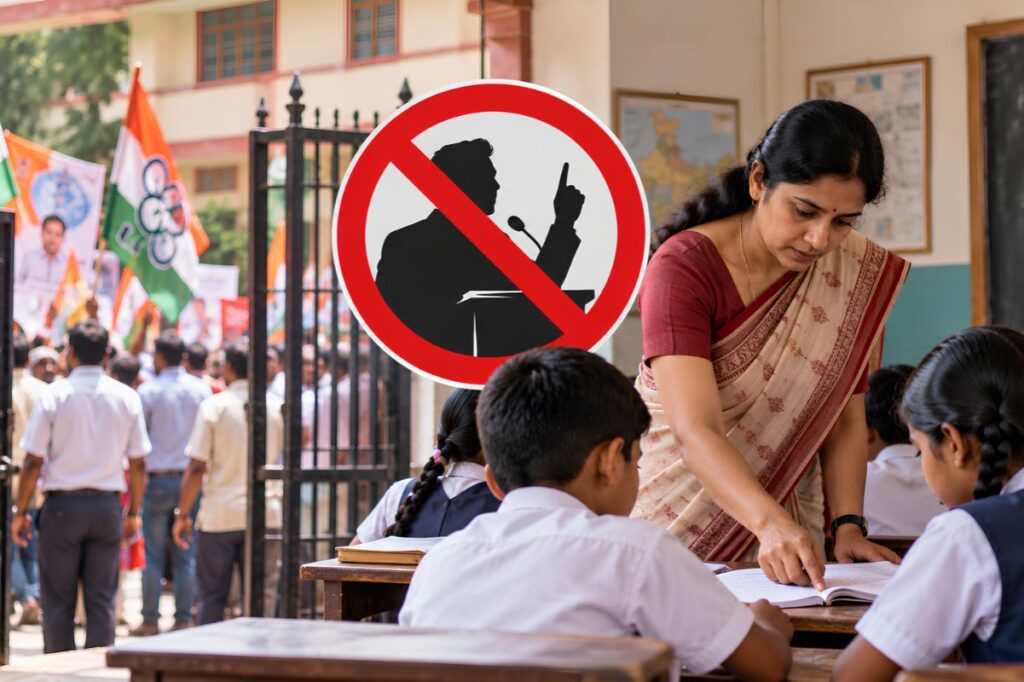
The West Bengal teacher politics ban splits state-aided schools into two legal tiers. Existing staff can keep holding party posts and elected local government seats, while new West Bengal School Service Commission recruits face disciplinary action for political activity and must cover the classroom hours of absent senior colleagues to earn performance-linked pay hikes.
That division lands on the desks of secondary and primary school headmasters. Following the state cabinet meeting on October 28, 2026, Chief Minister Suvendu Adhikari and School Education Minister Dipak Barman announced that the ban on political participation and contesting elections applies only to future candidates recruited through the West Bengal School Service Commission (SSC). The West Bengal School Service Commission is the statutory state recruitment board that selects teachers and non-teaching staff for government-aided secondary and higher secondary schools.
Exempting sitting teachers operates as a grandfather clause. A grandfather clause is a legal provision that exempts existing workers from a new restriction while applying the rule to future hires. Under this arrangement, two teachers teaching the same subject in adjacent classrooms answer to opposite conduct codes.
Across rural and semi-urban districts, incumbent teachers hold elected seats on municipal boards and panchayats, as documented in West Bengal State Election Commission candidate filings, while drawing full state salaries. Panchayats are India’s three-tier elected rural local government councils operating at the village, block, and district levels. Even inside the state legislature, sitting educators hold office: School Education Minister Dipak Barman served as the headmaster of Deogaon High School in Falakata before entering the West Bengal Legislative Assembly and joining the state cabinet.
Headmasters in government-aided schools manage daily timetables around those political commitments. According to the statutory circulars of the West Bengal School Education Department, including Notification No. 214-SE/S/10M-01/18 governing secondary staff conduct, headmasters must log staff attendance and forward misconduct reports to the state board. When an incumbent teacher leaves campus for a block-level party meeting or election campaign, the headmaster cannot cite the new political ban to deny leave or issue a disciplinary memo. If a newly hired teacher attends that same rally after school hours, the headmaster is legally bound to report a service-rule violation.
Why Do Junior Teachers Absorb the Cost of Performance-Linked Pay?
Junior teachers recruited under the new rules will carry a heavier classroom substitution load because senior politically active colleagues remain eligible for civic and political leave while new hires must meet student reading targets for pay hikes.
That workload transfer stems from the second half of the October 28, 2026 cabinet proposal, which links teacher salary hikes and student performance in West Bengal primary schools. Alongside barring future SSC recruits from politics, the cabinet outlined plans to tie annual salary increments and promotions for primary teachers to foundational learning outcomes, while reviewing a single-teacher classroom model and the return of a formal pass-fail system.
According to School Education Minister Dipak Barman, following the October 28, 2026 cabinet meeting, teachers whose classrooms see 15 out of 20 primary students fail to develop basic reading skills must submit a formal explanation before being considered for an annual increment or promotion.
Evaluating teachers on student test scores requires consistent classroom contact hours. Yet the WBBSE leave rules for teachers grant broad absence allowances to permanent staff. The West Bengal Board of Secondary Education (WBBSE) is the autonomous state authority that administers curriculum, conduct rules, and disciplinary oversight for government-aided secondary schools. According to the WBBSE Leave Rules, permanent teaching and non-teaching staff can combine 14 days of casual leave, 15 days of half-pay leave, up to two years of extraordinary leave without pay, and up to 18 months of special leave with board approval.
Every hour an incumbent teacher spends on sanctioned civic duty or political committee work becomes an unclaimed class period. Because junior recruits are barred from political absences, headmasters must assign those substitution periods to the newest staff on the payroll.
That dynamic creates a direct financial penalty for incoming teachers. According to Communist Party of India (Marxist) central committee member Sujan Chakraborty in his response to the October 28, 2026 cabinet decision, state-aided schools in West Bengal already fall short of the central government’s Right to Education mandate of one teacher for every 30 students. A junior recruit who absorbs extra substitution classes in an understaffed school loses preparation and remedial time with their own assigned students, the exact students whose reading progress determines whether that junior teacher receives an annual pay hike.
Incumbent teachers and political representatives counter that in rural Bengal, educators form the administrative backbone of local self-governance. Responding to the cabinet proposal, teacher-politicians noted that the current West Bengal cabinet and assembly include several sitting teachers, arguing that barring educated professionals from party politics lowers the quality of local governance without fixing school infrastructure.
Can the New West Bengal SSC Teacher Conduct Rules Survive a High Court Challenge?
Enforcing two different political conduct codes for teachers in the same pay scale creates an immediate constitutional challenge in the Calcutta High Court under Article 14 of the Indian Constitution.
West Bengal already maintains two separate rulebooks for public educators. Direct government employees, including teachers in the small number of schools run directly by the state, fall under the West Bengal Services (Duties, Rights and Obligations of the Government Employees) Rules, 1980, which superseded the 1959 Conduct Rules and enforces political neutrality under penalty of the 1971 Classification, Control and Appeal Rules. Most teachers in the state, however, work in government-aided schools governed by the WBBSE (Appointment, Confirmation, Conduct and Discipline of Teachers and Non-Teaching Staff) Rules, 2018.
Amending the 2018 West Bengal SSC teacher conduct rules to punish political participation only for post-ban hires means two assistant teachers in the same aided school, drawing salaries from the same state treasury under the same Revision of Pay and Allowances (ROPA) scale, face different termination triggers. One teacher can hold an elected party post. The teacher in the next room can be fired for campaigning.
Under Article 14 of the Indian Constitution, which guarantees equality before the law, a state government may divide employees into separate groups only if the cut-off date rests on an intelligible difference that serves the policy’s stated objective. According to the Supreme Court of India’s service-law ruling in D.S. Nakara & Others vs. Union of India, dividing a homogeneous class of public employees using an arbitrary date violates Article 14 unless the division bears a rational link to the goal sought to be achieved. In Calcutta High Court service parity litigation involving West Bengal teachers, the court has examined whether unequal service conditions for identically placed educators constitute impermissible discrimination under Articles 14 and 16.
If the state’s objective is keeping politics out of classrooms to improve student learning, exempting the tens of thousands of teachers already in those classrooms undercuts that legal rationale before the West Bengal Administrative Tribunal and the Calcutta High Court.
State education officials face a competing legal constraint that explains why they avoided a blanket ban on current staff. Changing the employment terms of hundreds of thousands of sitting teachers retroactively would invite lawsuits over vested contract rights and risk triggering statewide school strikes. As documented in legal and policy analyses of the October 2026 cabinet decision, phasing in the restriction through future SSC recruitment notifications is the government’s attempt to sidestep retroactive service-rule challenges while restricting new political teacher cells over a generation.
Union Asymmetric Warfare: Locking In Incumbent Political Factions
A generation-long phase-in reshapes power inside teacher unions right away by locking incumbent party factions into permanent leadership control.
In West Bengal, teacher union political activity is woven directly into state party machinery through organizations such as the All Bengal Teachers’ Association (ABTA) and the West Bengal Trinamool Primary Teachers’ Association (WBTPTA). Union office-bearers negotiate teacher transfers with district boards and represent accused staff in disciplinary hearings under Rule 5 of the 2018 WBBSE disciplinary framework.
By barring incoming teachers from active political involvement and prohibiting the formation of political teacher cells among new recruits while leaving incumbent staff untouched, the cabinet rule freezes the leadership pipeline of these unions. Senior teachers aligned with existing political factions retain an unchallenged monopoly over union executive posts and school managing committee influence until they reach retirement age.
Junior teachers entering the service over the next decade will pay association dues and rely on senior union leaders for transfer recommendations and pay-scale grievances, but they will be legally barred from organizing competing political slates to replace those leaders.
Where Does Trade Union Membership End and Political Activity Begin?
West Bengal education rules currently contain no statutory definition separating protected teacher union representation from prohibited party politics, leaving disciplinary enforcement to the discretion of local school officials.
Article 19(1)(c) of the Indian Constitution protects the fundamental right of citizens, including public teachers, to form associations and unions. Following the October 28, 2026 cabinet meeting, School Education Minister Dipak Barman stated that future teachers will remain permitted to join non-political organisations, while active political involvement and political teacher cells will be prohibited once formal rules are framed.
Previous attempts to police that boundary in West Bengal schools failed to touch staff networks. When the West Bengal School Education Department issued Notification No. 1368-ES/S/10M-134/11 on “Freeing Schools from Political Influence in West Bengal”, the order barred students from joining political rallies during school hours to maintain academic peace, yet left teacher political organizations intact.
Under Rule 9 of the 2018 WBBSE conduct rules, any penalty beyond a simple censure must be recorded in the teacher’s service book and countersigned by the District Inspector of Schools (DI), carrying the power to halt annual increments, Career Advancement Scheme benefits, and pensions. When a teacher association holds a street demonstration over school infrastructure or dearness allowance, elected party leaders share the stage with union organizers under party banners. Dearness allowance is a cost-of-living salary adjustment paid to public sector employees and pensioners to offset inflation.
Until the West Bengal School Education Department publishes a statutory definition separating protected trade union representation from prohibited party politics, District Inspectors of Schools and headmasters have no objective standard to enforce. A junior teacher marching for pay parity alongside a senior colleague could face a disciplinary show-cause notice and a frozen increment for participating in a political rally, while the senior colleague who organized the march walks back into the same school building immune from punishment.
Frequently Asked Questions
Does the West Bengal teacher politics ban apply to current teachers?
No. According to the October 28, 2026 cabinet announcement by Chief Minister Suvendu Adhikari and School Education Minister Dipak Barman, the ban on political participation and contesting elections applies only to future teaching and non-teaching staff recruited through the West Bengal School Service Commission (SSC). Incumbent teachers in government-aided schools are exempt under a grandfather clause and may continue holding party posts and elected panchayat or municipal seats.
How will West Bengal tie teacher salary hikes to student performance?
Under the state cabinet’s proposed primary-level accountability framework, annual salary increments and promotions will depend on foundational student learning outcomes such as basic reading skills. School Education Minister Dipak Barman stated that if 15 out of 20 students in a primary classroom fail to develop basic reading proficiency, the teacher will be required to submit a formal explanation before being considered for a salary hike or promotion.
Can new West Bengal teachers still join teacher unions under the conduct rules?
Yes, future SSC recruits retain the constitutional right under Article 19(1)(c) of the Indian Constitution to join non-political professional associations. However, the state cabinet announced that future recruits will be barred from forming political teacher cells or engaging in direct party politics, even though the West Bengal Board of Secondary Education (WBBSE) conduct rules do not yet define where trade union protest ends and political activity begins.
Why could the West Bengal teacher politics ban face a Calcutta High Court challenge?
Applying stricter disciplinary and termination rules only to newly hired SSC teachers while exempting current teachers in the same pay scale creates a two-tier workforce inside the same school. Under Article 14 of the Indian Constitution and the Supreme Court’s precedent in D.S. Nakara & Others vs. Union of India, dividing a single class of public employees by an arbitrary cut-off date invites legal challenge if exempting sitting teachers contradicts the state’s stated goal of keeping politics out of classrooms.