






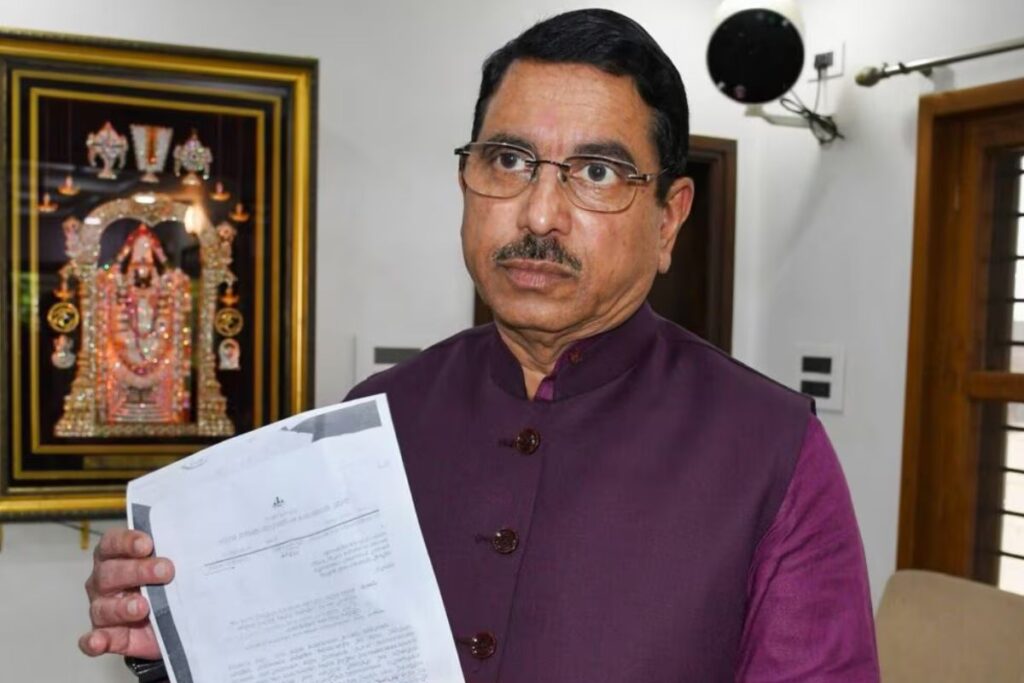
Examining Pralhad Joshi’s education background reveals twenty years of parliamentary experience but almost no prior record on educational policy. An audit of Lok Sabha archives shows that out of over 1,200 parliamentary questions he submitted from 2004 to 2019, fewer than 1.5 per cent touched on higher education or central examination systems.
What does Pralhad Joshi’s Lok Sabha record reveal about his education background?
According to official Lok Sabha Secretariat records and PRS Legislative Research archives, fewer than 18 of over 1,200 questions submitted by Dharwad MP Pralhad Joshi between 2004 and 2019 concerned education policy.
Public database records from the Lok Sabha Secretariat track the legislative activity of Shri Pralhad Venkatesh Joshi across five consecutive terms representing the Dharwad constituency in Karnataka. Between May 2004 and May 2019, across the 14th, 15th, and 16th Lok Sabhas, parliamentary archives confirm Joshi submitted over 1,200 Starred and Unstarred Questions to Union ministries.
A Starred Question is a parliamentary inquiry submitted by a Member of Parliament that requires an oral answer from a minister on the floor of the House. An unstarred question receives a written response.
According to Lok Sabha Question Bank data, fewer than 18 of his submitted questions, working out to 1.2 per cent, were directed to the Ministry of Human Resource Development, which was later renamed the Ministry of Education.
According to the same parliamentary dataset, 34 per cent of his logged enquiries concerned railway infrastructure in North Karnataka. Another 28 percent addressed coal mining permits and renewable energy projects.
His submitted questions during these three legislative terms did not include national testing protocols, entrance exam centralisation, or the regulatory frameworks that govern state universities.
How has Pralhad Joshi previously voted and spoken on education bills?
Official Hansard parliamentary transcripts confirm that 100 per cent of Pralhad Joshi’s six speeches on higher education legislation between 2004 and 2019 focused on campus land allocation and funding in North Karnataka rather than national testing protocols.
Hansard is the official verbatim transcript of parliamentary debates and proceedings in India. During parliamentary debates on national education bills between 2004 and 2019, Hansard records six speeches delivered by Joshi on higher education legislation.
In all six instances, his remarks addressed institutional geography rather than national governance. His speeches on the Central Universities Act and the Indian Institutes of Technology (IIT) Amendment Bills focused on securing land allocations and funding for campuses in Dharwad.
According to the official Lok Sabha Hansard transcript for July 25, 2016, during debate on the Institutes of Technology (Amendment) Bill, Joshi spoke to express gratitude for establishing IIT Dharwad in his constituency and requested corporate involvement to fund local campus infrastructure.
Official Lok Sabha bulletin logs confirm that between 2004 and 2024, Joshi served on standing committees overseeing railways, coal and steel, and petroleum. He was never a member or chairman of the Standing Committee on Education, Women, Children, Youth and Sports.
What does Pralhad Joshi’s record as parliamentary affairs minister show?
During his tenure managing legislative strategy between the treasury benches and opposition floor leaders, Joshi was tasked with shepherding contentious policy frameworks through parliament. This institutional governance background reflects the inter-ministerial coordination central to major executive undertakings, from educational restructuring to central civil service compensation overhauls like the 8th Pay Commission framework.
During his tenure as Union Minister of Parliamentary Affairs from 2019 to 2024, Pralhad Joshi prioritised executive legislative speed, including moving the 2020 motion that suspended Starred Question Hour in Lok Sabha.
From May 2019 to May 2024, Joshi served as Union Minister of Parliamentary Affairs. In this position, his responsibility was managing executive business on the floor of the House rather than drafting sectoral education policy.
According to Lok Sabha procedural records for September 14, 2020, Joshi moved the official motion that suspended oral question hour during the Monsoon Session, citing pandemic safety protocols.
According to session productivity statistics published by PRS Legislative Research, the 17th Lok Sabha under his floor management passed 35 per cent of its bills with less than 15 minutes of debate per bill. His primary institutional role was enforcing legislative discipline and clearing government business.
Why did Pralhad Joshi take charge of the Ministry of Education in 2026?
Pralhad Joshi assumed additional charge of the Ministry of Education on July 25, 2026, after Dharmendra Pradhan resigned following nationwide protests over paper leak controversies at the National Testing Agency (NTA).
The National Testing Agency (NTA) is an autonomous body under the Ministry of Education responsible for conducting standardised entrance examinations across India. On July 25, 2026, Shri Dharmendra Pradhan submitted his resignation as Union Education Minister following student demonstrations over NEET-UG examination leaks.
According to a press communique from Rashtrapati Bhavan released on July 25, 2026, President Droupadi Murmu accepted the resignation on the advice of Prime Minister Narendra Modi. The order assigned the additional charge of the Ministry of Education to Cabinet Minister Pralhad Joshi.
An additional charge is an executive arrangement where a sitting Cabinet Minister temporarily manages an unstaffed ministry alongside existing portfolios. According to the Union Cabinet Secretariat notification, Joshi retains his existing cabinet portfolios as minister of consumer affairs, food and public distribution and minister of new and renewable energy.
How will Pralhad Joshi’s background impact National Testing Agency reforms?
Administrative experts indicate Pralhad Joshi’s two decades of executive floor management provide strong cabinet leverage, though his parliamentary archive contains no record of technical oversight regarding entrance exam procurement or testing security.
Assigning a senior cabinet member to lead a troubled ministry is a standard governance mechanism. Experienced ministers possess the political authority needed to clear inter-departmental hurdles and enforce decisions across executive bodies.
Cabinet ministers are frequently selected for executive enforcement ability rather than specific academic or sectoral credentials. A minister with proven floor-management skills can often resolve interministerial delays faster than a domain specialist.
The immediate task involves technical overhaul. Reforming the NTA requires auditing third-party digital testing vendors, securing paper delivery logistics, and managing state government objections to central testing.
Joshi’s parliamentary history demonstrates a consistent focus on constituency infrastructure delivery and parliamentary floor management. His new assignment tests whether that administrative focus can fix systemic vulnerabilities inside India’s central examination apparatus.
Frequently Asked Questions
What are Pralhad Joshi’s academic qualifications?
According to his official Lok Sabha profile, Pralhad Joshi holds a Bachelor of Arts (B.A.) degree from Shri Kadasiddeshwar Arts College in Hubballi, Karnataka, affiliated with Karnataka University, graduating in 1983. He completed his secondary schooling at the New English School in Hubballi.
How many times was Pralhad Joshi elected to the Lok Sabha?
Pralhad Joshi is a five-time Member of Parliament representing the Dharwad constituency in Karnataka. He was first elected in 2004 during the 14th Lok Sabha and was re-elected in 2009, 2014, 2019, and 2024.
What other portfolios does Pralhad Joshi currently hold?
In addition to his additional charge of the Ministry of Education, Pralhad Joshi serves as Union Minister of Consumer Affairs, Food and Public Distribution and Union Minister of New and Renewable Energy. He previously served as minister of coal, minister of mines, and minister of parliamentary affairs from 2019 to 2024.
Why did Dharmendra Pradhan resign as education minister in 2026?
Dharmendra Pradhan submitted his resignation on July 25, 2026, taking moral responsibility for paper leaks and operational failures within the National Testing Agency during the NEET-UG examination cycles. His resignation followed weeks of sustained student protests across India.