






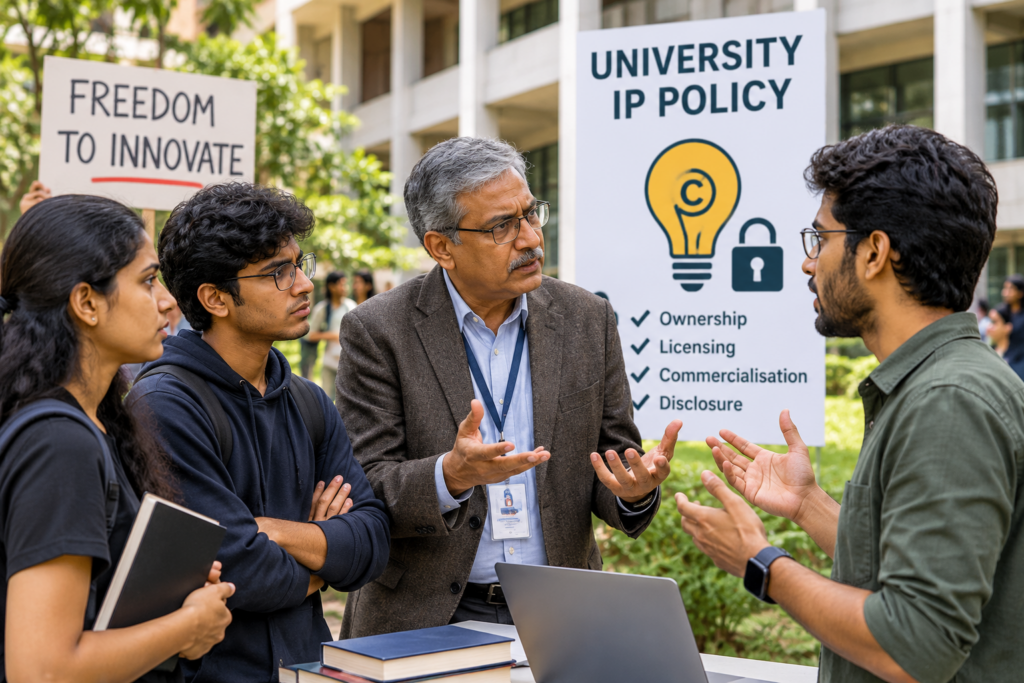
Yes: under a strict university IP policy for Indian startups, many colleges claim 5% to 20% equity or revenue stakes, even when student software relies minimally on campus infrastructure, while assigning faculty to run mandatory innovation councils without workload relief or promotion credit. As a result, venture-track founders often bypass campus incubators before raising seed capital.
Does Your Indian University Own Equity or IP in a Student Startup?
Under standard campus incubation contracts, Indian universities frequently claim equity stakes or licensing rights whenever a student startup uses institutional coworking space, internet access, or faculty guidance. Once a venture moves beyond a prototype, those contractual claims create immediate friction with outside investors.
In institutional incubation frameworks, universities define campus resource usage broadly enough to cover routine internet connections, desk space, and non-technical faculty advice. When software founders prepare to incorporate a private limited company, they often find that university incubation cells require a formal equity allotment or royalty commitment before granting a no-objection clearance.
Because early-stage software ventures rarely require wet labs or specialized hardware, founders frequently incorporate off-campus without institutional backing. They participate in campus hackathons for initial pitch feedback, then sever formal incubation ties before signing external term sheets.
How Do University IP Policies Compare Against NISP 2019 Guidelines?
Published institutional handbooks frequently impose tighter equity and revenue-sharing rules than central government guidelines recommend. In September 2019, the Ministry of Education’s Innovation Cell (MIC) and the All India Council for Technical Education (AICTE) released the National Innovation and Startup Policy (NISP) 2019, a national framework designed to standardize intellectual property ownership and startup rules across Indian higher education institutions.
Under the NISP 2019 guiding framework, universities are advised to take between 2% and 9.5% equity in startups incubated at their facilities, while granting inventors complete ownership of intellectual property when institutional funds or facilities are not substantially used. For pure software products, NISP 2019 recommends leaving share splits to mutual negotiation rather than imposing fixed hardware royalties.
Institutional handbooks diverge from those boundaries across both public and private campuses:
- Equity and stake caps: While NISP 2019 caps total incubator equity at 9.5%, ITM University Gwalior’s Innovation and Startup Policy allows its incubation foundation to claim up to 5% equity in a student-led company and take 20% of a faculty member’s equity stake (capped at 9.5% of total company equity).
- Incidental-support revenue splits: Under Gurudas College’s Intellectual Property Policy, even IP generated with “incidental support” from the institution triggers a 20:80 revenue-sharing split between the college and the researcher.
- Pre-incubation and arm’s-length conditions: While Galgotias University’s Innovation and Startup Policy caps equity between 2% and 9.5% in line with NISP, and IIT Bombay’s Revised Startup Policy 2024 permits researchers to launch startups outside its Society for Innovation and Entrepreneurship (SINE) incubator at arm’s length, founders at institutions without explicit “incidental use” exemptions remain exposed to institutional IP claims.
How Do AICTE Innovation Council Mandates Affect Faculty Workload?
Assistant and associate professors appointed as conveners for the Ministry of Education’s Institution’s Innovation Councils (IICs), campus committees mandated by AICTE to organize startup events and patent workshops, absorb the administrative workload of campus innovation mandates without teaching relief or promotion weightage.
Under the IIC scoring and star-rating mechanism, colleges must execute a quarterly calendar of hackathons, idea competitions, intellectual property rights workshops, and startup bootcamps to earn up to 25 marks per quarter toward a four- or five-star institutional rating. Colleges assign these coordination duties on top of full classroom teaching loads, lab supervision, and exam evaluation.
Under AICTE and state Career Advancement Scheme (CAS) promotion scorecards, the statutory framework governing academic pay-grade and rank promotions in Indian colleges, advancement from Assistant Professor to Associate Professor and Professor depends primarily on classroom contact hours, peer-reviewed publications in indexed journals, and formal Faculty Development Programmes. According to Performance Based Appraisal System (PBAS) promotion guidelines, administrative and co-curricular coordination falls under Category II, which carries a strict annual score cap compared to uncapped Category III research publications.
Faculty coordinators face a direct career trade-off: spending weekends organizing mandatory innovation events satisfies institutional compliance targets, but yields minimal credit when applying for academic promotion.
Why Do Universities Enforce Tight IP Rules and Compliance Targets?
University administrators enforce strict IP ownership rules and activity targets to satisfy national ranking formulas and recover incubator operating expenses. Under the National Institutional Ranking Framework (NIRF) Innovation methodology, the Ministry of Education’s annual ranking system for Indian colleges, an institution’s score depends on verifiable patent grants, technology transfer deals, incubation revenue, and IIC adoption.
In a March 2026 Lok Sabha reply on NIRF patent metrics, the Ministry of Education confirmed that NIRF evaluates granted patents alongside “Patent Commercialization & Technology Transfer (PCTT)” and incubation outcomes, pushing universities to formalize IP ownership and licensing pipelines.
For university Technology Transfer Offices (TTOs), the institutional departments responsible for patenting and licensing academic research, and Section 8 incubation companies, equity and royalty clauses serve as cost-recovery mechanisms. Incubators subsidize physical workspace, prototyping tools, legal filings, and early seed grants across dozens of high-risk student teams, knowing that most early-stage ventures will fail before generating commercial returns.
Central policymakers maintain that restrictive contracts stem from institutional implementation rather than central rules. In its NISP 2019 policy framework, the Ministry of Education explicitly recommended reducing hierarchical barriers, offering academic credits or reduced teaching loads for entrepreneurial work, and letting inventors retain IP built without substantial institutional resources.
What Happens Next: The Dual-Track Reality of Campus Entrepreneurship
The clash between ranking-driven campus mandates and founder-friendly startup norms has split university entrepreneurship into two separate tracks.
On campus, compliance-driven activity continues to expand: colleges log rising numbers of student hackathons, patent filings, and registered pre-incubation teams to satisfy annual accreditation and ranking audits.
Off campus, venture-backable student founders treat university incubators as temporary launchpads, or avoid them entirely. According to Indian venture capital due-diligence guides from BizWise Advisors on investor-ready cap tables and PedalStart’s analysis of Indian accelerator equity, institutional seed investors treat significant non-operating equity held by an inactive university entity as “dead equity” that complicates follow-on funding rounds.
Until universities align their binding IP contracts with NISP 2019’s non-binding guidelines, and count IIC coordination toward faculty CAS promotions, campus incubators risk retaining compliance projects while losing their strongest commercial startups to off-campus incorporation.
Frequently Asked Questions
Does an Indian university automatically own equity in a student startup?
No, central guidelines under the National Innovation and Startup Policy (NISP) 2019 advise universities to claim 2% to 9.5% equity only when startups use campus incubation facilities, while leaving IP with inventors if institutional resources are not substantially used. However, individual university policies, such as Gurudas College’s IP policy and ITM University Gwalior’s startup policy, can trigger 5% to 20% equity or revenue claims even for incidental campus support.
Why do venture-track student founders leave Indian campus incubators before raising seed funding?
According to Indian venture due diligence guidelines from BizWise Advisors and PedalStart, early-stage institutional investors treat 5% to 20% equity held by an inactive university entity as “dead equity” that complicates future funding rounds. Software founders who do not need campus wet labs often incorporate off-campus to preserve a clean cap table.
Do Indian college professors get promotion credit for running Institution’s Innovation Councils?
Very little. Under AICTE Career Advancement Scheme (CAS) and Performance Based Appraisal System (PBAS) rules, coordinating Institution’s Innovation Council (IIC) hackathons and workshops falls under Category II co-curricular activities, which face a strict annual score cap compared to uncapped Category III peer-reviewed journal publications.