






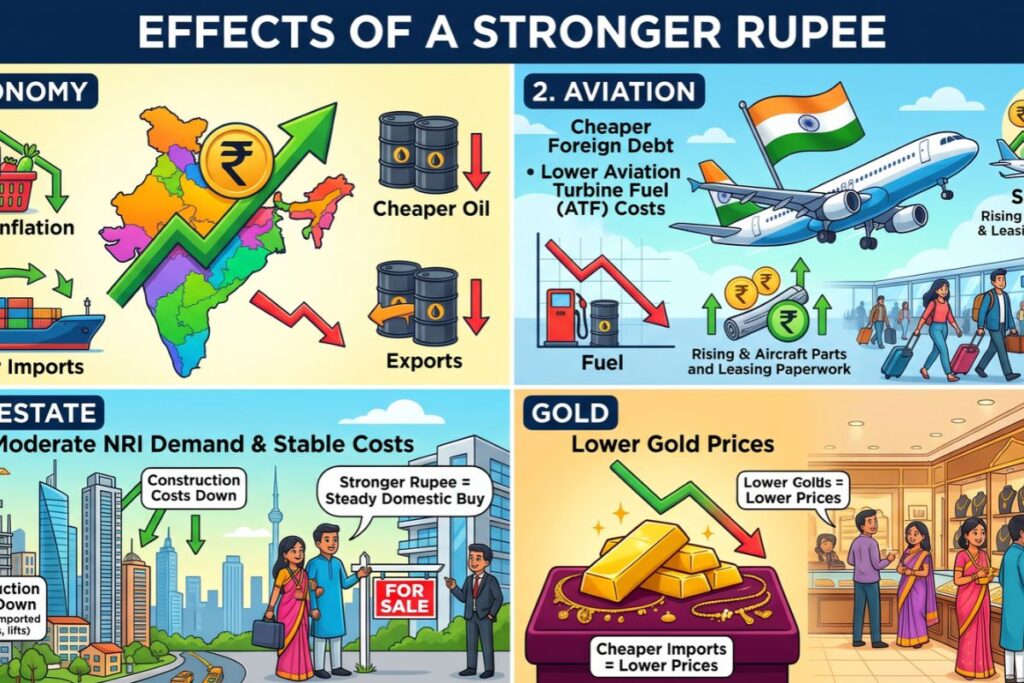
Domestic currency appreciation, an increase in the purchasing power of the Indian Rupee (INR) relative to major reserve currencies like the US Dollar (USD)reshapes the structural incentives of an emerging economy. For a net-importing, services-surplus economy like India, a sustained appreciation acts simultaneously as a disinflationary tailwind for domestic consumption and a competitiveness headwind for export-oriented manufacturing and services.
1. Macroeconomic Mechanics
- Domestic Inflation: India relies heavily on imported inelastic commodities, particularly crude oil, edible oils, fertilizers, and electronic components. When the Rupee strengthens, the landed cost of these imports falls immediately in INR terms. This directly lowers Wholesale Price Index (WPI) inflation and gradually filters through to Consumer Price Index (CPI) inflation by reducing transportation, energy, and input costs across the supply chain, as highlighted by RBI Bulletin Inflation Projections.
- Interest Rate Policy: As imported inflation cools and headline CPI trends toward the Reserve Bank of India’s (RBI) medium-term target of 4%, the Monetary Policy Committee (MPC) gains greater policy headroom. A stronger currency reduces the risk of capital flight driven by interest rate differentials against the US Federal Reserve, allowing the RBI to adopt an accommodative stance or cut policy repo rates to stimulate domestic credit and investment.
- Balance of Payments (BoP): Currency appreciation alters both halves of the BoP:
- Current Account: Cheaper imports stimulate domestic import volume, while costlier exports dampen foreign demand. Unless lower global commodity prices offset it, the merchandise trade deficit widens, putting downward pressure on the Current Account.
- Capital Account: Appreciation often reflects and further attracts Foreign Portfolio Investment (FPI) and Foreign Direct Investment (FDI) inflows, as foreign investors enjoy both local asset returns and currency translation gains. However, the RBI typically intervenes in the spot and forward markets to absorb excess dollar inflows, preventing excessive appreciation and preserving export competitiveness.
2. International Trade (Exports & Imports)
- Import-Heavy Sectors (Net Beneficiaries): Sectors reliant on imported capital goods, raw materials, and intermediate inputs such as electronics assembly, telecommunications, chemicals, petrochemicals, and heavy machinery experience immediate margin expansion. Lower capital expenditure costs for imported machinery also encourage domestic capacity expansion.
- Export-Driven Industries (Margin Compression):
- IT & Business Services:
- Because the vast majority of Indian IT revenue is billed in USD, EUR, and GBP while employee compensation is paid in INR, every 1% appreciation in the Rupee typically erodes operating margins by 25 to 40 basis points, forcing firms to rely on currency hedging or offshore billing rate hikes.
- Textiles, Apparel, & Leather: Operating on thin margins in fiercely competitive global markets, these labor-intensive sectors lose price competitiveness against regional rivals (such as Bangladesh, Vietnam, and Indonesia) unless those rival currencies appreciate simultaneously.
- Pharmaceuticals:
- While major exporters face lower INR realizations on US generic sales, the impact is partially cushioned because Indian pharma companies import a significant share of Active Pharmaceutical Ingredients (APIs) and key starting materials, creating a natural hedge.
- Current Account Deficit (CAD): In the short term, if demand for imports and exports is inelastic (the reverse J-curve effect), a lower rupee bill for inelastic oil imports may temporarily improve the trade balance. Over the medium term, however, sustained appreciation erodes export volumes and encourages discretionary imports, widening the CAD. This dynamic is a critical consideration for India’s External Sector Management, which seeks to balance growth with trade stability.
3. Gold & Foreign Exchange Reserves
- Domestic Retail Gold Prices:
- International bullion is priced in USD per troy ounce. Even if global gold prices remain flat, a stronger Rupee directly reduces the domestic retail price of gold in INR per 10 grams (net of customs duties and GST).
- Import Demand for Bullion:
- Lower domestic prices tend to trigger price-elastic retail and bridal jewelry demand in India, increasing physical gold import volumes. A surge in bullion imports acts as an automatic stabilizer: higher dollar outflows to pay for gold gradually temper further Rupee appreciation.
- RBI Reserve Valuation & Accumulation Strategy:
- Accounting Valuation:
- Because the RBI’s balance sheet is denominated in Rupees, an appreciating INR reduces the nominal Rupee valuation of its existing Foreign Currency Assets (FCAs) and gold holdings, which are detailed in the RBI Half-Yearly Management Report.
- Accumulation Strategy:
- Currency appreciation typically occurs during periods of strong capital inflows. During such phases, the RBI actively buys USD in the spot market to mop up excess liquidity (often sterilizing the resulting Rupee liquidity via market operations). Simultaneously, a stronger Rupee lowers the domestic currency cost of acquiring physical bullion, enabling the central bank to diversify its reserve chest toward gold as a hedge against global geopolitical and sovereign debt risks.
4. Domestic Industry & Manufacturing
- Supply Chain Winners: Downstream manufacturers and domestic-focused industries (such as consumer durables, automobiles, paints, and specialty chemicals) benefit from cheaper imported components, polymers, and industrial metals. Companies competing against imported finished goods, however, face intensified pricing pressure from cheaper foreign substitutes entering the Indian market. Such supply chain dynamics are heavily affected by whether the currency is experiencing Sustained Appreciation or Volatile Rupee Trends.
- External Commercial Borrowings (ECBs): Indian corporates with unhedged foreign-currency debt (ECBs) experience a substantial balance-sheet windfall. Both principal repayments and periodic interest obligations require fewer Rupees, reducing debt-servicing ratios, lowering effective borrowing costs, and boosting net profitability for capital-intensive infrastructure and manufacturing firms.
5. Real Estate & Property Promoters
- Construction Input Costs: While core inputs like cement, sand, and basic labor are domestically sourced, high-end residential and commercial projects rely heavily on imported inputs, including specialized structural steel, architectural glass, high-speed elevators, HVAC systems, and luxury fittings. Currency appreciation lowers these procurement costs, improving project-level gross margins for property promoters.
- Developer Debt: Large real estate developers and Real Estate Investment Trusts (REITs) holding dollar-denominated debt or foreign institutional credit lines see reduced INR debt-servicing burdens.
- NRI Capital Inflows: Non-Resident Indians (NRIs) earning in USD, AED, or GBP represent a critical demand driver for premium and luxury housing. An appreciating Rupee reduces the purchasing power of their foreign remittances and savings, making Indian property effectively more expensive in foreign currency terms and potentially slowing NRI pre-sales and capital inflows.
6. Tourism & Hospitality
- Boom in Outbound Travel: Currency appreciation acts as an immediate discount on international flights, overseas hotel accommodations, dining, and shopping. Rising disposable incomes paired with a stronger Rupee trigger a sharp surge in Indian outbound leisure and business travel, benefiting international tour operators and foreign destinations.
- Headwinds for Inbound Tourism: Conversely, India becomes a more expensive destination for foreign travelers. International tourists face higher USD-equivalent costs for domestic hotels, heritage monuments, internal flights, and curated packages, reducing price competitiveness against Southeast Asian destinations (such as Thailand, Vietnam, or Malaysia) and compressing occupancy rates and Average Daily Rates (ADRs) in inbound-dependent luxury hospitality circuits.
7. Aviation Sector
Aviation is among the single largest structural beneficiaries of Rupee appreciation because its revenue is predominantly earned in INR (from domestic ticketing), while a massive proportion of its cost structure is directly or indirectly pegged to the US Dollar:
- Aviation Turbine Fuel (ATF): ATF typically accounts for 30% to 40% of an Indian airline’s total operating expenses. Because domestic ATF prices are benchmarked to international Singapore jet fuel prices in USD, a stronger Rupee directly reduces fuel costs per available seat kilometer (ASK).
- Aircraft Leasing: Over 80% of India’s commercial airline fleet operates on operating leases denominated in USD. Rupee appreciation immediately lowers monthly lease rental outflows in INR terms.
- Maintenance, Repair, and Overhaul (MRO): Spare parts, engine overhauls, foreign pilot contracts, global distribution system (GDS) booking fees, and overseas airport handling charges are settled in foreign currency. Lowering these recurring dollar obligations directly expands operating margins (EBITDAR) and strengthens airline balance sheets.
Summary Matrix: Short-Term vs. Long-Term Winners & Losers
A visual overview of the net outcomes across different segments of the economy highlights who benefits immediately and who faces long-term structural adjustments:
| Sector / Economic Variable | Short-Term Impact (0–12 Months) | Long-Term Impact (1–5 Years) | Net Classification |
|---|---|---|---|
| Aviation | Immediate drop in ATF, lease rentals, and MRO costs; rapid margin expansion. | Sustained lower fleet acquisition/leasing costs; improved balance sheet solvency. | Clear Winner |
| Import-Heavy Manufacturing | Lower landed cost of raw materials, components, and energy. | Risk of domestic market share erosion from cheaper imported finished goods. | Short-Term Winner / Mixed Long-Term |
| Corporates with ECBs | Instant reduction in INR interest and principal repayment outflows. | Encourages over-reliance on unhedged foreign debt if currency reverses. | Winner (Conditional on Hedging) |
| Domestic Consumers | Lower fuel/import inflation; cheaper foreign travel and imported electronics. | Higher real purchasing power, though wage growth may slow if exports lag. | Winner |
| Real Estate & Promoters | Cheaper imported luxury fittings; lower foreign debt servicing. | Dampened NRI investment inflows due to reduced foreign currency purchasing power. | Moderately Positive / Mixed |
| Gold & Bullion Market | Domestic gold prices fall; retail jewelry demand spikes. | Higher gold import volumes widen the trade deficit, naturally capping INR gains. | Neutral / Self-Correcting |
| IT & Export Services | Currency hedging cushions immediate margin compression. | Hedges roll off; sustained margin pressure forces offshoring/automation shifts. | Loser |
| Textiles & Export Manufacturing | Immediate loss of price competitiveness; squeezed operating margins. | Loss of global market share to rival emerging economies; factory underutilization. | Clear Loser |
| Inbound Tourism & Hospitality | Minimal immediate impact due to bookings. | Sustained drop in foreign arrivals and lower foreign exchange earnings. | Loser |