






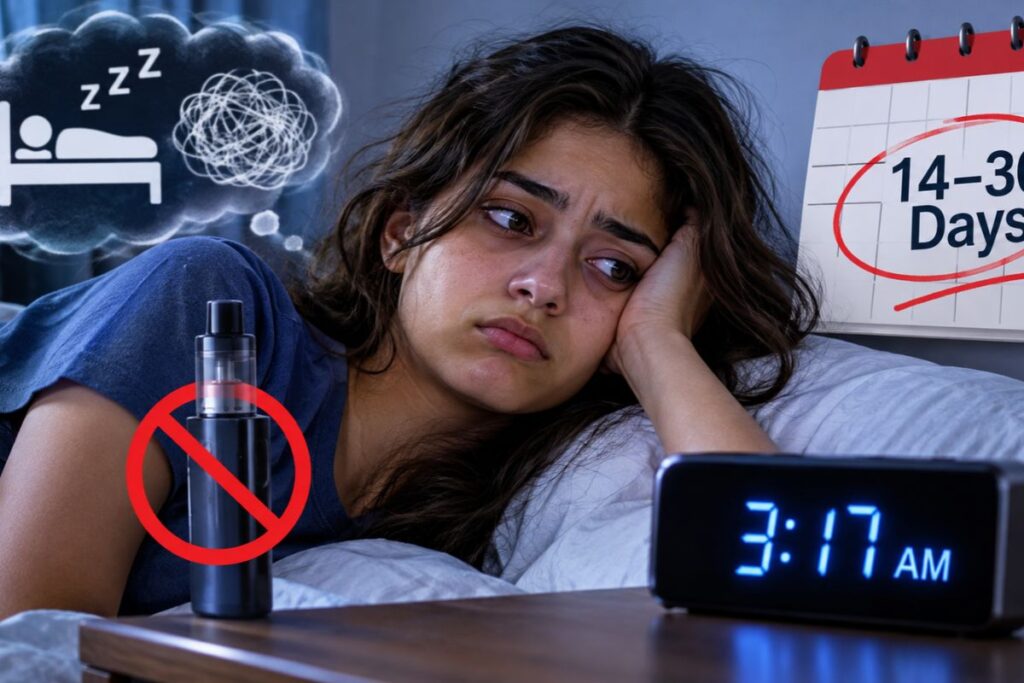
Quitting vaping worsens insomnia at first because abrupt nicotine withdrawal destabilizes brain chemicals that regulate sleep, triggering nighttime awakenings and fragmented rapid eye movement (REM) sleep for 14 to 30 days. Doctors prevent withdrawal-driven relapse by timing nicotine replacement therapy (NRT) patches, cutting caffeine intake, and pairing early medical check-ins with behavioral sleep therapy.
Why Does Quitting Vaping Trigger Acute Insomnia at First?
Stopping e-cigarettes abruptly sets off an immediate neurochemical rebound that disrupts sleep architecture for two to four weeks before baseline rest recovers. Nicotine stimulates the release of acetylcholine and dopamine, brain messengers that govern alertness and sleep-wake cycles.
According to the Royal Australian College of General Practitioners (RACGP) vaping cessation guide, clearing nicotine from the bloodstream triggers acute withdrawal symptoms that peak within the first week and last two to four weeks. Polysomnographic sleep-lab data compiled in clinical reviews of substance withdrawal show that nicotine abstinence begins disrupting sleep within six to 12 hours, peaks in days one through three, and persists for up to three weeks, marked by increased wakefulness after sleep onset and shortened REM latency, a sleep-stage rebound in which rapid eye movement (REM) sleep, the deep dreaming stage tied to memory and mood recovery, occurs earlier and fragments normal rest.
Professor Renee Bittoun’s 2025 Clinical Decision-Making Flow Chart for Vaping Cessation in Adults 18+, published through Avondale University’s Lifestyle Medicine & Health Research Centre, notes that rapid nicotine decay leaves dependent vapers vulnerable to intense urges between puffs and during the night. Without clinical preparation, patients often mistake temporary withdrawal wakefulness for permanent sleep damage and reach back for a vape at 2:00 a.m.
What Did Hobart’s LM26 Lifestyle Medicine Conference Miss About Vaping and Sleep?
Mainstream coverage of the Australasian Society of Lifestyle Medicine (ASLM), Australia’s peak medical society for preventive and lifestyle-focused clinicians, reported that active vapers face 38% higher odds of poor sleep, but omitted how acute nicotine withdrawal disrupts rest during a quit attempt.
News reports from the ASLM LM26 conference in Hobart, Tasmania, which closed November 15, 2026, centered on a straightforward directive: screen patients for both sleep problems and nicotine use, then push cessation. That takeaway drew on a September 2026 meta-analysis by Gulati and colleagues in Tobacco Induced Diseases, which pooled 16 cross-sectional studies and found exclusive e-cigarette users had 38% higher odds (odds ratio 1.38) of self-reported poor sleep than never-users.
Closing plenary speakers Dr. Moira Junge, Chief Health Officer at the Sleep Health Foundation, and Professor Renee Bittoun urged primary care clinicians to address both habits together. Mainstream summaries stopped at the population correlation, leaving out what happens in the exam room once a patient drops their vape.
How Does Nicotine Replacement Therapy Patch Timing Prevent Sleep Disruption?
Doctors prevent nicotine withdrawal sleep problems by combining slow-release skin patches with fast-acting oral lozenges, adjusting overnight patch wear based on morning craving severity, and cutting caffeine intake in half.
Modern disposable and pod vapes use nicotine salts, a formulation that enters the bloodstream faster and at higher concentrations than older freebase liquids. Under RACGP vaping cessation guidelines, single-product low-dose nicotine replacement therapy (NRT) often fails to blunt withdrawal in heavy vapers, leading clinicians to prescribe combination NRT: a transdermal patch paired with oral lozenges, gum, or spray.
Patch timing and metabolic interactions determine whether cessation therapy helps or hurts sleep, as detailed in Professor Bittoun’s Avondale University cessation algorithms:
- Daytime-only vs. overnight patch wear: In Bittoun’s vaping cessation guidance, clinicians weigh nighttime craving severity against sleep disruption, applying a 21 mg nicotine patch during waking hours for moderate dependence to prevent NRT-induced vivid dreams and nocturnal wakefulness, while reserving overnight patch wear or added morning fast-acting NRT for patients with short Time to First Vape (TTFV) on waking, a clinical measure of how soon after waking a person vapes, who wake up craving nicotine.
- Caffeine reduction rules: Bittoun’s 2025 adult vaping cessation flowchart flags a two-way metabolic interaction between nicotine and caffeine: nicotine accelerates liver clearance of caffeine, so stopping vapes slows caffeine breakdown and amplifies blood caffeine levels, worsening insomnia and triggering cravings unless patients cut caffeinated drinks, colas, and energy drinks.
- Alcohol restriction: The same clinical protocol advises reducing or eliminating alcohol during acute withdrawal, as alcohol both fragments second-half sleep and stimulates acute urges to vape.
How Do Doctors Separate Withdrawal Insomnia From Chronic Sleep Disorders?
General practitioners separate temporary withdrawal insomnia from chronic sleep disorders by scheduling a mandatory check-in within seven days of a patient’s quit date and prescribing Cognitive Behavioral Therapy for Insomnia (CBT-I) if sleep disruption persists beyond four weeks.
Under the RACGP 5As cessation framework, Ask, Assess, Advise, Assist, and Arrange, general practitioners book a follow-up visit within seven days of a patient’s quit date. That first-week check-in catches peak withdrawal insomnia and lets doctors adjust patch timing before frustration drives a relapse.
When sleep disruption persists beyond the acute withdrawal window, Sleep Health Foundation clinical guidance recommends Cognitive Behavioral Therapy for Insomnia (CBT-I), a four-to-eight-session behavioral program using sleep restriction and stimulus control, as the first-line treatment rather than habit-forming sleeping pills.
Screening for vaping and poor sleep in the same appointment identifies the problem. Whether patients stay vape-free depends on how primary care doctors manage the two to four weeks when quitting makes sleep worse first.
Frequently Asked Questions
How long does insomnia last after quitting vaping? According to the Royal Australian College of General Practitioners (RACGP) vaping cessation guide, acute nicotine withdrawal symptoms peak within the first week and last two to four weeks. Polysomnographic sleep-lab data show sleep disruption begins within six to 12 hours of stopping nicotine and persists for up to three weeks before baseline sleep architecture recovers.
Should you take off a nicotine patch at night to sleep better? It depends on nighttime craving severity, according to Professor Renee Bittoun’s Avondale University vaping cessation algorithms. Clinicians typically advise removing a 21 mg nicotine patch before bed for moderate dependence to prevent vivid dreams and nocturnal wakefulness, while keeping the patch on overnight for heavy users who wake up with an immediate urge to vape.
Why does coffee keep me awake more after I stop vaping? Nicotine accelerates liver enzymes that clear caffeine from the bloodstream, according to Professor Renee Bittoun’s 2025 adult vaping cessation flowchart. When you quit vaping, caffeine breakdown slows down, and blood caffeine levels rise, which worsens insomnia unless you cut caffeinated coffee, colas, and energy drinks.
What treatment do Australian doctors recommend if insomnia continues after quitting vapes? If sleep problems persist beyond the acute two-to-four-week nicotine withdrawal window, Sleep Health Foundation clinical guidance recommends Cognitive Behavioral Therapy for Insomnia (CBT-I), a four-to-eight-session behavioral program using sleep restriction and stimulus control, as first-line care instead of sleeping pills.