






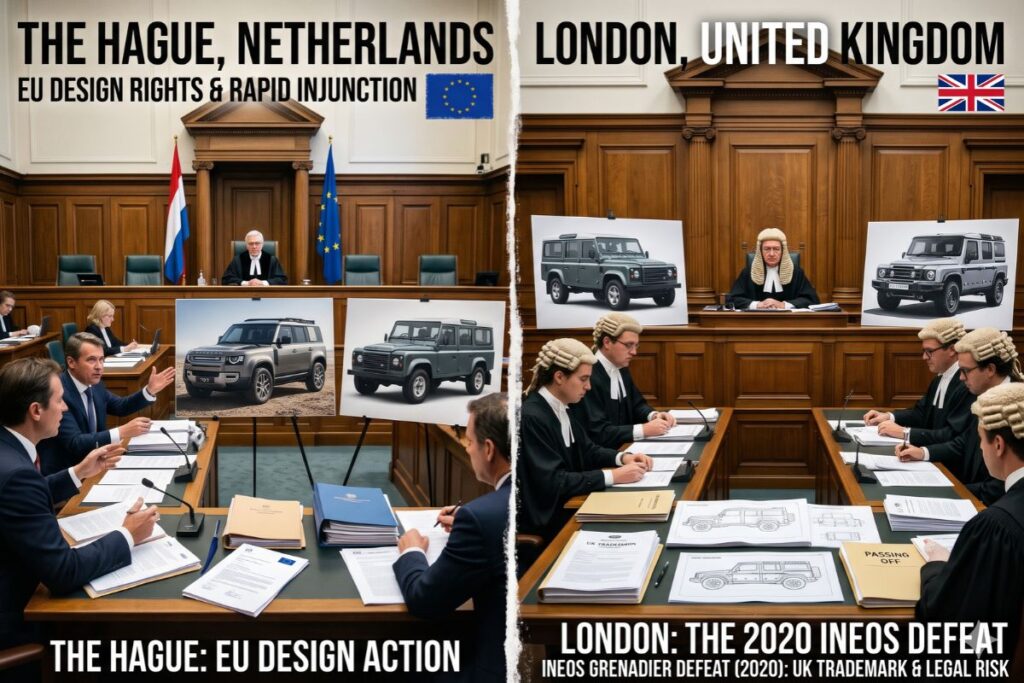
Jaguar Land Rover sued BYD in The Hague rather than London to secure a fast-track, 27-country EU Registered Community Design injunction, while avoiding a UK court test where JLR previously lost a 2020 High Court battle over the Defender’s shape against Ineos and where any injunction would only cover Britain.
Why Did Jaguar Land Rover Sue BYD in a Dutch Court Instead of the UK?
Jaguar Land Rover (JLR) filed in the District Court of The Hague (Rechtbank Den Haag) because Dutch law gives that single court power to freeze sales across all 27 European Union member states when a defendant is incorporated in the Netherlands. Even though the BYD Ti 7 UK launch, priced from £47,995 ahead of January 2027 customer deliveries, is the only European retail rollout currently underway, suing in London would have covered Britain alone.
Under EU Design Regulation (EC) No 6/2002, as amended by Regulation (EU) 2024/2822, an EU Registered Community Design is an intellectual-property right protecting the outward appearance of a product across all 27 EU member states through a single registration. Within the Netherlands, Rechtbank Den Haag acts as the sole designated EU Design Court authorized to grant cross-border injunctions against locally domiciled companies.
BYD bases its regional headquarters and Dutch sales operations in Schiedam (BYD Europe B.V.) and Hoofddorp (BYD Netherlands B.V.). Anchoring a fast-track summary proceeding (kort geding, case C/09/712003 / KG ZA 26-956) in The Hague allowed JLR to block imports, production, and sales throughout the EU in one stroke. As Corporate INTL’s IP litigation analysis notes, claimants routinely anchor European design disputes in The Hague because Dutch summary proceedings move quickly and carry pan-EU reach over Dutch-registered subsidiaries.
In its November 20, 2026 ruling (ECLI:NL:RBDHA:2026:34365), the Hague preliminary relief judge dismissed JLR’s UK-related claims, finding no jurisdiction over BYD (U.K.) Co., Limited and insufficient evidence that BYD’s Dutch companies managed the British rollout. Post-Brexit, a Dutch injunction cannot halt a UK subsidiary operating in Britain, leaving the BYD Ti 7 UK launch untouched unless JLR files a separate lawsuit in London.
How Did JLR Win in The Hague After Losing Its 2020 Defender Shape Case in London?
JLR won in The Hague because it asserted an EU Registered Community Design (Uniemodel 1) covering the current L663 Land Rover Defender, whereas its 2020 UK High Court defeat against Ineos relied on three-dimensional shape trademarks. Registered design law requires only that an accused vehicle create the same overall visual impression on an “informed user,” without proving that buyers treat the bare silhouette as a brand badge.
In August 2020, the High Court of England and Wales (Jaguar Land Rover Ltd v Ineos Industries Holdings Ltd [2020] EWHC 2130 (Ch)) rejected JLR’s attempt to register the exterior shapes of the classic Defender 90 and 110 as UK trademarks against Ineos Automotive’s Grenadier off-roader. Judge Melissa Clarke upheld the UK Intellectual Property Office’s refusal, finding that the Defender’s shape lacked both inherent and acquired distinctiveness among car buyers.
In the November 2026 Dutch proceedings, JLR relied on six EU Registered Community Designs for the L663 Defender, with the court grounding its injunction on the lead registration designated in the judgment as Uniemodel 1.
Comparing the vehicles under EU design rules, the Hague judge found plausible infringement of Uniemodel 1. The ruling cited the Ti 7’s upright stance, boxy flat-roof silhouette, squared-off wheel-arch cut-outs, continuous window line, and solid body-colored panel behind the rear passenger door.
Why Has JLR Not Sought a UK High Court Injunction Against the BYD Ti 7?
Even though JLR holds a post-Brexit UK-registered design matching Uniemodel 1, seeking an immediate UK High Court ban faces a steeper legal hurdle under England’s American Cyanamid test because BYD UK has already taken customer orders for January 2027 deliveries. Halting an active British vehicle rollout mid-stream exposes JLR to an uncapped financial cross-undertaking if the ban is later overturned at trial.
Under the UK government’s post-Brexit intellectual-property transition rules, existing EU Registered Community Designs were automatically cloned into equivalent UK “comparable re-registered designs” (prefixed with the digit 9) on January 1, 2021. JLR therefore owns an enforceable UK registered design right directly parallel to Uniemodel 1, even as the £47,995 BYD Ti 7 undercuts the £71,840 Land Rover Defender 110 P300e plug-in hybrid by £23,845.
In English courts, winning an interim injunction before a full trial requires passing the American Cyanamid Co v Ethicon Ltd test: a judge weighs the “balance of convenience” and asks whether money damages paid after trial would adequately compensate the claimant.
In the EU, BYD had not yet opened order books for the Ti 7, meaning a preliminary freeze caused minimal immediate commercial disruption. In Britain, BYD UK opened reservations on May 19, 2026, collected £500 refundable deposits matched by a £500 BYD contribution, and scheduled January 2027 handovers, giving BYD strong arguments that freezing deliveries now would inflict severe commercial harm while JLR could be compensated in damages if it won at trial.
As UK commercial injunction guidance from 33 Bedford Row and Virtuoso Legal’s IP injunction guide explains, an applicant for an English interim injunction must also give a binding “cross-undertaking in damages” to reimburse the defendant’s lost profits if the injunction is later discharged.
In a statement reported by Reuters and Euronext, Jaguar Land Rover said:
“We protect our intellectual property and take legal action when necessary. Legal proceedings are ongoing, and we won’t be commenting further at this time.”
Anchoring enforcement in the Netherlands allows JLR to lock down 27 European markets before an EU rollout begins, without assuming an immediate UK damages undertaking or waiving its UK registered design rights.
What Setback Did JLR Suffer Before the EU Ban, And What Happens Next?
Eight days before granting the EU sales ban, the same Hague court ordered JLR to destroy internal BYD research files seized during August 2026 bailiff raids, and JLR now faces a strict May 20, 2027 deadline to launch a full merits lawsuit or lose the injunction automatically.
On November 12, 2026, a Hague summary judge issued a corrected ruling (ECLI:NL:RBDHA:2026:33456) lifting evidence seizures (beslag) that JLR had carried out at BYD’s Schiedam and Hoofddorp offices in August 2026 under Article 1019b of the Dutch Code of Civil Procedure. The court rejected JLR’s €500,000 penalty demand, ruled that the raid swept too broadly into BYD’s internal research and development records, and ordered JLR to destroy the seized digital files within 24 hours, under penalty of €50,000 per hour up to €500,000, because no active EU sales or damages justified inspecting them.
BYD denies copying the Defender and has announced plans to appeal the November 20 design ruling. In a statement reported by Reuters, BYD said:
“The BYD Ti 7 is the result of BYD’s own independent design work and infringes none of JLR’s rights. We will pursue every legal avenue to demonstrate that this decision is incorrect.”
Meanwhile, the November 20 EU injunction, which takes effect one week after formal service and carries penalties of €100,000 per day or €25,000 per vehicle, capped at €10 million, faces two immediate legal tests:
- November 25, 2026: BYD faces a separate hearing before the District Court of Rotterdam (Rechtbank Rotterdam) over JLR’s parallel claims of copyright infringement and “slavish imitation” (slaafse nabootsing) under Dutch unfair-competition law.
- May 20, 2027: Under Article 1019i of the Dutch Code of Civil Procedure and the Hague court’s order (ECLI:NL:RBDHA:2026:34365), JLR has six months from the November 20 judgment to file full substantive infringement proceedings (bodemprocedure), or the preliminary EU ban expires automatically.
Frequently Asked Questions
Does the Dutch court’s EU ban stop BYD from selling the Ti 7 in the UK?
No. In its November 20, 2026 judgment (ECLI:NL:RBDHA:2026:34365), the District Court of The Hague ruled that it lacked jurisdiction over BYD (U.K.) Co., Limited and found insufficient evidence that BYD’s Dutch subsidiaries managed the British rollout. UK deliveries of the £47,995 BYD Ti 7 remain scheduled for January 2027 unless JLR obtains a separate injunction from a UK court.
Why did JLR win against BYD in 2026 after losing its 2020 Defender shape lawsuit against Ineos?
In Jaguar Land Rover Ltd v Ineos Industries Holdings Ltd ([2020] EWHC 2130 (Ch)), JLR tried to register the Defender’s shape as a UK trademark, which failed because buyers did not view the bare silhouette alone as a brand indicator. In The Hague, JLR asserted an EU Registered Community Design (Uniemodel 1), which requires only that an accused vehicle create the same overall visual impression on an informed user.
Can Jaguar Land Rover still sue BYD in London over the Ti 7?
Yes. Under the UK’s post-Brexit intellectual-property transition rules, JLR holds an automatically cloned UK comparable re-registered design equivalent to Uniemodel 1. However, obtaining an interim ban in London requires passing England’s American Cyanamid balance-of-convenience test against an already-open UK order book and giving an uncapped cross-undertaking in damages.
Is the Dutch EU ban on the BYD Ti 7 permanent?
No. The November 20, 2026 order is a preliminary summary ruling (kort geding) that BYD is appealing. Under Article 1019i of the Dutch Code of Civil Procedure and the court’s order, JLR must file full substantive infringement proceedings (bodemprocedure) by May 20, 2027, or the EU-wide injunction lapses automatically