






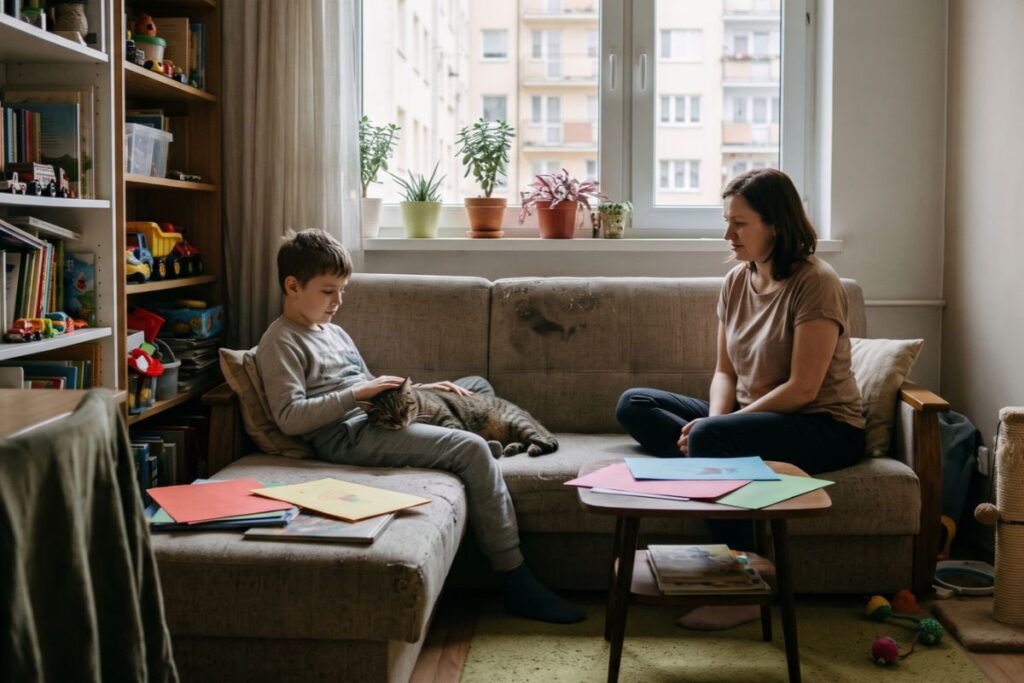
Pet cats do not cause anxiety in children; instead, families already managing childhood anxiety, sensory overload, or neurodivergence deliberately choose cats over dogs. Because cats are quiet and require no rigid outdoor routines, parents filter out high-energy dogs. creating a statistical pattern in health surveys that researchers often mistake for a feline-driven risk.
Why Do Parents of Anxious Children Choose Cats Over Dogs?
Parents of anxious and sensory-sensitive children deliberately select cats over dogs because cats are quiet and do not require rigid outdoor schedules that escalate household stress. When a child struggles with loud noises or sudden movements, bringing a high-energy dog into the home can overwhelm daily routines.
According to a peer-reviewed study in Frontiers in Veterinary Science, parents of children with autism spectrum disorder frequently avoid or discontinue dog ownership due to loud barking, unpredictable jumping, and strict exercise demands. Those same families report higher satisfaction with cats, whose quiet demeanor and predictable habits fit a child’s need for a low-stimulation environment.
In clinical and family settings, pet selection functions as an environmental adaptation. Parents of emotionally dysregulated children actively screen out animals that generate sudden auditory spikes, turning to indoor cats because a cat’s quiet presence fits a household already operating near its sensory threshold.
What Did the Viral Cat Mental Health Study Miss?
Cross-sectional pet-health surveys miss the direction of cause and effect because they measure current pet ownership and child mental health symptoms at the same time without tracking pre-adoption baselines. Recent media coverage highlighted observational findings showing that among household pets, only cats correlated with higher rates of mental health difficulties in children. Adding a brief caveat about correlation before speculating about biological triggers.
A closer look at how observational pet-health surveys are built reveals a structural blind spot: researchers rarely record why a family acquired the animal or what the child’s emotional baseline looked like beforehand. As methodological guidance from the National Institutes of Health on observational cohort studies outlines, cross-sectional snapshots cannot establish temporal sequence. leaving models vulnerable to confounding by indication, a bias where a patient’s pre-existing condition drives the choice of exposure rather than resulting from it.
Researchers investigating feline associations have also proposed biological and environmental hypotheses. including childhood exposure to Toxoplasma gondii, a single-celled parasite commonly carried by cats, alongside nocturnal sleep disruption or dander allergies. Yet large-scale longitudinal birth cohort research published in Psychological Medicine (indexed via PubMed Central) found that once socioeconomic status, household crowding, and baseline family variables were controlled for, childhood cat ownership showed no meaningful causal link to adolescent psychiatric outcomes.
How Do Cats and Dogs Affect Sensory-Sensitive Children Differently?
Dogs demand active social engagement and produce unpredictable sensory triggers, whereas indoor cats offer passive companionship and retreat when overstimulated. Veterinary and human-animal interaction researchers have documented this behavioral contrast across multiple populations, though it rarely appears in general health reporting.
Research published in the journal Anthrozoös on pet ownership in families with autism and summarized by the Human Animal Bond Research Institute (HABRI) indicates that species differences shape emotional outcomes: dogs require high physical energy and active co-regulation, whereas cats allow quiet coexistence.
That feline tendency to disengage mirrors the boundaries many anxious children need. Instead of forcing continuous interaction, an indoor cat allows a child to initiate calm, tactile contact on their own terms.
How Do Housing and Caregiver Limits Skew Cat Ownership Data?
Apartment living and single-parent caregiving schedules independently raise baseline household stress while restricting dog ownership, concentrating indoor cats in families facing higher structural pressures. Practical limits on caregiver time and living space push families toward cats, creating a second layer of unmeasured confounding in survey data.
Single-parent households and families in multi-unit apartments experience higher baseline stressors. including smaller living quarters and limited access to outdoor green space. These factors independently correlate with child mental health challenges. Demographic data tracked by the American Veterinary Medical Association (AVMA) Pet Ownership and Demographics Sourcebook shows that cat ownership is concentrated in apartments, multi-unit housing, and smaller households compared to dog ownership, which skews toward detached single-family homes with yards.
Landlord pet restrictions, lack of a fenced yard, and solo caregiving schedules leave parents little capacity for daily dog walks. An indoor cat requires minimal logistical overhead, concentrating cat ownership in households already carrying heavier structural loads.
How Do Clinicians Evaluate Cats for Anxious Children?
Pediatric psychiatrists and veterinary behaviorists evaluate feline temperament, sensory care demands, and adult responsibility rather than treating cat ownership as a uniform risk. Guidance from the American Academy of Child and Adolescent Psychiatry (AACAP) on pets and children emphasizes that a pet’s benefit depends on matching the animal’s temperament to the child’s developmental stage and ensuring adults retain primary care duties.
Clinical and veterinary behavior guidelines from the American Veterinary Society of Animal Behavior (AVSAB) point to three practical criteria when introducing a cat into a home with an anxious or sensory-sensitive child:
- Feline life stage and temperament: Adopting a calm, socialized adult cat with a predictable personality avoids the erratic scratching, biting, and nighttime hyperactivity common in young kittens.
- Sensory management of care routines: Keeping litter boxes in low-traffic, well-ventilated spaces prevents olfactory overload and spares sensory-sensitive children from stressful cleanup chores.
- Clear adult care ownership: Ensuring parents handle feeding, veterinary visits, and hygiene prevents a struggling child from feeling overwhelmed by daily care obligations.
Until large-scale studies track children’s mental health both before and after a pet enters the home, cross-sectional surveys will continue to confuse a family’s coping strategy with a cause of distress.
Frequently Asked Questions
Do pet cats actually cause anxiety or depression in children? No. Cross-sectional surveys show a statistical correlation between household cats and child mental health difficulties, but large-scale longitudinal research indexed in PubMed Central finds no meaningful causal link once family socioeconomic status, housing crowding, and pre-existing baseline traits are controlled for.
Why do families with anxious or neurodivergent children prefer cats over dogs? According to research in Frontiers in Veterinary Science, parents of sensory-sensitive and neurodivergent children actively avoid dogs because loud barking, jumping, and rigid outdoor walking routines trigger sensory overload. Indoor cats provide quiet, low-demand companionship and retreat when overstimulated.
What factors confound observational studies linking cats to child mental health? Two major variables skew observational pet surveys: reverse causality. where pre-existing childhood anxiety drives parents to choose a low-maintenance cat. and demographic constraints, as American Veterinary Medical Association data shows cat ownership is concentrated in multi-unit apartments and smaller households facing higher baseline stressors.
What type of cat is best for a child with anxiety or sensory sensitivity? Guidelines from the American Academy of Child and Adolescent Psychiatry and the American Veterinary Society of Animal Behavior recommend adopting a calm, socialized adult cat rather than an impulsive kitten, placing litter boxes in ventilated, low-traffic areas, and keeping daily care duties with adults.