






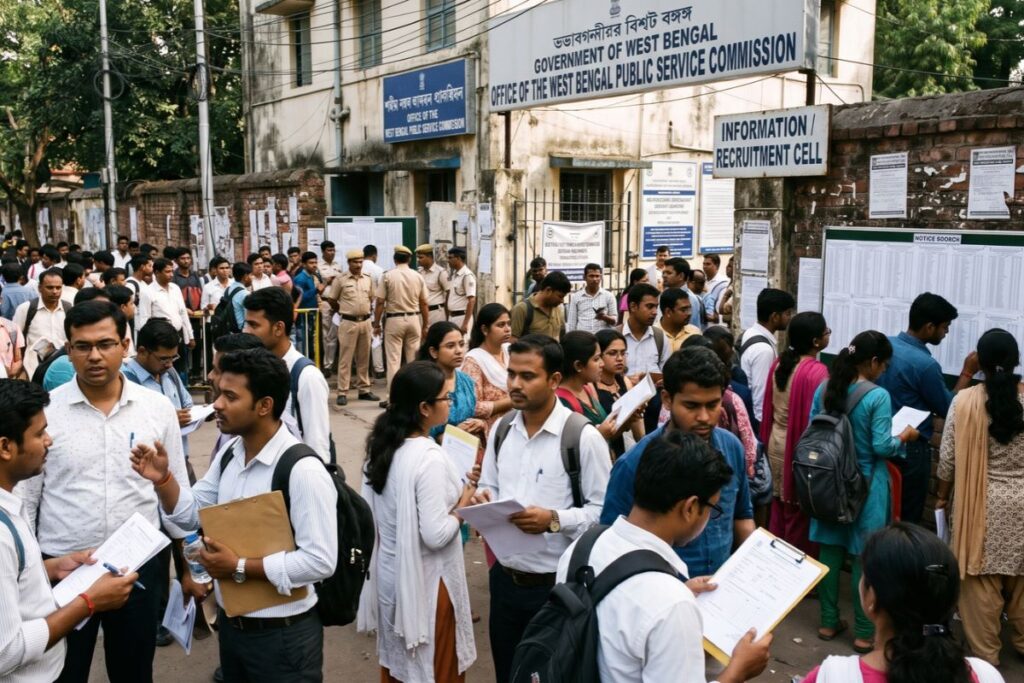
West Bengal’s newly announced exam fee waiver and age relaxation, set to take effect from 2027, will expand applicant pools across its 1-lakh recruitment push by an estimated 35% to 50%, colliding with state testing commissions that already carry multi-year backlogs and stretching exam-to-appointment timelines past 24 months.
How Much Will West Bengal’s Exam Fee Waiver and Age Relaxation Swell Applicant Pools?
Eliminating application fees and adding two upper-age cohorts will push competition ratios in West Bengal’s clerical and Group D drives past 200:1, adding millions of answer sheets to an evaluation system already near capacity. Current exam fees run Rs 400 to Rs 500 for general candidates and Rs 150 to Rs 250 for reserved categories.
According to the West Bengal Public Service Commission (WBPSC) Annual Report, the constitutional body responsible for recruiting officers into West Bengal’s state civil services processes roughly 14.97 lakh competitive exam applications in a single reporting cycle against just 1,335 final allotments.
At the West Bengal Central School Service Commission (WBSSC), the statutory board that recruits teaching and non-teaching staff for state-aided schools, candidate volume already dwarfs open seats. According to WBSSC examination filings, more than 16 lakh applicants sat for the March 2026 State Level Selection Test (SLST) for 8,477 non-teaching Group C and Group D posts (an application-to-vacancy ratio of nearly 189:1), while an earlier clerkship cycle drew 8.5 lakh applicants for 9,000 jobs.
Unemployment data explains why zero-fee access triggers sharp registration spikes. According to the Ministry of Statistics and Programme Implementation’s Periodic Labour Force Survey (PLFS) Annual Report 2025, West Bengal records an urban youth unemployment rate of 11.8% and a graduate unemployment rate of 25.7%.
When Rajasthan introduced free applications following a One Time Registration under its Department of Rural Development e-Governance Compendium, form submissions surged across departments. The spike forced the Rajasthan Staff Selection Board to introduce financial penalties for exam no-shows.
Millions of additional Optical Mark Recognition (OMR) answer sheets, paper forms scanned electronically to grade multiple-choice tests, will enter West Bengal’s evaluation pipeline without the fee receipts that previously funded exam logistics.
Why Can’t WBPSC and WBSSC Clear 1 Lakh Vacancies Within a Single Year?
WBPSC’s fixed interview ceiling of roughly 1,208 sittings per year and chronic delays by state departments in reporting verified vacancies mathematically prevent a 1-lakh recruitment drive from clearing within 12 months. Even when preliminary written tests happen on schedule, downstream verification stalls the pipeline.
According to WBPSC’s “Workload at a Glance” records in its annual operational filing, those 1,208 annual interview sittings evaluate roughly 9,794 candidates across all state cadres. Meanwhile, the West Bengal Budget 2026–27 framework splits the 1-lakh recruitment target across 50,000 education posts, 20,000 police posts, and 30,000 departmental vacancies.
Recent WBSSC schedules show how slowly existing queues move. Candidates who wrote Group C and D exams on March 1 and March 8, 2026, waited eight months, until November 5, 2026, just for the preliminary interview lists shortlisting 16,954 candidates in a 1:2 ratio to be published.
Official WBPSC disclosures also identify a recurring bottleneck outside the testing halls: state departments routinely fail to submit verified category-wise vacancy rosters on time. In the 2026 WBSSC non-teaching drive, the West Bengal Board of Secondary Education submitted its revised vacancy statement on October 14, 2026, more than seven months after the written exam took place.
Can West Bengal’s Budget Absorb Both the Fee Waiver and the Rs 50,000 Student Aid?
Waiving exam fees strips recruiting commissions of up to Rs 42.5 crore per major drive in direct application collections at the exact moment the state treasury is funding two new multi-year direct-transfer programs. Without matching treasury reimbursements, recruiting boards face tighter operating budgets for printing, center allocation, and OMR scanning.
Chief Minister Suvendu Adhikari announced the fee waiver and two-year age relaxation at a Paschim Medinipur police programme alongside two cash-transfer commitments:
- Bhagini Nivedita scheme: Launching in January 2027, this program grants Rs 50,000 over three years (Rs 17,000 in years one and two, and Rs 16,000 in year three) to unmarried female students entering higher education.
- Bhorosa scheme: This proposed program provides five years of direct financial assistance to unemployed job aspirants.
According to the PRS India West Bengal Budget Analysis 2026–27, total state expenditure excluding debt repayment is estimated at Rs 3,84,169 crore against a targeted fiscal deficit of Rs 62,421 crore (2.9% of Gross State Domestic Product). In the 8.5-lakh-applicant clerkship drive cited by the Chief Minister, a Rs 500 base fee generated up to Rs 42.5 crore in gross application receipts that the state treasury must now replace.
What Happens to Over-Aged Aspirants When Recruitment Cycles Stretch Past 24 Months?
For an applicant entering at age 41 or 42 under the two-year upper-age relaxation, a single cancelled exam or judicial stay closes their final legal window for state employment. Longer delays multiply the risk that administrative errors freeze merit panels before appointments are issued.
West Bengal’s court dockets show how quickly high-volume drives stall under scrutiny. Following the April 2025 Supreme Court verdict upholding the cancellation of the 2016 school recruitment panel, the apex court had to grant an eight-month deadline extension through May 31, 2027, after WBSSC cited legal and reservation-roster verification delays.
As recently as November 13, 2026, WBSSC issued fresh notices cancelling candidatures in the ongoing Group C and D cycle after cross-checking applicants against CBI OMR-mismatch records. Larger, zero-fee applicant pools increase the audit workload required to prevent similar litigation.
What Is the West Bengal Government’s Case for the 2027 Rollout?
State officials maintain that the policy corrects a multi-year financial inequity rather than creating an administrative bottleneck, noting that earlier recruitment drives collected Rs 500 each from roughly 8.5 lakh applicants for just 9,000 posts. The administration plans to phase the 1 lakh vacancies over five years rather than in a single recruitment cycle.
Speaking in Paschim Medinipur on November 16, 2026, Adhikari argued that waiving fees removes an unfair tax on unemployed youth while pairing immediate police inductions with private industrial incentives.
Whether that five-year phasing prevents a queue collapse depends on two forthcoming Gazette notifications:
- Finance Department rules: The exact treasury reimbursement formula covering WBPSC and WBSSC exam-conducting expenses.
- Personnel & Administrative Reforms Department rules: Clarification on whether the 2027 age relaxation applies uniformly across pending and future exam notifications.
Until those operational rules are published, aspirants face lower entry costs and a substantially longer wait for appointment letters.
Frequently Asked Questions
When will West Bengal’s exam fee waiver and two-year age relaxation take effect? The exam fee waiver and two-year upper-age relaxation are scheduled to take effect from 2027, alongside the January 2027 launch of the Bhagini Nivedita student aid scheme. Specific applicability across pending and future exams awaits formal Gazette notifications from the Personnel & Administrative Reforms Department.
How are the 1 lakh vacancies in West Bengal’s recruitment push divided across departments? According to the West Bengal Budget 2026–27 framework, the 1-lakh recruitment target is divided across 50,000 education posts, 20,000 police posts, and 30,000 departmental vacancies. The state government plans to phase these appointments over a five-year period.
Why could waiving exam fees slow down WBPSC and WBSSC recruitment timelines? Removing Rs 150 to Rs 500 application fees and adding two upper-age cohorts is projected to swell applicant pools by 35% to 50%, pushing competition ratios past 200:1 while stripping recruiting bodies of up to Rs 42.5 crore per major drive in direct fee revenue. Those higher volumes collide with WBPSC’s ceiling of roughly 1,208 annual interview sittings and multi-month departmental delays in submitting verified vacancy rosters.
What is the difference between West Bengal’s Bhagini Nivedita and Bhorosa schemes? Bhagini Nivedita is a three-year educational grant launching in January 2027 that provides Rs 50,000 in total (Rs 17,000 in years one and two, and Rs 16,000 in year three) to unmarried female students entering higher education. Bhorosa is a proposed five-year financial assistance scheme aimed at unemployed job aspirants.