






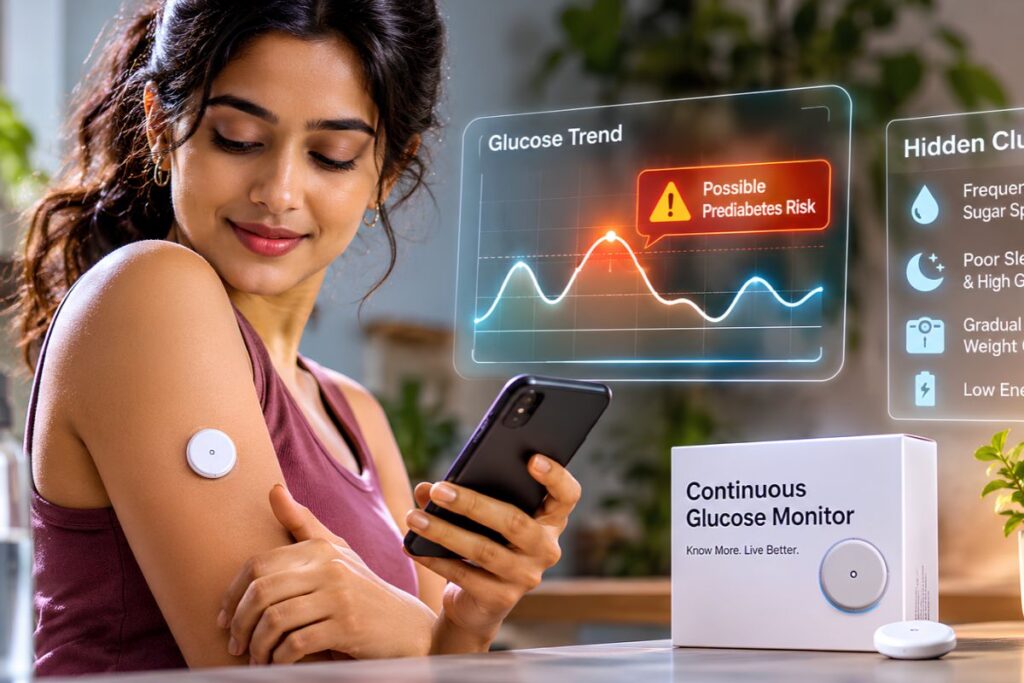
If you notice skin tags or feel tired after meals, skip an over-the-counter continuous glucose monitor and online metabolic panels. Standard prediabetes blood tests ordered through a primary care doctor cost a fraction of direct-to-consumer subscriptions, carry insurance coverage, and rely on clinically validated diagnostic thresholds that wellness startups are not cleared by federal regulators to replace.
How Do Startups Turn Skin Tags and Fatigue Into Paid Subscriptions?
Direct-to-consumer metabolic startups acquire customers by running sponsored search articles, affiliate health blogs, and social media ads that frame common physical traits, like skin tags and afternoon fatigue, as signs of undetected insulin resistance, routing readers into 89-to-365 recurring memberships.
An over-the-counter continuous glucose monitor is a wearable biosensor worn on the back of the upper arm that tracks glucose levels in fluid beneath the skin every few minutes without a prescription. Once a reader clicks from a symptom article into a startup’s checkout flow, the pricing structure centers on ongoing out-of-pocket subscriptions rather than one-time screening.
- Levels Health: Charges an annual software membership alongside recurring Dexcom Stelo biosensor shipments at $89 per month (or $99 for a one-time two-pack), plus $99 for a basic 28-biomarker lab panel.
- Signos: Prices its continuous glucose monitor plans between $136 per month on a six-month commitment and $240 for a single month.
- Function Health: Charges $365 per year for biannual multi-biomarker blood panels marketed directly to consumers.
How Much Do Direct-to-Consumer Metabolic Panels Cost Compared to Standard Lab Tests?
A direct-to-consumer metabolic panel costs $99 to $365 per year, whereas the exact same standard prediabetes blood tests reimburse at under $15 on federal fee schedules and sell direct to uninsured patients for under $30.
While startups bundle dozens of markers under proprietary wellness branding, clinical prediabetes screening relies on standardized Current Procedural Terminology (CPT) billing codes, the five-digit medical codes insurers and labs use to bill identical diagnostic assays, processed by the same national reference laboratories:
- Hemoglobin A1C (CPT 83036): Reimbursed at $9.71 on the Centers for Medicare & Medicaid Services (CMS) 2026 Clinical Laboratory Fee Schedule (with an $11.00 commercial insurer average), and sold directly to self-pay patients via JustLabs at $24.80 all-in including the Quest Diagnostics blood draw fee, or $39 to $45 through Labcorp OnDemand and Quest Health.
- Fasting Blood Glucose (CPT 82947): Carries a Medicaid and Medicare benchmark rate of $3.93 to $6.90 across state clinical laboratory schedules, and adds $6.00 to an existing self-pay lab order.
- Fasting Insulin (CPT 83525) and Lipid Panel (CPT 80061): Reimburse at $11.43 to $19.39 for insulin and $13.39 for a standard lipid panel, with a combined four-test diabetes panel available self-pay for $29.90 plus order fees.
In a standard primary care visit, preventive screening for abnormal blood glucose is covered without out-of-pocket cost-sharing for eligible adults under federal preventive care rules.
Startup executives and company materials defend their retail pricing by pointing to friction in traditional healthcare. On its membership pricing page, Function Health states that its model lets consumers test broad biomarker panels “without jumping through insurance hoops,” while Abbott’s Lingo product announcement positions continuous biosensors as personalized coaching tools that show how specific foods and workouts affect minute-by-minute glucose levels.
Are Over-the-Counter Continuous Glucose Monitors Cleared to Diagnose Prediabetes?
No, the U.S. Food and Drug Administration (FDA) has not cleared any over-the-counter continuous glucose monitor to diagnose prediabetes or diabetes, and major diabetes guidelines do not recommend them for adults with normal blood sugar.
Standard medical practice diagnoses prediabetes using three established laboratory thresholds: a hemoglobin A1C between 5.7% and 6.4%, fasting plasma glucose between 100 and 125 milligrams per deciliter, or a two-hour oral glucose tolerance test between 140 and 199 milligrams per deciliter.
Over-the-counter biosensors operate under strict federal labeling limits that prohibit diagnostic use:
- Dexcom Stelo: According to the FDA 510(k) clearance summary (K234070), the Stelo Glucose Biosensor System is cleared for adults 18 and older not on insulin, with the explicit condition that “the user is not intended to take medical action based on the device output without consultation with a qualified healthcare professional.”
- Abbott Lingo: The FDA 510(k) summary for the Lingo Glucose System (K233655) carries the identical restriction against taking medical action without a clinician, and Abbott’s consumer disclosure states that the device “is not intended for diagnosis of diseases, including diabetes.”
Clinical guidelines draw the same boundary. The American Diabetes Association (ADA) Standards of Care in Diabetes, 2026 recommend continuous glucose monitoring for adults with diabetes who use insulin or require glycemic management support, not for normoglycemic adults, people whose blood sugar stays within normal ranges.
A September 2026 clinical evidence review on continuous glucose monitoring without diabetes found that when 18 diabetes specialists evaluated 20 borderline sensor reports from people without diabetes, they showed poor agreement on how to interpret the traces. The review concluded that normal post-meal glucose rises occur in healthy people, no validated sensor thresholds predict disease outcomes in asymptomatic adults with normal A1C, and short-term dietary adjustments prompted by sensor feedback have not been shown to produce durable reductions in clinical events.
Do Skin Tags Mean You Have Prediabetes?
Having skin tags does not prove you have prediabetes, while multiple skin tags correlate statistically with insulin resistance; up to 60% of all adults develop them from aging and skin friction alone.
Marketing campaigns frequently highlight acrochordons, small, benign, flesh-colored skin growths commonly called skin tags, alongside post-meal fatigue as visual clues of “hidden” insulin resistance, a condition in which cells respond poorly to insulin and the pancreas secretes higher amounts of the hormone to compensate.
According to the National Institutes of Health (NIH) StatPearls clinical reference on acrochordons, skin tags occur in 50% to 60% of the general adult population, increasing in frequency with age and skin-on-skin friction. A 2025 comparative clinical study of acrochordons and diabetes found a statistically significant association between skin tags and diabetes (odds ratio 1.89), yet confirmed no specific count, size, or anatomical pattern unique to diabetic patients.
Because skin tags are visible in a mirror, they generate high engagement for consumer health articles, even though most adults with skin tags do not have prediabetes, and most people with prediabetes have no skin changes at all. According to the Centers for Disease Control and Prevention (CDC) National Diabetes Statistics Report (updated November 2026), an estimated 115.2 million U.S. adults aged 18 and older have prediabetes, the vast majority without noticeable physical symptoms.
What Happens When Unvalidated Glucose Data Enters Primary Care?
Bringing unvalidated consumer sensor graphs into a doctor’s office creates interpretation friction and extra testing without established clinical benchmarks for healthy adults.
Research on integrating continuous glucose monitoring into general practice, including a 2025 primary care CGM workflow study and a 2026 survey of 101 primary care physicians and 106 endocrinologists, shows that primary care practices already face workflow strain and lack specialized interpretation infrastructure even when managing prescribed diabetes sensors. Introducing non-diabetic glucose tracking graphs adds uncompensated review time and follow-up testing without validated reference ranges.
For readers deciding whether to spend money investigating potential prediabetes, established clinical guidelines set clear rules:
- When standard care applies: Under U.S. Preventive Services Task Force (USPSTF) guidelines, asymptomatic adults aged 35 to 70 who have overweight or obesity (a body mass index of 25 or higher, or 23 or higher for Asian American adults) qualify for routine A1C or fasting plasma glucose screening through a primary care clinician, typically with zero out-of-pocket cost under preventive coverage rules.
- When out-of-pocket testing lacks support: Paying $99 to $400 for a direct-to-consumer metabolic panel or over-the-counter continuous glucose monitor to investigate isolated fatigue or a single skin tag adds recurring retail expense without providing a medically valid diagnosis.
Until long-term clinical trials demonstrate that flattening daily post-meal glucose fluctuations in adults with normal A1C reduces future diabetes or cardiovascular events, direct-to-consumer metabolic subscriptions remain consumer wellness tools operating outside validated diagnostic medicine.
Frequently Asked Questions
Can an over-the-counter continuous glucose monitor diagnose prediabetes?
No. According to U.S. Food and Drug Administration (FDA) 510(k) clearance summaries for devices like Dexcom Stelo (K234070) and Abbott Lingo (K233655), over-the-counter glucose biosensors are not cleared to diagnose diabetes or prediabetes, and users are instructed not to take medical action without consulting a clinician. Prediabetes is diagnosed using a hemoglobin A1C test (5.7%–6.4%), fasting plasma glucose (100–125 mg/dL), or an oral glucose tolerance test.
How much cheaper is a standard A1C blood test than a direct-to-consumer metabolic panel?
A hemoglobin A1C test (CPT 83036) reimburses at $9.71 on the 2026 Medicare Clinical Laboratory Fee Schedule and sells direct to uninsured patients for $24.80 all-in via self-pay lab services. By comparison, direct-to-consumer metabolic subscriptions from platforms like Levels Health, Signos, and Function Health range from $89 per month to $365 per year.
Do skin tags always mean you have insulin resistance or prediabetes?
No. According to the National Institutes of Health (NIH), skin tags (acrochordons) affect 50% to 60% of all adults and commonly develop from skin friction and aging. While a 2025 clinical study found a statistical link between skin tags and diabetes (odds ratio 1.89), researchers found no specific number or location of skin tags that diagnoses prediabetes.
Who qualifies for insurance-covered prediabetes screening?
Under U.S. Preventive Services Task Force (USPSTF) guidelines, asymptomatic adults aged 35 to 70 with overweight or obesity (a BMI of 25 or higher, or 23 or higher for Asian American adults) qualify for routine A1C or fasting blood glucose screening through a primary care doctor, typically at zero out-of-pocket cost