






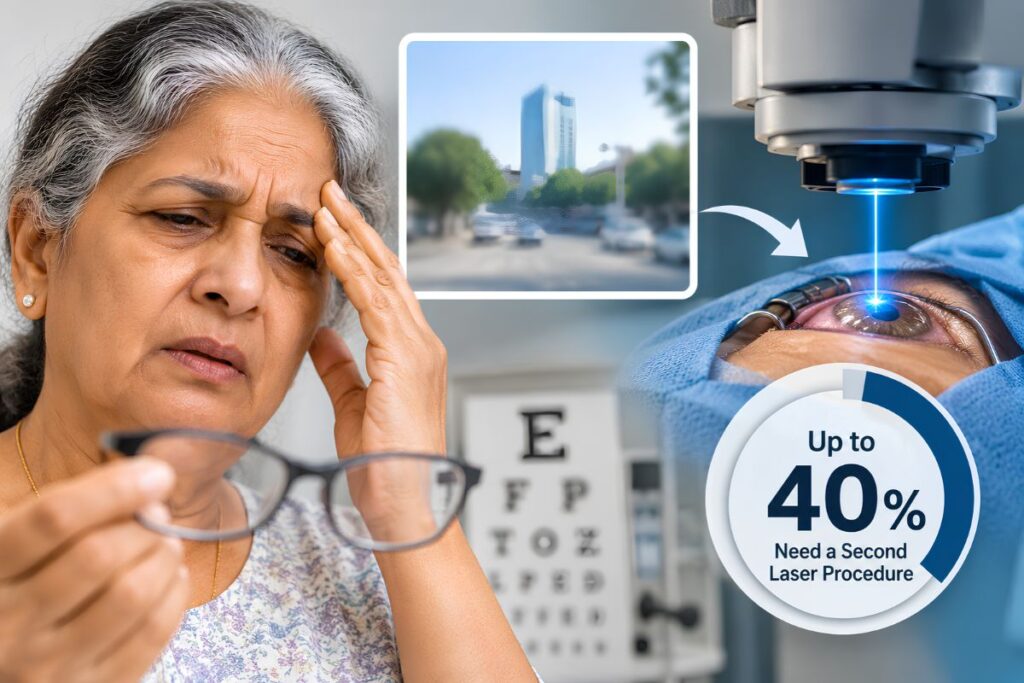
Blurry vision after cataract surgery does not mean your cataract has grown back; a removed natural lens cannot regenerate. Instead, your haze likely comes from Posterior Capsular Opacification, a common clouding of the thin membrane left behind to hold your artificial lens. Between 20% and 40% of patients develop this film within five years and require a secondary laser procedure to clear it.
How Common Is a Second Laser Procedure After Cataract Surgery?
According to Centers for Medicare & Medicaid Services (CMS) billing records, physicians perform roughly three secondary laser procedures for every ten primary cataract operations in the United States.
Data compiled from the CMS Part B National Summary Data File show that Medicare allowed roughly 879,000 YAG laser capsulotomies under billing code CPT 66821 in 2025, alongside approximately 2.89 million primary cataract extractions billed under CPT 66984. At the 2026 national Medicare physician rate of $335.35 per office procedure, those secondary treatments alone represent nearly $295 million in annual baseline Medicare physician spending before facility fees or commercial insurance claims are counted.
Despite that volume, Medicare Administrative Contractor coverage policies focus documentation rules on proving primary surgical necessity rather than standardizing pre-surgical warnings about long-term capsular clouding. For roughly three in ten Medicare cataract patients, clearing the initial cloudiness is only step one.
Why Does Blurry Vision Return After Cataract Surgery?
Blurry vision returns when leftover lens cells migrate across the transparent membrane holding your artificial lens, creating a light-scattering film known as Posterior Capsular Opacification (PCO).
Posterior Capsular Opacification is a post-surgical clouding of the eye’s natural posterior lens capsule, the thin membrane surgeons leave intact to support an artificial intraocular lens, that clinicians often call a “secondary cataract.” Over months or years, microscopic lens epithelial cells remaining inside that capsule multiply across its back surface, recreating the haze, glare, and faded contrast you experienced before surgery.
Preserving the capsular bag keeps modern cataract surgery safe, yet your odds of developing PCO depend heavily on which artificial lens the surgeon implants. Peer-reviewed systematic reviews and national registry analyses show that lens polymer and optic-edge geometry sharply alter failure rates:
- Hydrophilic acrylic lenses: Soft, high-water-content implants allow cells to migrate more easily across the posterior surface. A meta-analysis of 13 randomized controlled trials found that patients receiving hydrophobic acrylic lenses had a 62% lower relative risk of needing Nd: YAG laser capsulotomy (relative risk 0.38) compared with hydrophilic acrylic implants, meaning hydrophilic lenses required secondary laser intervention more than two-and-a-half times as often. Three-year clinical reviews cited in the American Academy of Ophthalmology (AAO) Intelligent Research in Sight (IRIS) Registry research report PCO rates of 18% to 65% for hydrophilic lenses versus 5% to 32% for hydrophobic designs.
- Square-edged hydrophobic acrylic lenses: Implants engineered with a sharp, 360-degree posterior square edge create a mechanical barrier that induces contact inhibition and blocks cell migration across the visual axis, as documented in experimental and clinical reviews of PCO prevention. In the same AAO IRIS Registry real-world analysis, patients implanted with diffractive multifocal or extended-depth-of-focus lenses still underwent Nd: YAG laser treatment at three times the rate of monofocal lens recipients within the first year, driven by lower tolerance for mild light scatter.
Ophthalmology guidelines note that leaving the posterior capsule intact prevents the artificial lens from slipping into the vitreous cavity at the back of the eye. Because epithelial cell growth is a natural wound-healing response rather than surgical error, some degree of capsular clouding remains a built-in trade-off of modern implant design.
What Happens During a YAG Laser Capsulotomy, And What Does It Cost?
A YAG laser capsulotomy is a five-minute, incision-free outpatient procedure in which an eye doctor uses focused infrared laser pulses to cut a permanent central opening in a clouded posterior lens capsule.
Unlike your initial operation, this procedure requires no stitches or operating-room sedation. You sit upright at a specialized slit-lamp microscope while the surgeon directs neodymium-doped yttrium aluminum garnet (Nd: YAG) laser pulses through your cornea and artificial lens, vaporizing a clear window for light to reach your retina.
While the laser treatment takes minutes, your medical bill depends heavily on where your doctor schedules it. According to the Medicare Procedure Price Lookup for CPT 66821, national average Medicare total costs jump from $576 (with a $115 average patient copay) in a standard ambulatory surgical setting to $836 (with a $167 average patient copay) in a hospital outpatient department, a 45% increase for the exact same laser treatment.
The site-of-service gap widens further when comparing an in-office laser suite against a surgical facility. Under the 2026 Medicare Physician Fee Schedule, Medicare sets a single global in-office rate of $335.35 (leaving a standard $67.07 patient coinsurance) because the physician owns the laser equipment. When performed in an Ambulatory Surgical Center or hospital outpatient department, Medicare splits the bill into a separate surgeon fee ($275.22 in 2026) plus an additional facility fee ($295 in an Ambulatory Surgical Center or $549 in a hospital outpatient department, per Nidek Medicare reimbursement guidance), roughly doubling to tripling combined program and patient charges.
What Are the Risks of YAG Laser Surgery?
Firing high-energy laser pulses inside the eye carries measurable structural risks, including a 57% higher relative risk of retinal detachment and potential laser pitting on the surface of the artificial lens.
Once the posterior capsule is opened, the gel-like vitreous humor at the back of the eye can shift forward and pull on the retina. A systematic review and meta-analysis published in the Journal of Cataract & Refractive Surgery examining 8,232 eyes that underwent Nd: YAG capsulotomy found a statistically significant 57% increase in relative risk (relative risk 1.57; hazard ratio 1.64) for pseudophakic retinal detachment, a medical emergency where the retina detaches from its supporting tissue, compared with eyes that did not receive laser treatment.
Overall absolute retinal detachment rates remain low: a nationwide French population study (the FreYAG2 Study) in Ophthalmology tracked 12-month retinal detachment incidence at 0.5% or lower. However, that same French cohort study found that 13.3% of patients experienced at least one tracked adverse event (ocular hypertension, macular edema, or retinal detachment) within one year of the laser, with 68.4% of complications occurring within the first three months.
Precision during the procedure also affects optical quality. The American Academy of Ophthalmology’s clinical education guidance on Nd: YAG capsulotomy warns that improper laser focusing can pit, crack, or mark the back surface of the artificial lens. Case filings in the U.S. Food and Drug Administration (FDA) MAUDE medical device adverse-event database document instances where YAG capsulotomies failed to resolve visual disturbances or were tied to post-implant optical complaints, particularly when laser marks scatter light across multifocal lens rings.
Are Doctors Performing YAG Laser Procedures Too Soon After Cataract Surgery?
Medicare coverage rules scrutinize YAG laser claims billed within 90 days of cataract surgery, yet national registry data show the average patient undergoes the procedure just six months after their original operation.
Because YAG capsulotomy takes minutes in an office chair while base Medicare surgeon fees for primary cataract surgery have compressed to $462.60 in 2026, billing compliance analysts and Medicare contractors track how soon after cataract surgery clinics perform the laser. Under Medicare Administrative Contractor Local Coverage Determinations (such as Palmetto GBA LCD L37644), claims for YAG capsulotomy within three months of primary cataract surgery face automatic scrutiny or denial unless specific, documented complications exist, because true cellular PCO rarely develops within 90 days.
Real-world registry data show that early laser intervention happens frequently, especially among patients who paid out of pocket for advanced lenses. In the AAO IRIS Registry study, the mean time from cataract surgery to Nd: YAG capsulotomy was 180.7 days overall, and 175.3 days for patients with diffractive multifocal or extended-depth-of-focus implants.
Ophthalmology coding and clinical bodies note that early YAG procedures are clinically warranted when pre-existing posterior capsule plaques or aggressive fibrosis immediately degrade vision, and emphasize that laser capsulotomy safely restores sight without returning a patient to the operating room. At the same time, Medicare coverage criteria strictly require documented functional impairment, such as best-corrected visual acuity of 20/30 or worse, or a two-line acuity drop on formal glare testing, rather than mild visual dissatisfaction.
Because opening the posterior capsule is permanent and increases early retinal and macular swelling risks, the FreYAG2 cohort analysis found patients undergoing YAG within one year of cataract surgery faced a 31% higher hazard ratio (HR 1.314) for post-laser adverse events than those treated later. Patients should verify three facts before consenting to the laser:
- Whether confirmed Posterior Capsular Opacification, rather than dry eye or retinal changes, is causing the blurry vision.
- Which polymer material (hydrophilic versus hydrophobic acrylic) was implanted during the original cataract surgery.
- Whether the laser procedure will be billed as a single in-office global fee ($335.35 national Medicare baseline) or a higher-cost surgical-center visit with separate facility charges.
Frequently Asked Questions About Blurry Vision After Cataract Surgery
Can a cataract grow back after cataract surgery?
No, a removed natural lens cannot regenerate. When blurry vision returns months or years after surgery, it is almost always caused by Posterior Capsular Opacification, a clouding of leftover lens epithelial cells on the thin membrane left behind to hold your artificial implant, which affects 20% to 40% of patients within five years.
How much does a YAG laser capsulotomy cost under Medicare?
Under the 2026 Medicare Physician Fee Schedule, an in-office YAG laser capsulotomy (CPT 66821) carries a national baseline global rate of $335.35, leaving a standard $67.07 patient coinsurance. Having the identical procedure performed in an Ambulatory Surgical Center or hospital outpatient department adds a separate facility fee ($295 to $549), pushing combined total costs to between $576 and $836.
Which cataract lens type is least likely to cause blurry vision later?
Square-edged hydrophobic acrylic lenses carry the lowest risk of Posterior Capsular Opacification. A meta-analysis of 13 randomized controlled trials found hydrophobic acrylic implants reduced the relative risk of needing a secondary YAG laser procedure by 62% compared with softer hydrophilic acrylic lenses.
Does YAG laser capsulotomy increase the risk of retinal detachment?
Yes. A systematic review of 8,232 eyes in the Journal of Cataract & Refractive Surgery found that Nd: YAG laser capsulotomy increases the relative risk of pseudophakic retinal detachment by 57% (hazard ratio 1.64), while the French FreYAG2 study found that 13.3% of patients experienced a tracked ocular adverse event within one year of the laser