





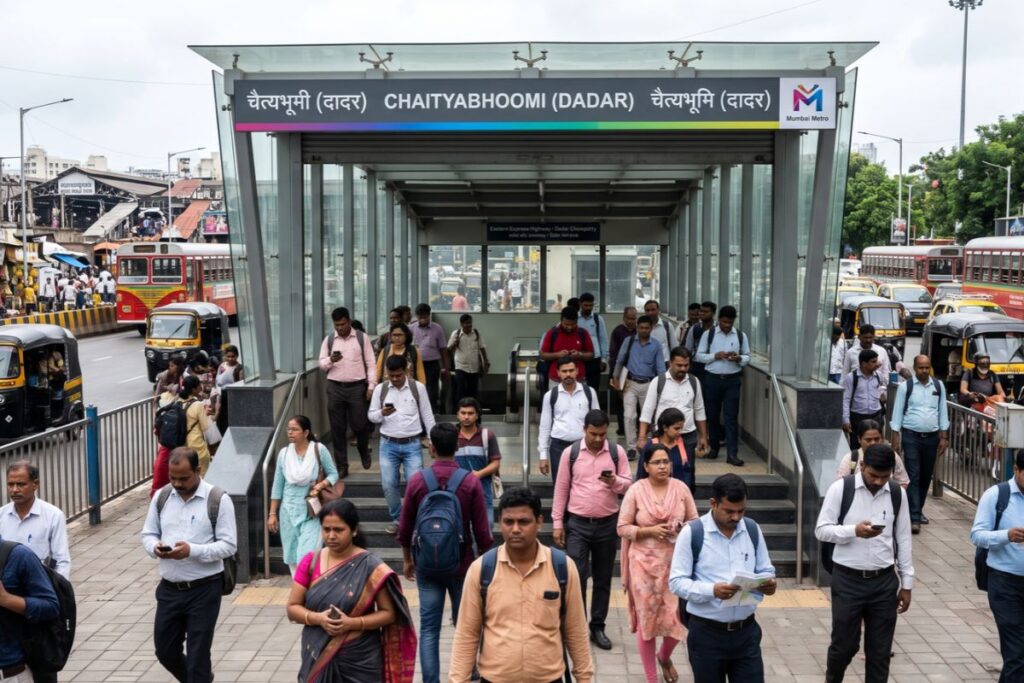
Having Dadar Metro Station renamed Chaityabhoomi while keeping the connected suburban railway hub named Dadar creates a split-name interchange. Updating automated announcements, platform screen doors, and dynamic route maps across all 27 Mumbai Metro Aqua Line 3 stations requires system-wide hardware and software changes, while daily commuters face mapping and ticketing mismatches.
What Hardware and Software Must Change Across 27 Metro Stations?
Renaming a single underground station on Mumbai Metro Aqua Line 3 requires reprogramming train displays and replacing route maps across all 27 stations and the entire train fleet, rather than swapping entrance signs.
Political coverage of Maharashtra’s Metro-only renaming plan treated the change as replacing a few exterior boards. On an automated underground corridor like Mumbai Metro Aqua Line 3, changing one station’s name triggers updates across the full network.
The Mumbai Metro Rail Corporation Limited (MMRCL), the state-central joint venture operating Aqua Line 3, runs driverless-capable Alstom Metropolis train sets equipped with digital dynamic route maps above every door. Inside all 27 underground stations, Platform Screen Doors (PSDs), glass barriers separating passengers from the tracks, carry illuminated route strips showing every stop in sequence.
When a single station name changes, engineers must update three separate layers across the corridor:
- Rolling stock software: Reprogramming dynamic route displays and trilingual (Marathi, Hindi, English) automated audio announcements across the active train fleet.
- Station hardware: Replacing printed PSD strip maps, concourse wayfinding totems, and fare-zone charts across all 27 stations.
- Fare-gate firmware: Updating entry and exit display terminals and backend station-master servers.
Comparable Metro renaming disclosures show that those updates carry a steep per-station price tag even before fleet-wide software rollouts. According to court submissions reported by The Tribune, the Delhi Metro Rail Corporation (DMRC) informed the Delhi High Court in February 2026 that updating the Hindi name signage and displays for a single stop, Supreme Court Metro station, would cost ₹40 lakh to ₹45 lakh.
How Does the Dadar–Chaityabhoomi Split Affect Multimodal Ticketing Apps?
Splitting a physical interchange into two different names forces integrated ticketing platforms and navigation apps to map separate station identifiers onto a single transfer point.
On November 19, 2026, Maharashtra Chief Minister Devendra Fadnavis clarified that only the underground Aqua Line 3 stop at Dadar would be renamed “Chaityabhoomi” ahead of Mahaparinirvan Diwas, the annual December 6 observance marking Dr. B.R. Ambedkar’s death anniversary, leaving Central Railway and Western Railway’s adjacent Dadar suburban hub unchanged. That split creates an immediate data problem for digital trip planners.
Public transit apps, including Google Maps, Chalo, and the Mumbai Metropolitan Region Development Authority (MMRDA)-backed Mumbai One common mobility app that integrates 11 public transport operators across the Mumbai Metropolitan Region, rely on standardized station identifiers and map coordinates to issue single QR-based multimodal tickets. When a suburban rail hub is indexed as “Dadar” in Indian Railways’ Unreserved Ticketing System (UTS), the mobile and counter ticketing platform used for unreserved suburban trains, while the connected underground stop is indexed as “Chaityabhoomi” in MMRCL’s National Common Mobility Card (NCMC) fare matrix, trip planners must link two distinct stop names to one transfer node.
What Do Daily Commuters Actually Face at the Dadar Interchange?
Commuters transferring between Dadar’s suburban railway platforms and Aqua Line 3 face an aboveground street walk between separate concourses, while out-of-town visitors risk mistaking the Metro exit for the seafront memorial gates.
While politicians debated historical symbolism, the physical geography of Dadar shapes what passengers experience at street level. Unlike suburban stations where Metro exits open directly onto railway foot-over-bridges, Aqua Line 3’s Dadar Metro station sits roughly 1.3 kilometers (about a 17-minute walk) from Dadar TT Circle and is separated from the main Central and Western Railway concourses, while the actual Chaityabhoomi stupa memorial lies along Dadar Chowpatty.
For regular office-goers transferring between suburban trains and the underground corridor, a split name adds a second layer of signage to check during peak rush hours. For out-of-town visitors among the roughly 15 lakh followers expected on December 6, seeing “Chaityabhoomi” on Metro maps risks implying direct underground access to the memorial gates.
How Have Other Mumbai and Delhi Interchanges Handled Mismatched Names?
Metro operators in Mumbai and New Delhi manage split-name interchanges by adding parenthetical dual labels on maps and announcements, keeping both names in active circulation.
Mumbai already operates a split-name rail-Metro pair two stops south on the same corridor. Western Railway’s long-distance and suburban terminal remains officially named “Mumbai Central,” while the connected Aqua Line 3 underground station operates as Jagannath Shankar Sheth Metro Station.
Across Indian metro systems, including Delhi’s State Names Authority updates where two stations were renamed and seven modified in February 2026, mismatched interchange names force operators to display parenthetical dual names, such as “Chaityabhoomi (Dadar),” on route maps and train announcements so passengers recognize the transfer point. Dual labels prevent missed stops, though they leave two competing names in daily circulation on tickets, bus route boards, and station totems.
How Will Maharashtra’s Metro Naming Guidelines Affect Co-Branding Contracts?
Maharashtra’s new state-level Metro naming committee must align political renamings with corporate station co-branding contracts that fund non-fare-box revenue for Metro operators.
Alongside the Dadar clarification, the Maharashtra government formed a special state-level committee chaired by Chief Minister Devendra Fadnavis and co-chaired by Deputy Chief Minister Eknath Shinde, bringing together Members of Parliament, Members of the Legislative Assembly, and mayors across Mumbai, Pune, and Nagpur, to frame statewide Metro naming guidelines. Those rules carry financial stakes for MMRCL’s non-fare-box revenue model, money earned outside ticket sales through advertising and corporate sponsorships.
To offset construction debt, MMRCL auctions station naming and co-branding rights under multi-year commercial contracts, having awarded branding rights for five stations in 2022 and three-year naming rights for Bandra Colony Metro Station to AU Small Finance Bank in November 2026. When a government mandates a political renaming mid-contract, operators must reconcile sponsor visibility clauses and cover the cost of reprinting branded station panels while setting uniform rules for future interchanges.
Frequently Asked Questions
Will Dadar railway station also be renamed Chaityabhoomi? No. On November 19, 2026, Maharashtra Chief Minister Devendra Fadnavis clarified that only the underground Dadar station on Mumbai Metro Aqua Line 3 will be renamed Chaityabhoomi, while Central Railway and Western Railway’s Dadar suburban station will retain its existing name.
What has to be updated across Mumbai Metro Aqua Line 3 when one station is renamed? Renaming a single Aqua Line 3 stop requires reprogramming dynamic route maps and trilingual automated audio announcements across the Alstom Metropolis train fleet, updating fare-gate firmware, and replacing Platform Screen Door route strips and wayfinding totems across all 27 underground stations.
How much does it cost to rename a single Metro station in India? While MMRCL has not published a separate rupee estimate for the Dadar Metro update, the Delhi Metro Rail Corporation informed the Delhi High Court in February 2026 that updating Hindi name signage and displays for a single stop, Supreme Court Metro station, would cost ₹40 lakh to ₹45 lakh.
How does a split-name interchange affect Mumbai One and transit apps? When Indian Railways’ Unreserved Ticketing System indexes the surface hub as Dadar while MMRCL’s National Common Mobility Card system indexes the underground stop as Chaityabhoomi, multimodal apps such as Mumbai One, Google Maps, and Chalo must map two different stop names onto a single transfer node.