






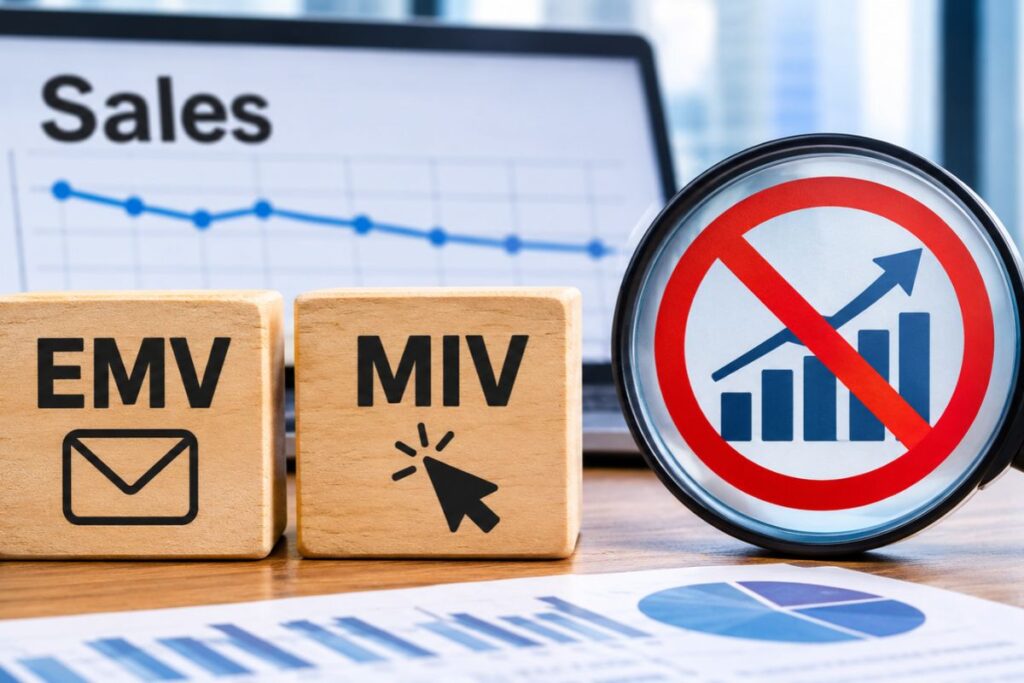
Do EMV and MIV predict sales? Public financial filings from 2025 and 2026 show they do not. Across major fashion and beauty companies, top-ranked Earned Media Value (EMV) and Media Impact Value (MIV) brands frequently post flat or declining comparable sales, or rely on heavy marketing spend and acquisitions rather than organic buzz, to grow.
Do Top EMV and MIV Rankings Predict Sales in Public Filings?
Public financial statements from 2025 and 2026 show no consistent link between topping a fashion visibility leaderboard and posting strong quarterly revenue growth.
Earned Media Value (EMV) is a metric that estimates the dollar equivalent of unpaid social media mentions, while Media Impact Value (MIV) is a proprietary score from analytics firm Launchmetrics that assigns a monetary value to media placements across print, online, and social channels.
During Paris Fashion Week in late September and early October 2026, Launchmetrics’ Fashion Week Visibility Index ranked Christian Dior first with a 13.5% share of total MIV, followed by Chanel at 13.3%, Saint Laurent in fourth at 7.4%, Louis Vuitton in fifth at 6.6%, and Balenciaga in tenth at 2.8%. Yet the parent companies behind those runway leaders reported weak commercial performance in the surrounding quarters.
At Kering S.A. (Kering), which owns Saint Laurent and Balenciaga, full-year 2025 revenue fell 13% as reported, and 10% on a comparable basis, from €16.87 billion to €14.68 billion, according to the group’s 2025 financial results release. That decline continued into late 2026: in its third-quarter 2026 revenue report, Kering reported that sales from its directly operated retail network, including e-commerce, dropped 3% on a comparable basis to €3.35 billion.
At LVMH Moët Hennessy Louis Vuitton (LVMH), which owns Christian Dior and Louis Vuitton, organic revenue growth, sales growth stripped of currency swings and acquisitions, reached 2% across the first nine months of 2026, while reported revenue slipped from €58.09 billion to €57.15 billion, according to the company’s Q3 2026 financial publication.
Conglomerate accounting further obscures the link between luxury brand buzz and sales. While Kering breaks out major houses such as Gucci and Yves Saint Laurent individually, LVMH bundles Christian Dior and Louis Vuitton inside its broader Fashion & Leather Goods division in its half-year and quarterly filings. Because LVMH reports only division-level totals, outside claims that a single brand’s Fashion Week visibility drove quarterly revenue cannot be verified from public records.
Why Do Mass Beauty Brands Convert Buzz Faster Than Luxury Houses?
Accessible beauty brands convert social media spikes into short-term revenue faster than heritage luxury houses because their lower price points and direct online checkouts remove purchase friction, though acquisitions and regional demand still outweigh organic buzz.
On CreatorIQ’s September 2026 U.S. beauty leaderboard, The Estée Lauder Companies Inc. (Estée Lauder) brand MAC ranked second with $82.9 million in EMV, e.l.f. Cosmetics ranked third with $72.3 million, and e.l.f.-owned Rhode Skin led U.S. skincare with $57.2 million.
For e.l.f. Beauty, Inc. (e.l.f. Beauty), high CreatorIQ EMV coincided with rapid top-line expansion. In its Q1 fiscal 2027 U.S. Securities and Exchange Commission (SEC) filing for the quarter ended June 30, 2026, e.l.f. Beauty reported net sales growth of 36% to $479.4 million.
Dealmaking, however, drove most of that headline gain. In the company’s Q4 fiscal 2026 earnings transcript, CFO Mandy Fields stated that the acquisition of Rhode contributed $113 million, roughly 34 percentage points, of e.l.f. Beauty’s 35% quarterly net sales growth, while management projected underlying organic net sales growth at 4% to 5%.
Estée Lauder’s financial results show how macro demand overrides social rankings when comparing Earned Media Value vs. revenue. Despite MAC holding the number-two U.S. beauty EMV spot, Estée Lauder posted 3% organic net sales growth for fiscal 2026, with reported net sales rising 5% from $14.33 billion to $15.05 billion, according to its August 2026 SEC filing. Regional demand shifts, including a softer environment in China noted by LVMH in its Q3 2026 release, move quarterly revenue far more than a weekend spike in online mentions.
How Does Chasing Top Buzz Rankings Affect Profit Margins?
Generating top-ranked media visibility often requires heavy marketing outlays that compress operating margins, even when top-line sales grow.
Public filings record these costs under selling, general, and administrative expenses (SG&A), a company’s overhead and operating costs outside direct manufacturing, and dedicated marketing budgets. At e.l.f. Beauty, adjusted SG&A jumped to 67% of net sales in Q4 fiscal 2026, up from 52% a year earlier, according to its Q4 fiscal 2026 earnings call. Marketing and digital investment alone climbed to 31% of net sales for the quarter, up from 23% the prior year, finishing the full fiscal year at 24% of net sales.
At Estée Lauder, full-year gross margin rose from 74.0% to 75.5% in fiscal 2026, while adjusted operating margin expanded from 8.0% to 11.2%, per its August 2026 SEC filing. That profit recovery came primarily from its Profit Recovery and Growth Plan, a restructuring program that cut a net 10,000 positions to generate $1.2 billion in gross benefits, while the filing noted that higher consumer-facing marketing investments partially offset operating income gains in both skin care and fragrance.
At Kering, lower sales combined with fixed brand-building costs reduced profitability: recurring operating margin fell 3.4 percentage points in 2025, from 14.5% to 11.1%, with Gucci’s recurring operating margin dropping 4.9 points to 16.1%, according to Kering’s 2025 financial results release.
How Are Media Impact Value and Earned Media Value Calculated?
Neither MIV nor EMV tracks checkout data; both calculate dollar-equivalent estimates of media exposure based on reach and engagement.
According to Launchmetrics’ MIV methodology guide, the Launchmetrics MIV methodology multiplies an advertising or activation value equivalent by source-based factors, such as audience reach, and content-based factors like likes, shares, and media format.
CreatorIQ’s EMV documentation explains that CreatorIQ EMV estimates the value of third-party social engagement based on platform, creator, and interaction volume. CreatorIQ attributes the full EMV of a post to every brand tagged in it: if a creator shares an outfit tagging Coach, H&M, and Benefit Cosmetics and generates $500,000 in EMV, all three brands collect $500,000 in EMV from that single post.
Both systems reward posting frequency and celebrity reach rather than purchase intent. A single post from a global pop star at a runway show produces a large dollar-equivalent score, regardless of whether viewers buy anything.
How Do Measurement Vendors Defend EMV and MIV?
Measurement firms argue that MIV and EMV were built to benchmark long-term brand awareness and cultural desirability, not to measure immediate quarterly sales.
In its guide to MIV, Launchmetrics frames Media Impact Value in fashion and beauty as a benchmark for share of voice and brand equity rather than checkout attribution. CreatorIQ makes a similar case in its EMV overview, stating that earned media builds consumer reputation over time, and pairing EMV with EMV Retention to track sustained creator advocacy instead of one-off spikes.
For heritage luxury houses, that upper-funnel argument carries weight: staying at the center of cultural conversation helps protect full-price sell-through and support annual price increases even when unit volumes stay flat.
Measurement vendors are already rolling out new proprietary scores before resolving the sales-correlation gap. In its 2026 Data-Powered Yearbook and Fashion Week Visibility Index, Launchmetrics introduced AI Visibility (AIV), a metric tracking how often brands appear in generative AI search answers from ChatGPT, Claude, Gemini, and Perplexity.
Until conglomerates report brand-level sales more transparently, or measurement vendors tie their scores to audited checkout data, investors and marketers have no public way to tell whether a top visibility ranking is building future pricing power or simply recording how much a company spent to be seen.
Frequently Asked Questions
Do high EMV and MIV rankings guarantee higher quarterly sales?
No. Public financial filings from 2025 and 2026 show that top-ranked visibility leaders frequently post flat or declining sales; for example, Kering’s Saint Laurent and Balenciaga ranked in the top ten of Launchmetrics’ Paris Fashion Week MIV index while Kering’s full-year 2025 comparable revenue fell 10% and Q3 2026 direct retail sales dropped 3%.
Why did e.l.f. Beauty’s sales grow 35% to 36% alongside top EMV rankings?
Acquisitions drove almost all of that headline surge rather than organic social buzz alone, according to e.l.f. Beauty’s Q4 fiscal 2026 earnings transcript, its acquisition of Rhode contributed $113 million, roughly 34 percentage points, of its 35% quarterly net sales growth, while underlying organic growth was projected at 4% to 5%.
Can investors verify if Paris Fashion Week MIV drove Christian Dior’s sales?
No. Although Christian Dior ranked first in Launchmetrics’ Paris Fashion Week MIV index with a 13.5% share, parent company LVMH bundles Dior and Louis Vuitton inside its broader Fashion & Leather Goods division in quarterly filings, making single-brand revenue verification impossible from public records.
Does CreatorIQ split Earned Media Value when multiple brands are tagged in one post?
No. According to CreatorIQ’s EMV documentation, the platform attributes the full EMV of a post to every brand tagged in it, meaning if a single post tagging three brands generates $500,000 in EMV, each of the three brands receives $500,000 in credited EMV.