






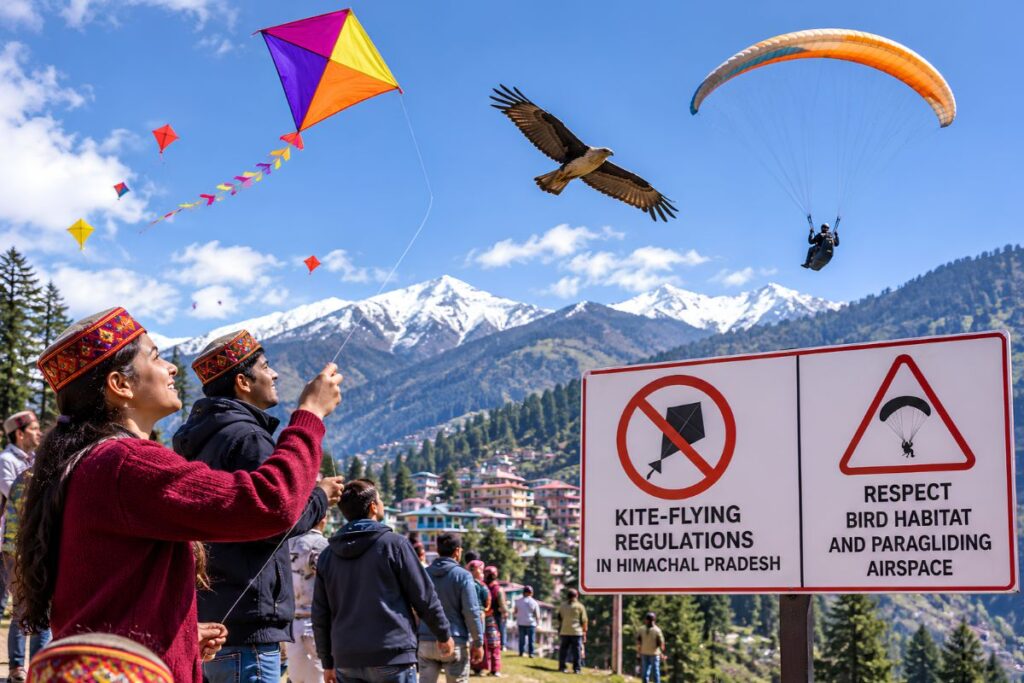
Kite-flying rules in Himachal Pradesh permit festivals only when flyers use biodegradable cotton thread away from restricted airspace and protected wetlands. National Green Tribunal orders ban synthetic and glass-coated kite string statewide, while state aviation regulations require formal safety clearances near paragliding corridors and wildlife sanctuaries like Pong Dam.
Key Finding: According to claritytimes.org‘s regulatory review, district tourism calendars in Himachal Pradesh promote winter and spring kite-flying events without publishing spatial buffer distances from Pong Dam’s Ramsar wetland boundaries or Bir-Billing’s registered paragliding landing corridors.
Where Do Seasonal Kites Meet Migratory Birds and Paragliders?
Winter and early spring bring two overlapping activities into Himachal Pradesh’s lower valleys: state-promoted cultural kite festivals and peak migratory bird arrivals along the Central Asian Flyway. Between November and March, more than 100,000 waterbirds across over 100 species gather along the shorelines and mudflats of Pong Dam Lake Wildlife Sanctuary, according to Himachal Pradesh Forest Department Wildlife Wing census data.
In the 2025–26 winter waterbird census, state wildlife teams recorded 1.24 lakh migratory birds across 115 species at the Kangra reservoir, down from a record 1,53,719 birds across 97 species the previous winter. Low-altitude foraging flights over exposed winter mudflats, tracked by the state’s Avian Monitoring and Bird Ringing Station at Nagrota Surian, place flocks directly inside the 100-to-300-foot elevation band where recreational kites operate.
A second spatial overlap occurs in the Kangra and Kullu valleys. In hubs such as Bir-Billing and Solang, where more than 300 licensed pilots operate in Bir-Billing and 445 in Kullu, according to Department of Tourism and Civil Aviation licensing figures, paragliders descend through fixed thermal and landing corridors.
Stray, non-biodegradable kite lines drift across valley winds and catch on trees, power lines, and open fields. For low-flying paragliders on final approach, an airspace already under scrutiny following tightened solo-flying safety conditions at Bir-Billing, thin translucent lines present an entanglement and canopy-slicing hazard. District tourism calendars list no published buffer distances separating kite events from active aero-sport landing zones.
What Do the NGT Order and State Adventure Rules Actually Say?
Three binding legal frameworks prohibit non-biodegradable kite strings and require safety protocols for organized sky-based leisure events in Himachal Pradesh.
First, the National Green Tribunal (NGT), India’s specialized environmental court, issued a nationwide directive in Khalid Ashraf vs. Union of India banning the manufacture, sale, storage, purchase, and use of synthetic and glass-coated manjha, an abrasive kite string typically made from nylon or coated with powdered glass. The tribunal’s order leaves traditional, uncoated cotton thread legal, but directs all Chief Secretaries, District Magistrates, and Superintendents of Police to enforce the synthetic ban within their jurisdictions.
Second, organized outdoor and aero-leisure activities fall under the Himachal Pradesh Miscellaneous Adventure Activities (Amendment) Rules, 2021 and the Himachal Pradesh Aero Sports Rules, 2022, notified by the Department of Tourism and Civil Aviation. Under these rules, registered operators must maintain documented Standard Operating Procedures (SOPs), third-party liability insurance, emergency evacuation arrangements, and certified equipment inspections before conducting activities in notified zones.
Protected wetlands carry a third layer of restriction. Pong Dam is both a notified Wildlife Sanctuary under the Wildlife (Protection) Act, 1972, and a Ramsar Wetland of International Importance, an internationally recognized wetland designated for conservation, where the Himachal Pradesh Forest Department Wildlife Wing restricts drones, unpermitted boats, and shoreline disturbances.
How Tourism Calendars Bundled Kites With Adventure and Wetlands
State and district tourism promotions frame kite-flying as part of a broader push to diversify visitor activities beyond congested hill stations like Shimla and Manali. Himachal Pradesh Tourism’s seasonal fairs and festival listings and district tourism roundups in Kangra, Bilaspur, and Hamirpur group spring and winter cultural festivities alongside reservoir boating, trekking, and aero-sports.
None of those promotional calendars specify thread-inspection rules, wetland buffer zones, or coordination protocols with local aviation marshals.
Why Do On-Paper Bans Struggle During Festival Weeks?
On-paper kite-string bans fail during peak festival weeks because illegal nylon spools visually resemble legal cotton rolls, while severed lines drift far outside municipal inspection zones into forest canopies and paragliding corridors.
In Kangra, district magistrates have issued targeted prohibitory orders banning the sale and use of nylon and glass-coated kite string ahead of peak kite-flying months in compliance with NGT directives, as documented in district-level administrative orders in Dharamsala. Across neighboring northern states, continuing court monitoring of synthetic manjha fatalities and pre-festival police raids seizing dozens of illegal spools show that underground retail supply persists despite periodic crackdowns.
Wildlife researchers have documented the biological mechanism behind avian injuries when synthetic string enters bird habitats. An ornithological study of kite-string entanglement in urban India found that larger soaring birds, particularly raptors such as black kites, accounted for nearly 70 percent of rescued victims, with more than 90 percent trapped after severed lines tangled in tree canopies at heights between 6 and 46 meters. Once a bird’s wing or leg catches in translucent nylon filament, the line tightens and slices into tissue as the bird struggles.
Paragliding administrators face a parallel monitoring problem when informal flying expands near established aero-sport valleys. Under the Himachal Pradesh Aero Sports Rules, 2022, District Aero Clubs chaired by the District Tourism Development Officer oversee registered pilots, equipment airworthiness, and takeoff or landing site safety. Yet safety reviews at Bir-Billing have documented gaps in real-time corridor monitoring and ground communication across the broader valley.
District administrators maintain that periodic market checks and public advisories are issued ahead of local festivals to deter synthetic thread sales, treating kite-flying as a plastic-control and public-safety compliance issue. Cultural event organizers also note that traditional kite-flying with plain cotton string remains a low-cost community gathering that draws domestic visitors to lower-elevation towns without requiring permanent construction.
What Does Legal Kite-Flying Compliance Look Like for Himachal Festivals?
Aligning Himachal Pradesh’s kite-flying promotions with existing wildlife and aviation laws requires enforcing three statutory rules before events are added to official tourism calendars:
- Mandatory cotton-only checkpoints: Event organizers and municipal inspectors verify biodegradable, uncoated cotton thread at entry points, matching the NGT’s existing legal distinction between legal cotton and banned synthetic manjha.
- Fixed spatial buffers: District Magistrates publish explicit no-kite radius limits around Pong Dam’s Ramsar boundaries, Gobind Sagar bird foraging zones, and registered paragliding landing corridors.
- Pre-event safety sign-offs: Any state-backed kite festival near active flying zones clears its schedule and site coordinates with local District Aero Clubs and Wildlife Wing officers under the state’s aero-sport and adventure safety framework.
Until district calendars pair promotional dates with those enforceable boundaries, kite-flying events will continue to operate in the gap between tourism marketing and environmental law.
Frequently Asked Questions
Is kite flying legal in Himachal Pradesh?
Yes, traditional kite flying is legal in Himachal Pradesh only when using plain, uncoated biodegradable cotton thread. Under binding National Green Tribunal directives enforced by District Magistrates, manufacturing, selling, storing, or flying kites with nylon, synthetic, or glass-coated manjha is strictly prohibited across the state.
Why are kite festivals restricted near Pong Dam in Kangra?
Pong Dam is both a notified Wildlife Sanctuary and a Ramsar Wetland of International Importance that hosts over 100,000 migratory birds along the Central Asian Flyway between November and March. Low-altitude foraging flights place waterbirds and raptors directly in the 100-to-300-foot elevation band where kites fly, creating severe entanglement risks from stray lines.
How do kite strings affect paragliding zones like Bir-Billing?
Severed synthetic kite lines drift across valley winds and snag on trees, power lines, and open fields near paragliding landing corridors in Kangra and Kullu. For low-flying pilots on final approach, regulated under the Himachal Pradesh Aero Sports Rules, 2022, translucent nylon string poses a canopy-slicing and line-entanglement hazard.
Who enforces kite-string rules at local festivals in Himachal Pradesh?
The National Green Tribunal makes Chief Secretaries, District Magistrates, and Superintendents of Police personally responsible for enforcing the ban on synthetic manjha. Within notified aero-sport valleys, District Aero Clubs chaired by the District Tourism Development Officer oversee airspace safety and landing-corridor compliance.