






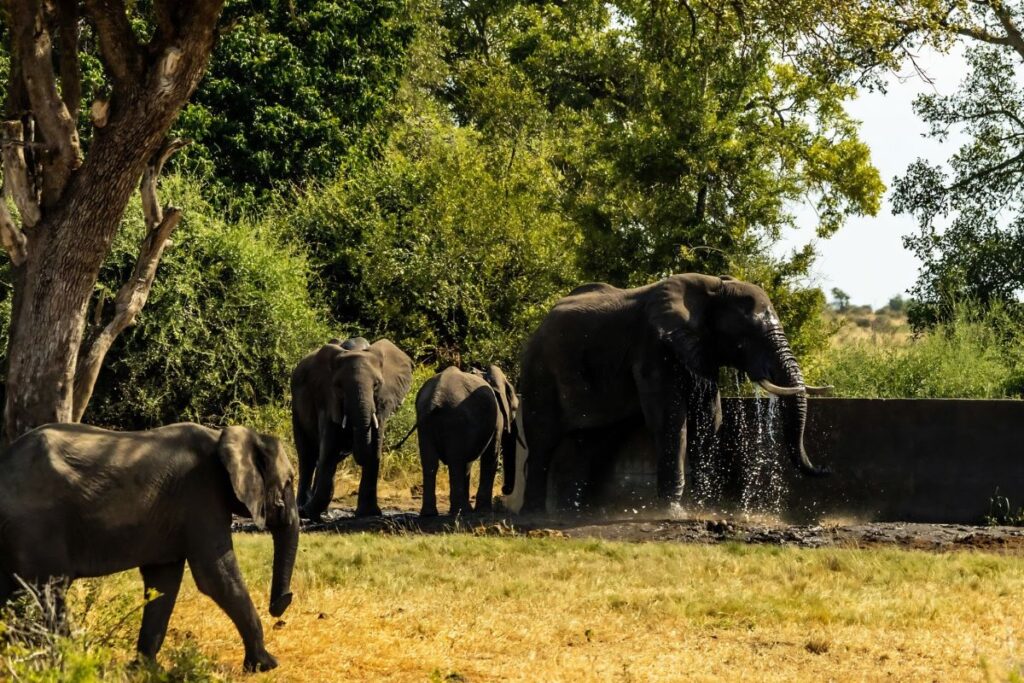
African safari parks and private concessions are not untouched wilderness; they are actively engineered landscapes built to match European and Asian tourist expectations. Across Kenya’s Laikipia plateau and South Africa’s Greater Kruger area, reserves bury power lines, zone human settlements out of sightlines, and pump artificial waterholes to concentrate wildlife, manufacturing a pre-industrial aesthetic that erases contemporary African life.
How Do Safari Lodges Hide Power Lines and Modern Infrastructure?
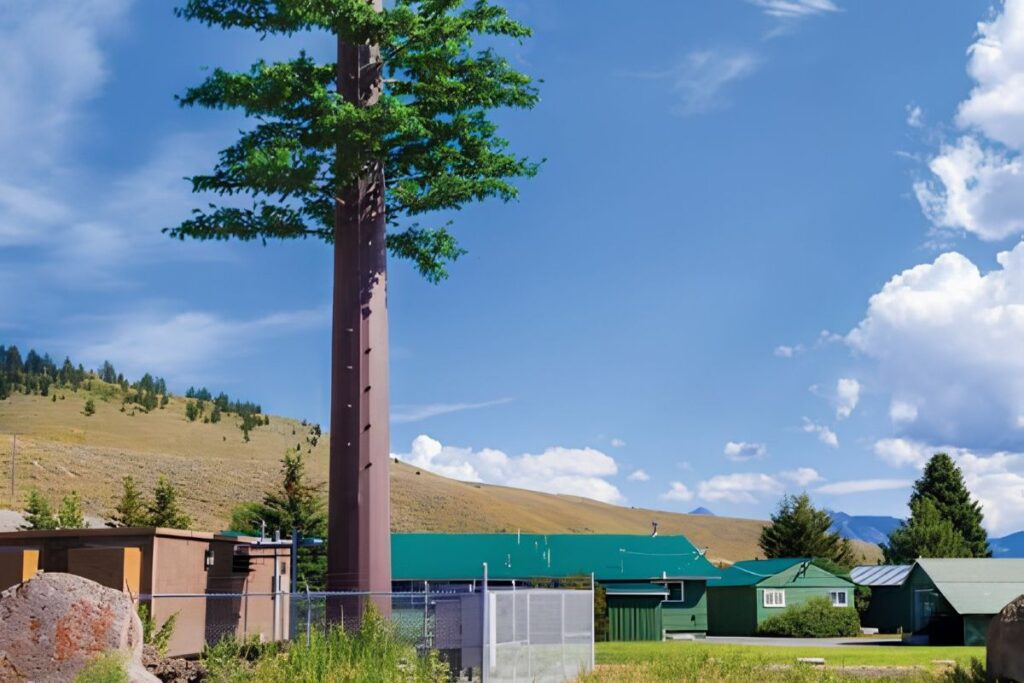
Luxury safari lodges hide modern utility grids by burying high-voltage transmission cables underground and disguising telecom towers as native trees. When a guest steps onto a lodge veranda in East or Southern Africa, the uninterrupted savannah horizon is the product of deliberate civil engineering rather than an absence of infrastructure.
To preserve a pre-industrial visual field, energy and lodge developers across regions like Kenya’s Laikipia County increasingly route high-voltage power lines underground rather than stringing overhead cables across conservation corridors. In its environmental impact addendum for a 16.5-kilometer underground 132-kilovolt transmission line in Laikipia County, the state-owned Kenya Electricity Transmission Company (KETRACO) documented how burying transmission infrastructure avoids visual intrusion and bird collision risks across sensitive wildlife rangelands.
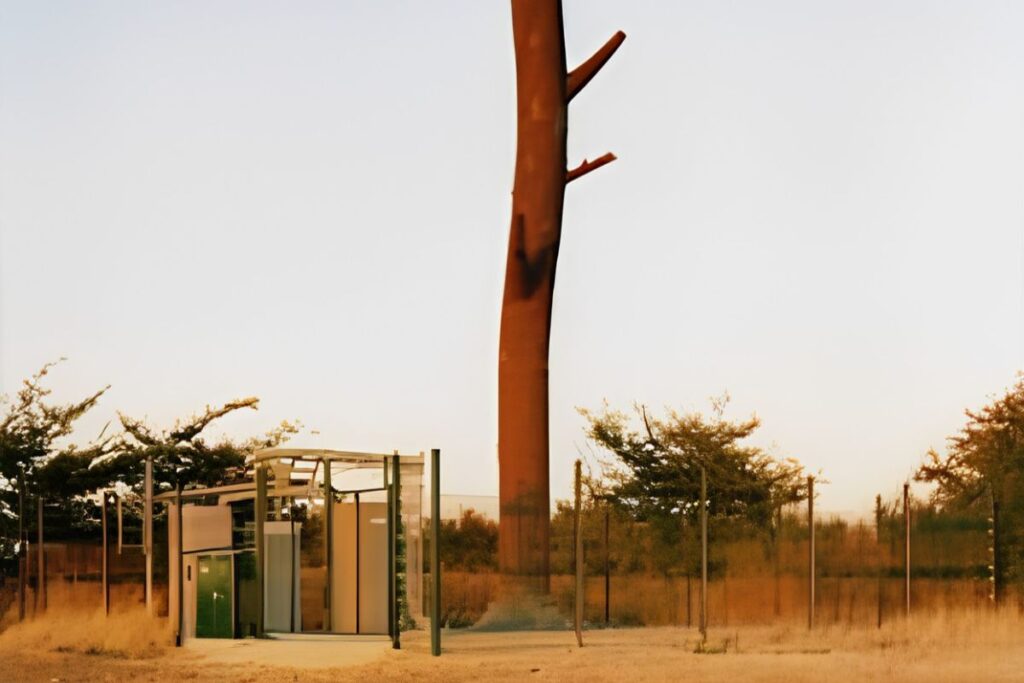
Communications infrastructure undergoes similar visual disguise across Southern and East Africa. As documented in photojournalist Dillon Marsh’s architectural series on South African cell towers, telecom operators encase metal masts in fiberglass bark and synthetic fronds so mobile coverage reaches remote luxury lodges without breaking the illusion of an unbuilt horizon.
Lodge operators and conservation planners point out that visual engineering serves ecological goals alongside aesthetic ones. Burying electrical cables eliminates electrocution deaths among raptors and giraffes, while removing legacy cattle fencing restores seasonal migration routes for elephants and zebras.
Why Are Villages and Roads Absent From Safari Sightlines?
Villages, livestock herds, and public roads are absent from safari sightlines because park authorities and private conservancies enforce “viewshed” buffer zones and perimeter barriers that exclude human settlement. A viewshed is the entire geographical area visible from a fixed vantage point, such as a wilderness camp or lodge deck.
In its official Kruger National Park Revised Zonation Plan, South African National Parks (SANParks) conducted formal viewshed visibility analysis to establish a Peripheral Development Zone, restricting buildings, roads, and external human infrastructure along park boundaries so they do not intrude on tourist sightlines.
In private and community conservancies bordering national parks, physical barriers and land-use boundaries enforce a similar separation between wildlife zones and local settlement. An Environmental Impact Assessment for Ole Naishu Ranch in Laikipia filed with Kenya’s National Environment Management Authority (NEMA) details the construction of a 15-kilometer, 4-by-8-foot boundary trench, costing Ksh 16.92 million, alongside electric fencing to keep neighboring pastoralists from entering the ecotourism and ranching zone for grazing or firewood.
“Across Laikipia County in Kenya, pastoralist communities have long lived with an uncomfortable reality: the land their livelihoods depend on has no formal map,” the Wyss Academy for Nature noted in a 2026 rangeland governance report, describing participatory mapping across 15 villages in Koija and Murupusi to negotiate where grazing zones end, and wildlife corridors begin.
For neighboring pastoralists, hard boundaries and visual buffer zones reshape daily movement. Herders who once moved livestock across open rangeland during dry spells must route around trenched or fenced conservation perimeters, while landowners supporting roughly 70 percent of Kenya’s wildlife receive less than 0.5 percent of national tourism revenue, according to a 2026 analysis by the International Fund for Animal Welfare (IFAW).
Why Do Safari Operators Sell an Unbuilt Aesthetic to Foreign Buyers?
Over the past three decades, wildlife tourism in East and Southern Africa has pivoted toward a low-volume, high-cost business model aimed at affluent travelers from Europe and Asia. According to a 2026 sustainability framework published in Frontiers in Sustainability, destination managers actively curate “landscape imagery”, controlling variables like openness, naturalness, and visual harmony, because foreign tourists equate the absence of visible modern infrastructure with authenticity.
Kenya’s national tourism strategy, cited in the 2026 IFAW ecological review, aims to double international arrivals from 2.4 million to 5 million visitors staying 12 to 14 nights and generating $9 billion annually. Conservation managers argue that catering to foreign expectations of unspoiled scenery is what makes private wildlife protection financially viable, generating the lease payments and anti-poaching budgets needed to keep savannah from being subdivided into farms.
How Do Reserves Engineer Reliable “Big Five” Wildlife Sightings?
Private reserves engineer reliable wildlife sightings by drilling solar-powered boreholes and pumping artificial waterholes year-round to anchor herds, and the predators that hunt them, along predictable game-drive loops. Because many European and Asian visitors book tight, multi-park itineraries lasting only a few days, lodges face commercial pressure to deliver guaranteed sightings of lions, leopards, elephants, rhinos, and buffalo.
Manipulating permanent water availability reshapes animal movement across vast territories. By 1980, South Africa’s Kruger National Park alone had constructed roughly 300 borehole-fed waterholes and 50 reservoirs so wildlife remained within 5 kilometers of permanent water, according to a peer-reviewed Kruger water-provisioning study.
In neighboring private reserves within the Associated Private Nature Reserves (APNR), a consortium of privately owned conservation areas sharing an unfenced border with Kruger National Park, high densities of pumped waterholes remain central to tourism operations. A 2026 Africa Geographic investigation into APNR elephant management found that year-round artificial water keeps elephants anchored near prime tourist viewing circuits rather than migrating long distances during dry months, with landowners resisting waterhole closures because guests expect reliable wildlife sightings.
What Are the Ecological Costs of Staging a Pre-Industrial Landscape?
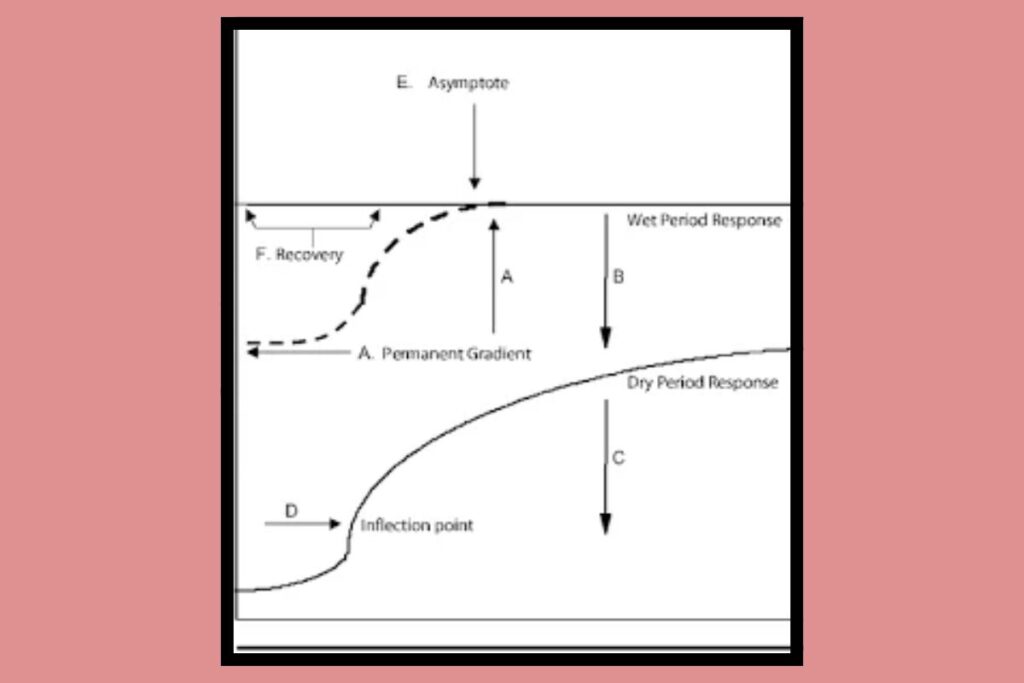
Staging a pre-industrial landscape concentrates herbivores around artificial waterholes, causing localized soil compaction and vegetation loss known as the “piosphere” effect. The piosphere effect is the radial zone of ecological degradation that forms around a permanent water point as animals repeatedly trample and overgraze native grasses.
In a long-term Kruger piosphere study published through the International Grassland Congress, researchers measuring transects extending 5 kilometers from artificial waterholes found that sustained herbivore pressure pushed surrounding grasslands past structural ecological thresholds. Similarly, the 2026 Africa Geographic APNR report documented how elephants clustered around permanent tourist waterholes strip nearby marula and knobthorn trees, prompting reserve managers in 2026 to debate population culls to undo damage caused by artificial water provisioning.
At the same time, high-end tourism remains one of the few economic engines capable of funding large-scale habitat preservation across sub-Saharan Africa. As international demand from European and Asian markets continues to expand, reserve managers face an ongoing contradiction: the physical engineering and spatial exclusions required to sell an “untouched” landscape steadily alter the wild ecosystems visitors pay to see.
For visual reporting on how physical barriers separate conservation zones from surrounding communities in Kenya, see Kenyan authorities erect electric fences to protect forests and animal life, which documents how conservation agencies deploy perimeter fencing to control human access.
Frequently Asked Questions
Are African safari parks actually untouched wilderness?
No. Across Kenya’s Laikipia plateau and South Africa’s Greater Kruger area, private reserves and park agencies actively manage viewsheds by burying high-voltage power lines, disguising cell towers as trees, enforcing buffer zones that exclude human settlements, and pumping artificial waterholes to concentrate wildlife along tourist routes.
How do safari lodges hide power lines and cell towers from tourists?
In regions like Kenya’s Laikipia County, developers bury high-voltage transmission cables underground, such as the 16.5-kilometer underground 132-kilovolt line documented by the Kenya Electricity Transmission Company (KETRACO). Telecom operators across Southern and East Africa also encase mobile masts in fiberglass bark and synthetic fronds so they resemble native trees.
Why do private safari reserves maintain artificial waterholes?
Private reserves within South Africa’s Associated Private Nature Reserves (APNR) and Kruger National Park pump borehole-fed waterholes year-round to keep herbivores and predators within easy reach of game-drive loops. This spatial concentration helps lodges deliver reliable “Big Five” sightings for European and Asian travelers on tight, multi-day itineraries.
What is the piosphere effect around safari waterholes?
The piosphere effect is a radial ring of soil compaction and vegetation loss caused by animals repeatedly trampling and overgrazing native grasses around permanent artificial water points. Long-term transect studies in Kruger National Park show this sustained grazing pressure can push surrounding grasslands past structural ecological thresholds and strip nearby marula and knobthorn trees.