






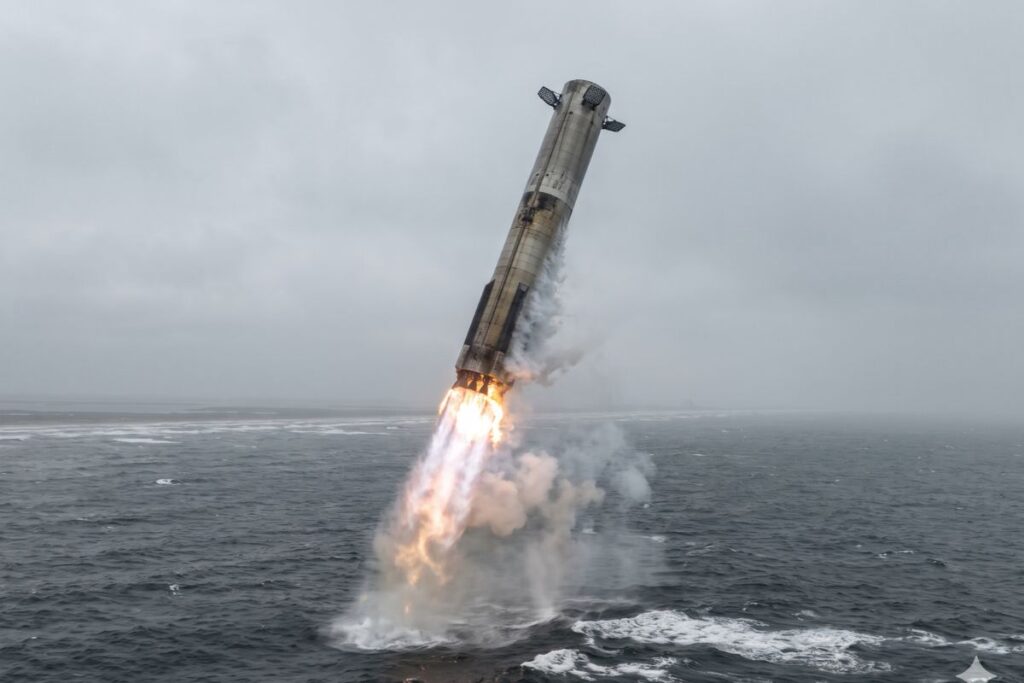
Losing one engine on SpaceX’s Super Heavy V3 booster prevented a landing because the upgraded rocket separates higher and faster, leaving razor-thin fuel reserves. Even while carrying 26 Starlink V3 satellites, around 52 metric tons, roughly half of Starship’s 100-ton target, that single dropout forced adjacent engines to steer off-center, burning extra fuel and erasing the return margin.
Why Did the Starship Flight 15 Booster Abort Its Landing?
The SpaceX Super Heavy V3 landing margin vanished during Flight 15 because a single Raptor engine failed to relight during boostback while the rocket was already operating near the edge of its return propellant budget.
On its Nov. 13–14, 2026 test flight, SpaceX’s Version 3 Super Heavy booster (Booster 22) lost one of its 33 Raptor engines during the boostback burn, the retrograde firing maneuver that reverses the rocket’s direction toward the Starbase launch tower in Boca Chica, Texas. Automated flight computers immediately diverted the 72.3-meter stage to an offshore Gulf of Mexico splashdown rather than attempting a mechanical tower catch.
According to SpaceX’s Starship Flight 15 mission timeline, 32 of 33 engines relit at T+00:02:26 for boostback, and the offshore divert was triggered prior to the scheduled T+00:06:35 catch. Following the mission, SpaceX CEO Elon Musk confirmed on X that the booster ran slightly low on landing propellant due to minor engine underperformance, noting that cutting the booster’s engines roughly one second earlier during ascent would have preserved enough fuel for recovery.
Yet the vehicle was flying well below its advertised 100-plus metric ton payload ceiling. As documented in SpaceX’s Federal Communications Commission (FCC) launch authorization filings for Starlink V3 and companion Starlink V3 hardware specifications, each V3 satellite weighs approximately 2,000 kilograms, putting the 26-satellite batch at roughly 52 metric tons, or just over half of the rocket’s marketed capacity.
A rocket carrying roughly half its design load still exhausted its return propellant after losing one engine out of 33. That shortfall shows how the Version 3 architecture trades booster fuel reserves for upper-stage performance.
How Did Version 3 Upgrades Tighten Super Heavy’s Recovery Math?
Stretching the Version 3 booster and installing higher-thrust Raptor 3 engines pushed stage separation to higher velocities, dramatically increasing the propellant required to reverse course back to Texas.
Earlier Block 1 Super Heavy boosters survived engine anomalies and still returned to the launch mount on three separate flights: Flight 5 in October 2024, Flight 7 in January 2025 (which succeeded despite an engine failing to relight during boostback), and Flight 8 in March 2025. Version 3 changes the underlying physics of that return trip.
According to SpaceX’s published Starship vehicle specifications and historical Super Heavy engineering comparisons, the Block 3 booster was stretched from 71 meters to 72.3 meters, increasing propellant capacity by 250 metric tons, from 3,400 metric tons on earlier blocks to 3,650 metric tons. Replacing Raptor 2 with Raptor 3 also boosted sea-level thrust per engine from 230 metric tons-force to 250–280 metric tons-force and raised vacuum specific impulse, a measure of how efficiently a rocket engine converts propellant into thrust, to 350 seconds.
More propellant and higher thrust allow the booster to carry the upper stage higher and faster before hot-staging, the separation technique where Starship’s upper-stage engines ignite while still attached to the booster. As SpaceX’s Starship Flight 12 timeline and Flight 15 timeline show, hot-staging occurs roughly two minutes and 21 seconds into flight, after which the booster must execute an immediate retrograde burn.
Every extra meter per second of forward speed at separation gives the upper stage a head start toward orbit, but forces the booster to burn substantially more propellant to cancel its momentum and fly back to Starbase. Operating at higher staging energy pushes the V3 booster closer to the edge of its return-to-launch-site envelope than Block 1 ever flew.
Why Does Losing 1 of 33 Engines Cost More Than 3% of Fuel?
Losing one Raptor engine during a boostback burn triggers asymmetric thrust gimbaling and extends burn duration, multiplying propellant consumption well beyond the raw 3.03% thrust drop.
When one Raptor fails to ignite during a high-thrust boostback burn, the remaining 32 active engines no longer push symmetrically through the rocket’s center of mass. To keep the booster from tumbling, neighboring engines in the inner gimbal rings must swivel their nozzles to steer the thrust vector back through the centerline.
As detailed in Embry-Riddle Aeronautical University’s aerospace rocket performance curriculum and standard orbital delta-v budget mechanics, angling engine nozzles wastes propellant because a portion of the exhaust pushes sideways rather than directly along the flight path, a steering penalty engineers call cosine loss. At the same time, lower net thrust lengthens the burn duration, forcing the booster to fight Earth’s gravitational pull for extra seconds, known as gravity drag.
Combined, cosine losses and gravity drag turn a 3.03% thrust deficit into a multi-ton propellant shortfall that consumes the landing reserve, leaving the guidance system no choice but to divert offshore.
How Much Payload Does Reusable Starship V3 Lose to Guarantee Recovery?
Preserving enough booster propellant reserve to survive a single boostback engine-out on Super Heavy V3 requires cutting an estimated 15 to 30 metric tons of usable upper-stage payload below SpaceX’s 100-ton benchmark.
Holding back extra booster fuel at stage separation directly reduces the velocity Super Heavy imparts to the upper stage, shrinking the cargo Starship can haul to low Earth orbit. Applying the Tsiolkovsky rocket equation to V3’s 3,650-metric-ton first-stage propellant load and 1,600-metric-ton upper-stage propellant load, cutting booster engine burn one to two seconds earlier to preserve an engine-out reserve reduces separation velocity by roughly 40 to 80 meters per second, translating to that 15-to-30-ton payload reduction.
This tradeoff mirrors the operational record of SpaceX’s Falcon 9. According to published Falcon 9 payload performance specifications, returning a booster to the launch site or an offshore drone ship reduces maximum low-Earth-orbit capacity by roughly 23% compared to flying expendable, dropping payload from 22,800 kilograms to 17,500 kilograms.
For Starship, a 15-to-30-ton recovery penalty alters mission math for both internal Starlink deployment and NASA’s Artemis lunar lander, which depends on repeated orbital tanker flights to refuel in Earth orbit. Lower payload per tanker flight forces SpaceX either to accept occasional booster losses or to launch additional tankers per lunar mission.
What SpaceX Can Fix Before Flight 16, and What It Can’t
SpaceX can adjust engine cutoff timing, Raptor 3 chamber pressure, and structural dry mass before Flight 16, but the physical propellant tank volume of the 72.3-meter Version 3 airframe is fixed.
Following Flight 15, Musk stated that SpaceX is rolling out Raptor V3.2 performance improvements alongside flight software updates that trigger main engine cutoff roughly one second earlier. Early production rocket engines typically operate at conservative chamber pressures until flight data validates hardware durability; raising Raptor 3 thrust toward its 280-to-300 metric tons-force design ceiling reduces gravity losses during both ascent and boostback.
Adjusting the staging profile offers a second lever. Shifting a fraction of the orbital velocity workload from Super Heavy’s 33 engines onto the Ship’s six engines preserves booster return fuel without hardware changes.
Shaving dry weight from the booster’s stainless-steel airframe, grid fins, and aft heat shielding also lowers the propellant needed to decelerate the empty stage before tower capture. Until Raptor V3.2 thrust climbs or structural mass drops, SpaceX faces a direct choice on heavy missions: push for maximum payload near 100 metric tons, or hold back enough propellant to survive an engine-out and bring the booster home.
Frequently Asked Questions
Why did the SpaceX Super Heavy V3 booster fail to land on Flight 15?
During the Flight 15 boostback burn on Nov. 13–14, 2026, one of Booster 22’s 33 Raptor engines failed to relight, forcing adjacent engines to gimbal off-center and burn extra fuel. Because the stretched V3 booster separates at higher velocity with tighter fuel margins, that single engine-out exhausted its landing reserve and triggered an automated splashdown in the Gulf of Mexico.
How much payload was Starship Flight 15 carrying when the booster aborted?
Starship Flight 15 carried 26 Starlink V3 satellites weighing roughly 2,000 kilograms each, for a total payload of about 52 metric tons. That load represents just over half of SpaceX’s advertised 100-plus metric ton reusable capacity, showing that V3’s booster propellant margins were already tight, well below maximum cargo weight.
How much payload does Starship V3 lose to guarantee a booster catch?
Based on Tsiolkovsky rocket equation mass-fraction modeling for V3’s 3,650-metric-ton booster, holding back enough fuel to survive a single boostback engine-out cuts separation velocity by 40 to 80 meters per second. That velocity reduction translates to an estimated 15 to 30 metric tons of lost upper-stage payload capacity below the 100-ton mark.
How is Super Heavy Version 3 different from Version 1 boosters that landed successfully?
Super Heavy Version 3 was stretched from 71 meters to 72.3 meters to hold 3,650 metric tons of propellant, 250 metric tons more than Block 1, and upgraded from Raptor 2 to Raptor 3 engines. While those upgrades boost upper-stage performance, they push stage separation to higher speeds that require substantially more boostback fuel to return to Starbase.