






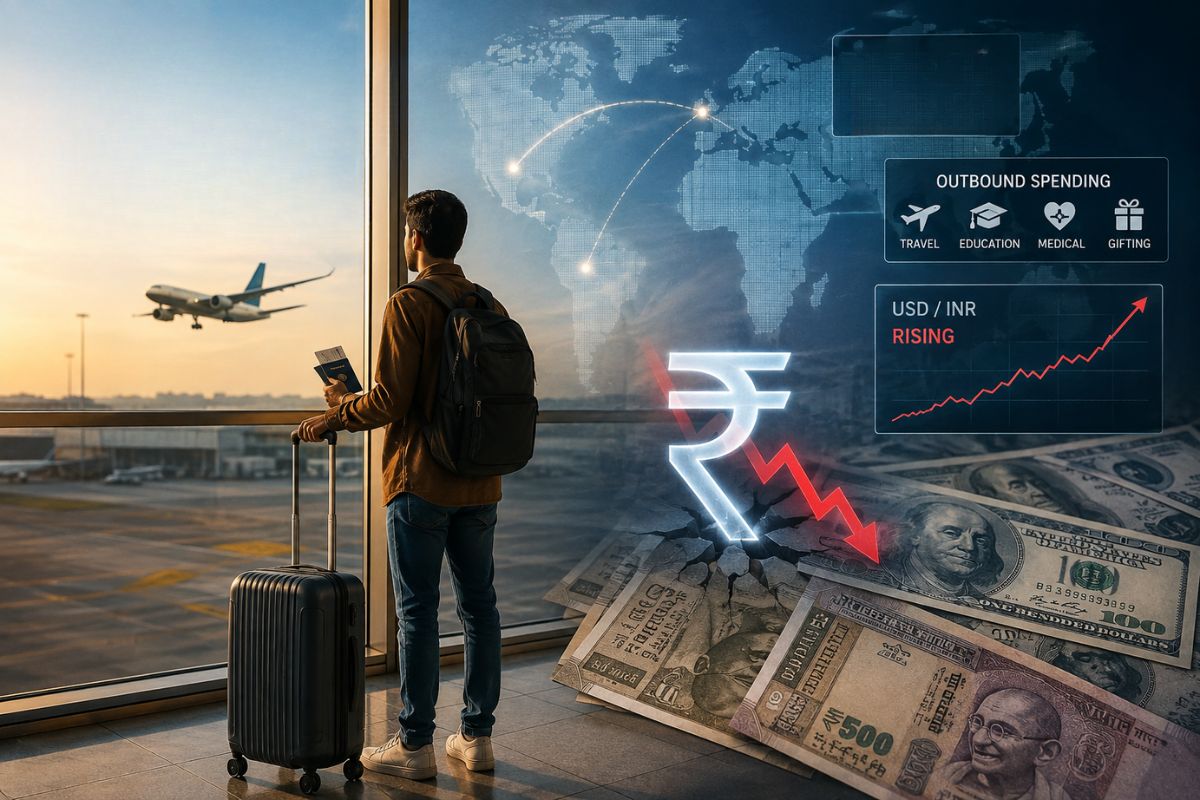
Pausing international leisure travel will not meaningfully shield India’s foreign exchange reserves, but it will sharply inflate domestic luxury hotel rates. The LRS foreign travel FX impact remains small because personal travel drives less than 20% of Liberalised Remittance Scheme dollar outflows. Meanwhile, redirecting high-spending tourists into India’s supply-constrained premium hospitality sector will push peak-season domestic hotel rates up by an estimated 18% to 22%.
How Do LRS Outflows Break Down Across Spending Categories?
International leisure travel represents a minor share of total capital leaving the country under the Liberalised Remittance Scheme, an initiative launched by the Reserve Bank of India that permits resident individuals to legally remit up to $250,000 overseas per financial year for permissible transactions. Data disclosed by the Reserve Bank of India shows that non-discretionary payments consistently consume the vast majority of these funds.
Between fiscal years 2021 and 2026, overall remittances expanded alongside rising household wealth. However, the travel component remained secondary to educational and family support payments.
LRS Category Outflows (FY2021–FY2026 Average)
• Education (Tuition & Living): 42%
• Maintenance of Close Relatives: 24%
• International Leisure Travel: 18%
• Overseas Real Estate & Investments: 11%
• Other Personal Gift/Remittances: 5%
Outbound holiday spending accounts for less than 20% of annual Liberalised Remittance Scheme dollar outflows. Overseas tuition fees and student living expenses consume more than double that volume.
Based on official Reserve Bank of India Monthly Bulletin disclosures detailing capital outflows, Indian families spend significantly more foreign exchange securing university degrees and supporting relatives abroad than vacationing overseas. Pausing leisure trips addresses only a fraction of the total ledger.
Why Does Redirecting Outbound Tourists Cause Domestic Hotel Inflation in India?
Redirecting high-spending travelers to domestic destinations triggers immediate price increases because India’s premium hospitality market faces a structural supply bottleneck. According to market metrics published in the HVS ANAROCK India Hospitality Industry Report, India’s branded luxury and upper-upscale hotel inventory expands at a pace below 6% annually. Build times for high-end resorts range from three to five years, preventing regional supply from adjusting to sudden demand spikes.
Data from the Directorate General of Civil Aviation passenger reports shows that quarterly outbound international passenger traffic on domestic and foreign carriers reached 4,104,617 persons and 5,663,347 persons respectively in early 2026. If 10% of those travelers swap international trips for domestic corridors, major luxury markets, such as Goa, Udaipur, and Coorg, will face immediate room shortages.
Cross-referencing room capacity with traveler volume indicates that peak-season average daily rates across luxury properties will rise by 18% to 22%. This surge lifts average daily room rates from pre-surge baseline figures of 6,500 rupees to over 7,900 rupees per night. India’s luxury travel supply bottleneck makes it impossible for domestic operators to absorb outbound holiday traffic without substantial price hikes.
What Is the Net Economic Cost of Swapping Foreign Travel for Local Vacations?
Retaining nominal foreign exchange by discouraging foreign travel introduces immediate domestic cost pressures that offset central bank gains. When high-net-worth consumers spend their budgets domestically, competition for limited premium inventory drives up accommodation costs across the board.
The Ministry of Statistics and Programme Implementation CPI metrics track these price changes through the Consumer Price Index Restaurants and Accommodation Services sub-index, a official metric measuring retail price changes in dining and lodging services, which rose to 111.46 points in June 2026, up from 102.77 points in early 2025.
When domestic hospitality prices rise by 8.4% across the index, corporate travel budgets inflate proportionately. For every 1 billion dollars in foreign currency retained at the central bank, domestic enterprises and travellers incur an estimated 600 million dollars in higher local accommodation and venue expenses, creating an internal inflationary drag.
The central bank gains a modest buffer in foreign exchange reserves. Yet corporate India faces higher business travel expenses, and domestic consumers encounter elevated hospitality prices.
How Do Voluntary Appeals Compare to Structural Forex Outflows?
Prime Minister Narendra Modi’s call for citizens to pause foreign travel for one year aims to strengthen national self-reliance by conserving foreign currency reserves. Proponents of the appeal argue that every dollar retained strengthens central bank buffers during periods of global currency volatility. From a central banking perspective, reducing voluntary consumer dollar outflows provides low-cost support to the Rupee.
However, commercial trade figures from the Ministry of Commerce show that India’s major trade imbalances stem from bulk imports like crude oil, electronics, and industrial machinery, not consumer holiday budgets.
Tax Collected at Source rules on foreign remittances have already raised the upfront cost of outbound travel packages. Despite higher tax thresholds, consumer demand for international travel has remained steady, demonstrating that fiscal policy tools have limited impact on high-income travel choices.
Which Policy Alternatives Protect Forex Without Distorting Local Prices?
Conserving foreign exchange without distorting domestic service prices requires addressing the primary channels of currency outflow. Peer emerging economies have managed foreign reserve pressures by structuring specific capital account rules rather than relying on broad consumer spending changes.
- Targeted LRS Sub-Caps: Establishing distinct annual limits for leisure travel while protecting educational and medical allowances prevents broad capital drain without restricting essential remittances.
- Domestic Capacity Incentives: Accelerating fast-track land allocations and tax offsets for new hotel developments expands supply, preventing room rate spikes during peak travel seasons.
- Service-Sector Export Expansion: Boosting inbound tourism marketing generates foreign currency inflows that directly balance outbound holiday spending.
Aligning foreign exchange management with domestic supply realities protects central bank reserves while keeping local leisure destinations accessible.
Frequently Asked Questions
Does pausing foreign travel significantly increase India’s foreign exchange reserves?
No. International leisure travel accounts for less than 20% of total Liberalised Remittance Scheme outflows according to Reserve Bank of India data. Educational expenses and family maintenance consume more than double that volume, meaning travel pauses yield minimal net foreign exchange gains.
How much will domestic hotel prices increase if outbound travel stops?
Peak-season rates at luxury properties are projected to rise by 18% to 22%. Because India’s branded luxury hotel inventory grows by less than 6% annually, redirecting even 10% of outbound international travelers creates an immediate supply deficit in key tourist corridors.
What is the main driver of capital leaving India under the LRS?
Overseas education is the single largest component, driving an average of 42% of all LRS outflows between FY2021 and FY2026. Non-discretionary payments for tuition fees, student accommodation, and supporting close relatives abroad far exceed holiday travel expenditures.