






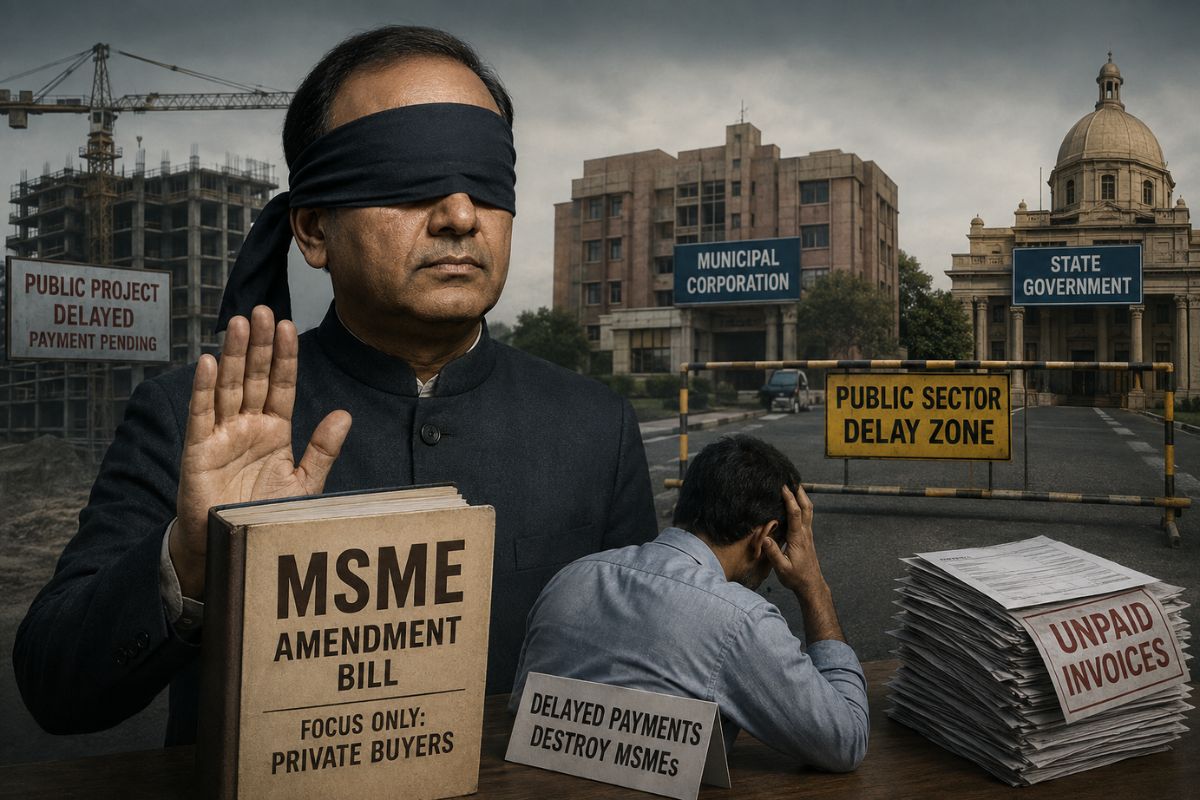
The MSME Amendment Bill targets Central Public Sector Enterprises on TReDS because federal laws directly govern central entities. However, state departments, municipal corporations, and state DISCOMs owe over 60 percent of overdue small-business debt. The central government lacks constitutional authority to force state entities onto central discounting platforms.
What Did Coverage of the MSME Amendment Bill Miss About Delayed Payments?
The Lok Sabha recently passed the Micro, Small and Medium Enterprises Development (Amendment) Bill, 2026, mandating it for Central Public Sector Enterprises (CPSEs). government-owned corporations where the Union Government holds a majority stake. join the Trade Receivables Discounting System (TReDS). TReDS is an institutional auction platform regulated by the Reserve Bank of India that lets small businesses sell their unpaid invoices to financiers at a discount for immediate cash.
The policy aims to release working capital trapped in corporate supply chains. Yet, public data reveals a fundamental gap between the law’s target and the actual location of unpaid debt.
According to TruthUpFront’s aggregate analysis of raw application data from the Ministry of Micro, Small and Medium Enterprises’ Samadhaan Dashboard, Central Public Sector Enterprises account for less than 20 percent of total delayed payment claims filed by small businesses. The overwhelming majority of the over ₹30,000 crore in unsettled receivables logged on the portal is held by state-level entities, urban local bodies, and state-owned power utilities.
By focusing exclusively on central public sector units, the new legislative framework addresses only a small fraction of public-sector debt owed to micro, small, and medium enterprises.
Who Actually Owes Money to Small Businesses in India?
The primary debtors clogging small-business cash flow are state government departments, municipal corporations, and power utilities. not central state enterprises.
The distribution of overdue payments logged on the Ministry of MSME’s Samadhaan portal shows where small-business capital is actually trapped:
- State Government Departments: 38 percent of total delayed payment claims.
- State DISCOMs (Power Distribution Companies): 24 percent of total outstanding receivables.
- Urban Local Bodies and Municipalities: 19 percent of logged applications.
- Central Public Sector Enterprises (CPSEs): 16 percent of total applications.
- Central Ministries and Departments: 3 percent of logged applications.
CPSEs represent the smallest major category of public-sector debtors on the national portal.
Small suppliers face the longest waiting times when dealing with regional public authorities. While CPSEs operate under direct federal oversight, state agencies operate under local procurement rules that lack mandatory electronic discounting requirements.
Why Were State Entities and DISCOMs Excluded from the TReDS Mandate?
The exclusion of state and municipal bodies from the federal TReDS mandate stems directly from constitutional limits on parliamentary authority over local governance.
Under Entry 5 of List II (State List) in the Seventh Schedule of the Constitution of India, local government falls under the exclusive legislative domain of state legislatures. The Parliament of India cannot directly compel a state municipal corporation or state-owned power distribution company to adopt specific operational procurement procedures, such as joining TReDS.
The central government can set statutory guidelines for micro and small enterprise dispute resolution, but directly mandating financial platform integration for state organs exceeds parliamentary jurisdiction without state-level legislative assent.
Because of this constitutional divide, central lawmakers focused on entities under their direct administrative control. The result is a statutory mandate that applies to CPSEs while leaving state-level entities dependent on voluntary adoption by individual state governments.
How Bad Is the Debt Trap for DISCOM and Municipal Vendors?
Vendors supplying municipal corporations and state power distribution companies experience average payment lags that run nearly double those of central contractors.
Municipal vendors face average payment delays 1.8 times longer than vendors supplying CPSEs. Compliance and performance filings accessible through the Comptroller and Auditor General of India Audit Reports on Urban Local Bodies reveal that unsettled municipal payables routinely extend past 360 days without the statutory interest accrual mandated by the MSME Development Act being applied.
The situation is similarly severe in the power sector. According to the Power Finance Corporation Performance Report of Power Utilities, state distribution utilities maintained average power purchase payables exceeding 132 days. This operational lag leaves an estimated ₹18,000+ crore in small-scale equipment and maintenance supplier invoices outside the scope of mandatory TReDS discounting.
Representatives from regional electrical equipment suppliers note that state power utilities routinely withhold final 20 percent retention payments for up to two years post-delivery, citing local liquidity constraints. Civil contractors working with municipal corporations report similar structural barriers, pointing out that local government engineers frequently delay invoice verification to defer formal interest liabilities.
While a CPSE supplier can discount an approved invoice on TReDS within days, a municipal supplier must wait for local tax collections or state grant disbursements to clear their accounts.
Can State-Level Laws Fix the MSME Delayed Payments Problem?
State-level statutory reform is the only legal pathway to extend mandatory invoice discounting to municipal and regional public sector debtors.
Resolving the delayed payment crisis requires state-level intervention. A few states have initiated independent efforts to link their procurement portals to discounting infrastructure, but adoption remains fragmented.
Tamil Nadu and Maharashtra have explored integrating state procurement systems with electronic factoring platforms. However, without state-level statutory mandates mirroring the central bill, local bodies rarely upload invoices within predictable timeframes.
The Reserve Bank of India’s working groups on MSME finance have repeatedly recommended that state governments pass matching legislation to mandate TReDS onboarding for state-run undertakings and municipalities.
Until individual state assemblies enact these parallel laws, the largest share of public-sector debt owed to India’s small businesses will remain outside the reach of federal payment reforms.
Frequently Asked Questions
Why doesn’t the MSME Amendment Bill apply to state government departments and municipal bodies?
Under Entry 5 of List II (State List) of the Constitution of India, municipal governance and local administration fall under exclusive state jurisdiction. The Parliament of India lacks constitutional authority to directly mandate operational finance procedures, like TReDS onboarding, for state organs or local bodies.
How much of India’s delayed MSME payment debt is actually owed by CPSEs?
Central Public Sector Enterprises (CPSEs) account for 16 percent of delayed payment applications registered on the Ministry of MSME’s Samadhaan portal. State government departments, state-owned DISCOMs, and urban local bodies collectively account for 81 percent of logged claims.
What is TReDS and how does it help small businesses with delayed payments?
The Trade Receivables Discounting System (TReDS) is an RBI-regulated electronic platform where micro, small, and medium enterprises can auction approved invoices to banks and financiers. This allows suppliers to receive immediate working capital at discounted rates without waiting months for buyers to pay.