






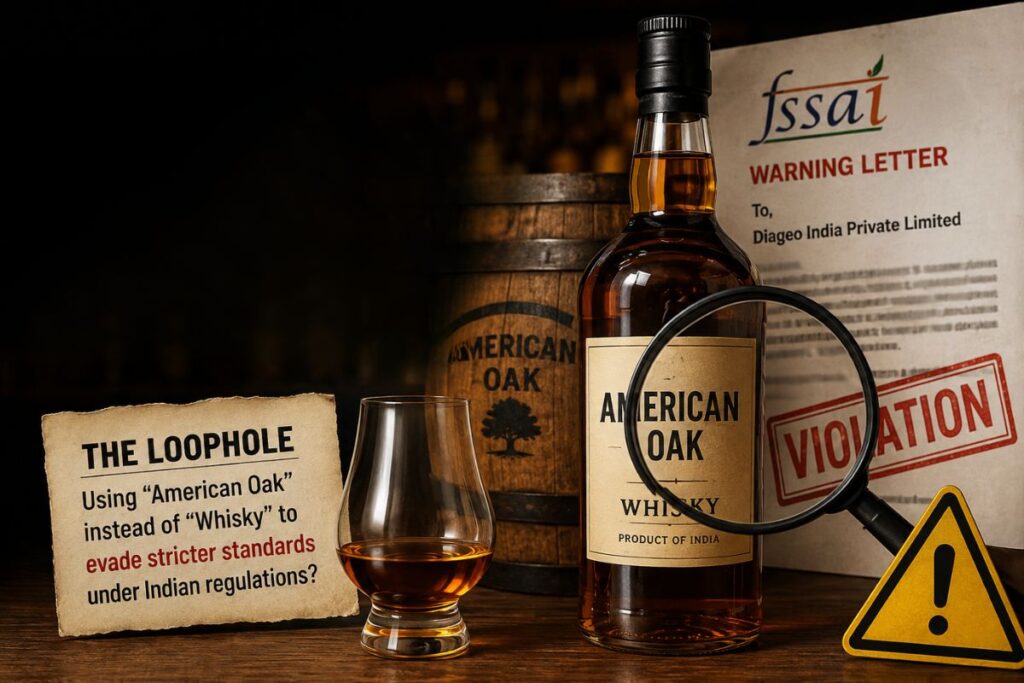
The regulatory scrutiny initiated by the Food Safety and Standards Authority of India (FSSAI) against multinational liquor giant Diageo and domestic blenders has exposed an open secret in the Indian alco-bev ecosystem: the widespread exploitation of labeling loopholes surrounding “American Oak” maturation. While front-of-pack labels showcase artisanal oak barrels and aged heritage, the underlying liquid inside mass-market Indian Made Foreign Liquor (IMFL) bottles remains predominantly unaged molasses or grain-based Extra Neutral Alcohol (ENA) blended with minute percentages of imported malt or synthetic wood extracts.
The Regulatory Architecture: FSSAI Alcoholic Beverages Regulations
Under the statutory mandate of the Food Safety and Standards Authority of India (FSSAI), specifically the Food Safety and Standards (Alcoholic Beverages) Regulations, 2018, whisky is defined as an alcoholic distillate obtained from a fermented mash of malted cereal grains, matured in wooden casks (such as oak). However, sub-clauses historically permitted blended whiskies to combine grain-neutral spirits with mature malt distillates, creating a regulatory ambiguity:
- The Maturation Void: While single malts and authentic Scotch whisky require a minimum statutory aging period of three years in oak barrels, Indian regulations set no minimum cask-aging duration for standard IMFL blended whiskies.
- The “Contact” Loophole: Certain commercial producers satisfy nominal “oak contact” claims by running bulk neutral spirits through stainless steel tanks packed with toasted American oak staves, wood chips, or oak shavings—or by infusing legal limits of oak flavoring extracts—rather than incurring multi-year barrel aging.
- Misleading Deceptive Nomenclature: Labels boldly advertising terms like “Matured in Select American Oak Casks” or “Reserve Barrel Finish” frequently refer only to a tiny malt fraction (often as low as 2% to 5%) in a bottle otherwise comprised of 95% unaged ENA.
The Economic Arithmetic: Barrel Aging vs. ENA Blending
The reluctance of commercial distillers to age spirits in physical oak barrels is driven by stark financial mathematics and India’s tropical climatic penalties:
| Cost Factor | Authentic Oak Barrel Maturation | Industrial ENA Blending |
|---|---|---|
| Base Liquid Cost | ₹250–₹450 per litre (Grain/Malt distillate) | ₹55–₹65 per litre (Industrial ENA) |
| Cask Capital Expenditure | ₹30,000–₹45,000 per imported ex-bourbon American oak cask | ₹0 (Stainless steel bulk storage tanks) |
| Working Capital Lock-in | 3 to 5 years minimum | 24 to 72 hours formulation cycle |
| Evaporation Loss (“Angels’ Share”) | 10% to 12% annually in tropical Indian climate | Zero evaporation loss |
| Effective Production Cost per Case | ₹3,500–₹6,000+ | ₹600–₹900 |
The “Angels’ Share” Climate Multiplier
In the cool, humid climate of Scotland, the rate of evaporation from porous wooden barrels—poetically termed the “Angels’ Share”—averages roughly 1.5% to 2% per annum. In contrast, India’s extreme ambient heat and fluctuating humidity (such as in Rajasthan, Goa, or Punjab) accelerate evaporation to an astonishing 10% to 12% each year. Over a standard 3-year aging cycle, an Indian distiller loses nearly a third of the cask’s physical volume into the atmosphere.
For mass-market consumer brands retailing at ₹500 to ₹1,000 per 750ml bottle, true multi-year barrel maturation in imported Quercus alba (American White Oak) is economically unviable without subsidizing costs or pricing out the mainstream consumer base.
Enforcement Shifts and Consumer Transparency
FSSAI’s tightening compliance notices demand that brand packaging provide unambiguous proportional disclosure. If a whisky advertises American oak maturation, regulatory authorities are moving toward mandating that the percentage of barrel-aged distillate be explicitly declared on the principal display panel.
This scrutiny parallels wider legal and regulatory enforcement crackdowns across India’s consumer goods and excise landscape. For detailed insights into how state enforcement agencies navigate statutory loopholes and judicial evidentiary burdens, read our investigative analysis on why state regulatory seizures frequently face prosecution hurdles in court, and discover how impending trade negotiations under the UK-India trade deal are expected to slash tariffs on imported Scotch and luxury imports.
Frequently Asked Questions
What is Extra Neutral Alcohol (ENA) in Indian whisky?
Extra Neutral Alcohol (ENA) is highly rectified, 96% pure ethyl alcohol produced from sugarcane molasses or agricultural grains (broken rice, maize). It is virtually colorless, odorless, and neutral in flavor, serving as the base spirit for approximately 90% of Indian Made Foreign Liquor (IMFL).
Yes. Under current FSSAI guidelines, blenders are permitted to incorporate nature-identical flavoring substances and approved food coloring (such as plain caramel) within specified limits, provided all food safety toxicity parameters are met.