






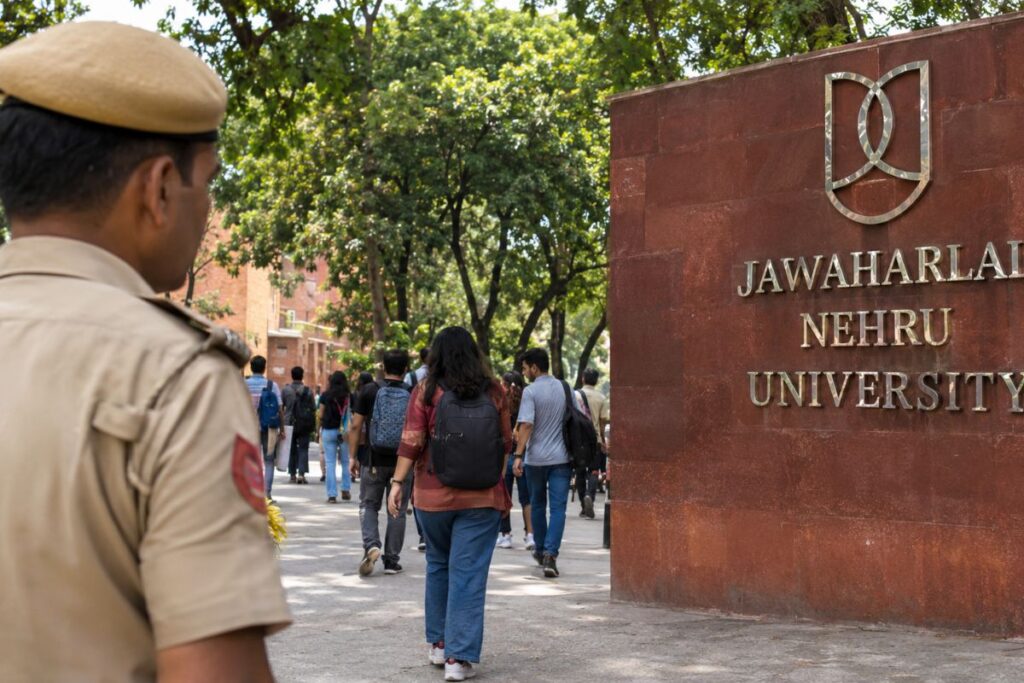
Delhi Police delayed filing an attempt-to-murder First Information Report for two days because Jawaharlal Nehru University administrators held custody of the dispute for internal inquiry proceedings. Although hospital staff dispatched mandatory trauma alerts on November 5, this institutional JNU attack FIR delay stalled formal criminal registration until campus arbitration concluded late on November 7.
Why Did Police Delay the JNU Attempt-to-Murder FIR for 48 Hours?
The 48-hour delay occurred because campus administrators kept the complaint within internal university proceedings before forwarding documentation to the police station.
The assault took place inside Barak Hostel at roughly 3:00 PM on Wednesday, November 5. Emergency Police Control Room vans arrived on campus shortly thereafter, and ambulances transferred the injured students to the hospital before 4:30 PM.
Yet Vasant Kunj North Police Station registered the formal First Information Report (FIR), the initial official record prepared by police upon receiving information about a cognizable offense, under Section 109 of the Bharatiya Nyaya Sanhita only on the night of Friday, November 7. As documented in reporting by Deccan Chronicle, the formal police case moved forward only after an attending woman student lodged a separate written complaint two days after the incident.
Public daily diary logs accessible via the Delhi Police Citizen Portal show that for 48 hours, the sharp-weapon assault inside university housing was cataloged merely as an unverified station entry rather than an active criminal investigation.
What Happened to the Hospital’s Medico-Legal Trauma Alert?
The hospital’s statutory trauma alert reached the police on November 5, meaning the registration delay stemmed from station house inaction rather than missing medical facts.
Under emergency care guidelines issued by the Ministry of Health and Family Welfare, attending doctors must immediately draft a Medico-Legal Case (MLC), a formal medical document recording injuries suspected to result from criminal acts, whenever they treat severe bladed-weapon trauma. Hospital authorities must dispatch this record directly to local police, which establishes an immediate duty for officers to begin an inquiry.
Emergency trauma logs at the AIIMS Apex Trauma Centre confirm that staff prepared and sent the MLC record for the primary victim on the evening of November 5. Attending surgeons confirmed extensive facial fractures and permanent loss of vision in the right eye, notifying police that the injuries were life-threatening.
Investigators frequently explain registration delays by citing the victim’s condition: officers cannot take a formal statement if the patient is sedated or undergoing surgery.
Under the Bharatiya Nagarik Suraksha Sanhita, 2023, India’s primary statute governing criminal procedural law, police do not require a victim’s personal deposition to lodge an FIR for cognizable, non-bailable offenses when hospital MLC records verify severe trauma. The hospital alert remained on the station desk without an accompanying crime number throughout November 6.
How Did JNU’s Proctorial Inquiry Stall External Criminal Procedures?
The procedural lag developed because university authorities took administrative custody of the witnesses and evidence on November 6 before lodging a formal police complaint.
Throughout Thursday, November 6, the JNU Chief Proctor’s Office conducted internal hearings, summoning students and recording initial depositions under Statute 32 of the Jawaharlal Nehru University Act, 1966.
Administrative records show that the proctorial board prioritized executing summary rustications against four students rather than transmitting formal complaint records to the local Station House Officer. By keeping witness testimonies and initial accounts within internal hearing rooms, university authorities effectively insulated the event from criminal detectives for an entire working day.
The university administration maintains that its initial actions aimed to prevent campus unrest and secure emergency medical attention. In official notifications published by the JNU Administration, university officials stated that invoking proctorial disciplinary powers serves to stabilize student residences and fulfills statutory governance mandates without intending to impede statutory law enforcement.
What Sequence Did Wire Reports and Initial News Coverage Present?
Mainstream news accounts presented the police arrest and FIR as the immediate, uninterrupted outcome of the November 5 clash, omitting the two-day administrative hold entirely.
Wire coverage focused on the immediate physical injuries, including permanent vision loss in the victim’s right eye and secondary lacerations sustained by three other students, before skipping directly to weekend enforcement.
Statements released by Deputy Commissioner of Police (Southwest) Amit Goyal confirmed over the weekend that an FIR had been registered and arrests were underway.
What initial coverage omitted was that the accused remained on campus grounds for two days while administrative bodies debated the scope of their internal notices.
How Does a Two-Day FIR Delay Weaken the Prosecution’s Case in Court?
The 48-hour gap weakens the prosecution by compromising physical evidence preservation and giving defense attorneys legal precedent to argue that initial witness claims were coordinated.
In criminal jurisprudence governed by the Supreme Court of India, unexplained delays between an offense and an FIR permit defense attorneys to argue that investigators used the intervening time to embellish claims, alter witness lists, or coordinate narratives.
More concretely, the delay affected physical preservation: Delhi Police forensic units from the Forensic Science Laboratory (FSL) Delhi were not deployed to seal or examine Room 119 in Barak Hostel until after the formal complaint was admitted on November 7.
When an institutional body filters evidence before police intervention, chain-of-custody arguments become central to bail hearings and appellate reviews. Delhi High Court precedents consistently note that administrative mediation before police reporting complicates criminal trials, giving defense litigators grounds to question the spontaneity and truthfulness of the initial charges.
By prioritizing internal administrative inquiries over immediate statutory reporting, university officials created a procedural delay that defense counsel can exploit at trial.
Frequently Asked Questions
Why did it take 48 hours to register an FIR after the JNU Barak Hostel stabbing?
The delay occurred because JNU administrators retained custody of the dispute for internal proctorial hearings throughout November 6. Delhi Police did not convert the hospital’s trauma alerts into an FIR until a separate written complaint was submitted on the night of November 7.
Did hospital staff alert Delhi Police about the JNU attack on November 5?
Yes. Emergency staff at the AIIMS Apex Trauma Centre generated and dispatched a Medico-Legal Case report on the evening of November 5, which verified life-threatening, sharp-weapon injuries and permanent vision loss in the victim’s right eye.
Can Delhi Police register an attempt-to-murder FIR without a victim’s statement?
Yes. Under the Bharatiya Nagarik Suraksha Sanhita, 2023, police have the statutory authority to register an FIR for cognizable, non-bailable offenses using hospital MLC alerts, without waiting for an injured victim to regain consciousness or give a deposition.
When did forensic teams inspect the crime scene at Barak Hostel?
Forensic teams from the Forensic Science Laboratory (FSL) Delhi were not dispatched to seal and examine Room 119 in Barak Hostel until November 7, more than 24 hours after the assault occurred.