






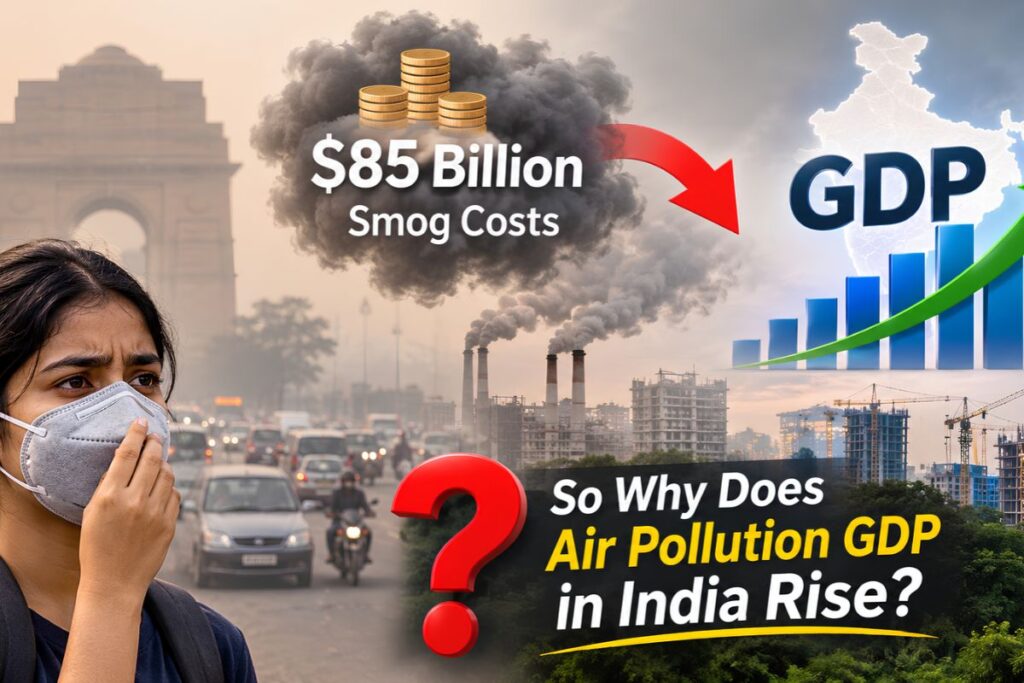
North India’s winter tax collections and economic figures do not drop during severe smog because India’s GDP accounting records pollution-driven spending as growth. Hospitalizations, inhaler purchases, air purifiers, and commercial fuel shifts all register as positive output, masking the $85 billion in lost labor productivity estimated by clean-air researchers.
Why Don’t North India’s Winter Tax and GDP Numbers Drop During Severe Smog?
North India’s winter tax receipts keep rising because Goods and Services Tax (GST) tracks retail and industrial billing, which expands as households and businesses spend money coping with toxic air. Every October through December, particulate levels across the Indo-Gangetic Plain routinely cross the “severe” threshold on the Central Pollution Control Board’s Air Quality Index, yet state-level GST collections across Delhi, Haryana, Uttar Pradesh, and Punjab show no winter contraction.
In October 2026, even as post-Diwali smog pushed Delhi’s Air Quality Index past 377 and triggered emergency restrictions across the National Capital Region, monthly state GST collection data recorded double-digit year-on-year growth across every major northern state:
- Uttar Pradesh: Up 24 percent, from ₹8,283 crore in October 2025 to ₹10,235 crore in October 2026.
- Punjab: Up 25 percent year-on-year to ₹2,856 crore.
- Haryana: Up 17 percent year-on-year to ₹11,529 crore.
- Delhi: Up 10 percent year-on-year to ₹9,298 crore.
That resilience puzzles business owners who watch construction sites halt and outdoor workers slow down. To see why the macro numbers hold steady, you have to look at how national statisticians measure an economy.
How Does “Defensive Expenditure” Turn Illness Into GDP Growth?
India’s Ministry of Statistics and Programme Implementation (MoSPI) counts money spent to cope with environmental harm as positive economic output, which offsets unrecorded productivity losses. A January 2026 report by Dalberg Advisors and the Clean Air Fund estimates that cutting fine particulate pollution (PM2.5, inhalable particles smaller than 2.5 micrometers) by 20 percent by 2030 would avert $85 billion in annual economic losses across India. That study updates Dalberg’s 2021 finding that air pollution cost India $95 billion, or roughly 3 percent of GDP, in 2019, while a November 2026 analysis by the Federation of Indian Chambers of Commerce and Industry (FICCI) and EY puts the broader annual burden at up to 9.5 percent of GDP.
Those headline numbers come from counterfactual modeling, where economists calculate what Indian workers and businesses would have produced if the air were clean. Official quarterly Gross Domestic Product (GDP) figures published by MoSPI work differently because they follow the United Nations System of National Accounts, an international bookkeeping standard that measures market transactions and income flows rather than human well-being.
Within MoSPI’s Private Final Consumption Expenditure (PFCE) methodology, household outlays made solely to protect against or recover from environmental damage, a category economists call “defensive expenditure”, are added directly to national output.
When a factory worker stays home sick, no market transaction occurs, so the lost workday never registers as a negative entry in quarterly GDP. When that same worker buys a nebulizer, pays for an emergency room visit, or purchases a room air purifier, cash changes hands, and MoSPI records every rupee as economic expansion.
Which Sectors Boom When Air Quality Crosses 400?
Four pollution-coping sectors, hospital care, respiratory drugs, air purifiers, and commercial fuel compliance, capture steep seasonal revenue increases across Northern India during severe smog months:
- Hospital admissions and outpatient clinics: Private and public hospitals across the National Capital Region see recurring winter surges in respiratory care. Medanta Chairman Dr. Naresh Trehan warned in November 2026 of a sharp hospital spike in asthma and respiratory cases, while healthcare workers at South Delhi’s Majeedia Hospital reported in Down To Earth that respiratory patient arrivals jump by 60 to 70 percent during high-pollution episodes. Earlier in August 2026, Fortis Healthcare also launched dedicated respiratory care clinics in Delhi-NCR to treat chronic lung failure.
- Respiratory pharmaceuticals and devices: Retail pharmacy audits track sharp seasonal increases in anti-asthma and chronic obstructive pulmonary disease (COPD) therapies. According to Pharmarack market data, Indian respiratory medicine sales crossed ₹5,620 crore in the October–December 2025 quarter, up 17 percent over the previous quarter and 14 percent year-on-year, with December sales hitting a record ₹1,950 crore. A January 2026 industry survey further found that winter demand for children’s nebulizers and inhalers in Delhi rises by up to 60 percent.
- Air purifiers and filtration: Consumer appliance makers and e-commerce platforms record their steepest order volumes during the fourth calendar quarter. Industry tracking reported by The Economic Times in November 2026 showed daily air purifier sales jumping 3.7 times month-on-month, with online sales doubling as winter smog set in.
- Commercial fleet and generator compliance: Under the Commission for Air Quality Management’s Graded Response Action Plan (GRAP), an emergency protocol that enforces escalating curbs as air quality worsens, severe winter pollution triggers bans on older BS-III and BS-IV diesel commercial vehicles and restricts diesel generators. Those rules shift business spending toward compliant commercial transport, cleaner fuels, and replacement filtration parts.
Why Doesn’t Counterfactual Loss Show Up on the Cash Register?
Counterfactual loss stays off official growth ledgers because GDP tracks gross cash circulation rather than net wealth, an accounting blind spot economists call the “broken window fallacy.” Paying to repair damage keeps money moving through the economy, even though society ends up poorer than if the damage had never occurred.
According to The Lancet Planetary Health’s India state-level disease burden study, air pollution caused $28.8 billion in lost output from premature deaths and $8.0 billion from morbidity in 2019 alone. Direct medical bills and lost earnings drain capital that households would otherwise put into savings, education, or productive business investment.
MoSPI statisticians maintain that keeping GDP strictly tied to observable market transactions prevents subjective political adjustments to growth rates. Yet India once designed an alternative: in March 2013, an expert group chaired by economist Sir Partha Dasgupta submitted MoSPI’s Green National Accounts in India framework. As documented in India’s United Nations Statistics Division presentation, that roadmap explicitly called for subtracting defensive environmental spending from GDP to measure true Net Domestic Product, a step India has yet to integrate into its headline quarterly growth releases.
What Happens to Tax Revenue If the Air Actually Clears?
If India permanently cleans its winter air, state and central treasuries will lose 18 percent GST receipts on pollution-defense hardware while households redirect capital toward productive sectors. Under GST Council tax schedules, residential air purifiers and automotive cabin air filters classified under Harmonized System of Nomenclature (HSN) code 8421 attract an 18 percent GST rate, generating direct tax revenue whenever winter air quality deteriorates.
In December 2025, the Delhi High Court questioned why air purifiers remain taxed at 18 percent rather than the 5 percent slab applied to medical devices. Meanwhile, hospital healthcare services remain exempt from GST, and lost wages among informal outdoor workers generate no direct tax clawback at all.
If the National Clean Air Programme, India’s flagship multi-city particulate reduction initiative, succeeds in lowering winter pollution, defensive-sector companies will see an immediate drop in smog-driven sales as workers gain healthy, productive days. Dalberg’s January 2026 report projects that a 20 percent pollution reduction would instead unlock over $200 billion in economic opportunities across cleaner transport, industry, energy, and construction.
Until India tracks net wealth alongside gross cash flow, headline GDP will remain an unreliable gauge of what toxic air actually costs.
Frequently Asked Questions
Why don’t India’s quarterly GDP numbers fall when air pollution shuts down construction and slows workers? Official quarterly GDP compiled by the Ministry of Statistics and Programme Implementation measures market transactions rather than unrecorded lost workdays. When households buy air purifiers, inhalers, or hospital care during severe smog, those “defensive expenditures” register as positive consumption in Private Final Consumption Expenditure, offsetting lost outdoor output.
How much does air pollution cost the Indian economy each year? According to a January 2026 report by Dalberg Advisors and the Clean Air Fund, cutting fine particulate pollution (PM2.5) by 20 percent by 2030 would avert $85 billion in annual economic losses across India. A separate November 2026 analysis by FICCI and EY estimates the broader annual economic burden at up to 9.5 percent of GDP.
Which industries see higher sales in North India during severe winter smog? According to hospital disclosures, retail pharmacy audits, and appliance industry tracking, four sectors see sharp winter spikes: NCR hospital respiratory wards, respiratory pharmaceuticals (which crossed ₹5,620 crore nationally in Q3 FY26 per Pharmarack), room air purifiers (whose daily sales jumped 3.7 times month-on-month in November 2026), and GRAP-compliant commercial transport and filtration.
How are air purifiers taxed under India’s GST system compared to medical care? Residential air purifiers and automotive cabin filters fall under HSN 8421 and carry an 18 percent GST rate, generating direct tax revenue for state and central treasuries during pollution spikes. By contrast, hospital healthcare services are exempt from GST, and medical devices sit in the 5 percent slab, a gap questioned by the Delhi High Court in December 2025.