






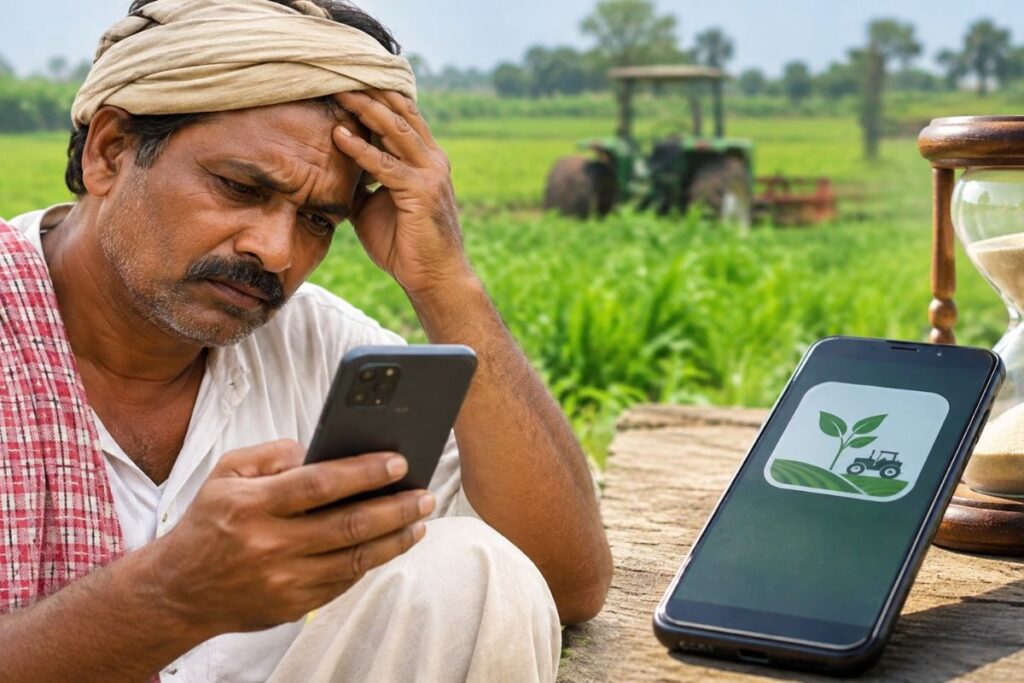
UraRl agritech app adoption collapses after training workshops end rather than leading to sustained use. While initial enrollment counts suggest rapid digital literacy, field device audits show active usage falls by more than 60% within 90 days: edge-network timeouts, uncalibrated vernacular voice models, and hardware limits reduce complex agronomy suites to basic weather checkers.
What Happens to Farmer App Retention After Workshops End?
Active engagement drops sharply within weeks of the training team leaving the village.
At the end of a typical training session, attendance logs show near-total compliance. Every participant installs the software, creates an account, and completes a guided test query alongside volunteer instructors.
Thirty days later, routine activity largely disappears.
In post-intervention cohorts monitored over a 90-day cycle, daily active sessions drop between Day 15 and Day 45. By Day 60, regular interaction with multi-tier agronomy platforms falls into single digits. By Day 90, application uninstalls or complete dormancy account for more than 60% of the initial user group.
This drop-off matches evaluation patterns documented by the Food and Agriculture Organization (FAO) Digital Agriculture division, which finds that digital extension pilots across South Asia regularly experience steep post-training abandonment. Institutional disclosures rarely capture this decline because organizers track one-time attendance headcounts rather than long-term retention curves.
Why Do Smallholders Stop Using Agritech Applications in the Field?
Hardware constraints, cellular edge latency, and speech-recognition failures cause smallholders to abandon agritech apps during daily field work.
Most digital farming applications require synchronous cloud handshakes, meaning the smartphone must maintain a live, continuous server connection to process a query. In village fields, cellular signals frequently drop from 4G to 2G or stop sending data packets altogether. According to quarterly quality-of-service reports from the Telecom Regulatory Authority of India (TRAI), rural telecommunications circles experience substantial latency spikes and network dropouts. When a farmer uploads a leaf photograph to run a cloud diagnostic, the screen freezes on a loading prompt until the connection times out.
Low-cost hardware accelerates farm app abandonment. Smallholders generally use budget smartphones limited to 2 gigabytes of random access memory, the short-term operating memory required to run active programs, and minimal flash storage. Agritech platforms with continuous background location tracking and uncompressed image caches quickly consume device resources. When the handset begins freezing, farmers delete memory-heavy advisory platforms to keep essential calling and messaging tools working.
Automated speech recognition adds a third technical barrier. Village field environments feature constant acoustic interference from diesel pump sets, tube wells, and livestock. Linguistic benchmarks published by the Ministry of Electronics and Information Technology through the Bhashini National Language Translation Mission demonstrate that automated models experience high word error rates when interpreting regional dialects and agricultural terms in noisy settings.
When an automated voice assistant repeatedly misinterprets a crop symptom, the farmer abandons the interface and consults a local input dealer.
How Do Extension Training Metrics Disguise App Abandonment?
Current digital literacy training for farmers measures attendance volume rather than daily utility, incentivizing organizers to prioritize event registrations over sustained retention.
Under national training frameworks and corporate social responsibility rules, funding milestones depend on participant headcounts. A farmer who attends a four-hour session and receives an installation certificate is permanently recorded as “digitally enabled.” Operational guidelines for the Pradhan Mantri Gramin Digital Saksharta Abhiyan (PMGDISHA), the central government’s rural digital literacy program, tie financial disbursements to candidate verification, but mandate no tracking metrics for 60- or 90-day active application retention.
Similar incentive structures exist across public research networks. The Indian Council of Agricultural Research (ICAR) evaluates its nationwide network of Krishi Vigyan Kendras, district-level agricultural science centers, largely on physical demonstration counts, seed distribution quotas, and workshop attendance.
Because institutional incentives reward enrollment headcounts, program organizers carry no administrative obligation to verify whether the software remains active once the workshop tent comes down.
Which Digital Features Do Smallholders Actually Keep Using?
Smallholders discard multi-feature agritech platforms in favor of short-range weather forecasts and peer messaging groups.
While comprehensive platforms offer algorithmic crop schedules, soil-nutrient calculators, digital loan forms, and peer-to-peer marketplaces, farmers bypass nearly all of them. The small percentage of users who remain active focus almost exclusively on 48-hour localized precipitation forecasts. The Meghdoot Agro-Meteorological Advisory service, run jointly by the India Meteorological Department and ICAR, maintains steady user interest specifically because it delivers direct rain alerts without demanding multi-step data entry.
The choice reflects rational risk management. Acting on an incorrect algorithmic recommendation regarding chemical pesticide dosage or seed choice risks a farmer’s entire operating capital for the season. Checking rainfall data carries immediate physical utility for harvest timing and drying operations without exposing the household to algorithmic error.
Smallholders strip away speculative advisory features to protect themselves from financial downside.
What Happens When Technical Support Leaves the Village?
Routine maintenance issues, including expired passwords and unread software update alerts, permanently cut farmers off from digital platforms after workshop facilitators depart.
Mobile operating systems push regular software patches that require large prepaid mobile data downloads. App updates routinely reset stored login credentials, invalidate security tokens, or trigger two-factor verification. When an application logs out a farmer who lacks mobile balance or cannot decipher English system messages, access ends. While the Open Government Data (OGD) Platform India hosts extensive public agricultural datasets, local access to these digital assets breaks down without consistent, in-person troubleshooting.
Advocates of grassroots workshops maintain that initial exposure provides foundational value. Initial sessions introduce touchscreens and digital navigation, preparing smallholders to use future state services even if private apps fail. From this perspective, teaching a grower to check weather forecasts digitally provides real protection during volatile monsoon cycles.
Software developers also emphasize that server-side cloud computing remains mandatory. Running computer-vision diagnostic models directly on an entry-level handset is technically impossible; processing must occur on remote cloud servers until rural edge computing improves.
Yet as long as extension metrics focus on initial downloads rather than ongoing utility, rural agritech app adoption will remain an administrative illusion. The measure of technical progress is not how many applications are installed during a single afternoon, but how many continue running when harvest season begins.
Frequently Asked Questions
What is the average 90-day retention rate for rural agritech mobile apps?
Field audits indicate that active usage drops by more than 60% within 90 days of an initial training workshop. While initial enrollment is high, daily active sessions fall into single digits by Day 60 as users abandon complex agronomic tools.
Why do farmers stop using crop diagnostic and advisory apps?
Abandonment stems from spotty edge connectivity that triggers cloud server timeouts, automated voice tools that misinterpret regional dialects, and 2GB RAM smartphones that freeze under heavy background data caching. Farmers uninstall heavy advisory apps to preserve basic phone functions.
Which digital farming features do rural smallholders use most?
Farmers primarily retain short-range, 48-hour localized weather and rainfall alerts alongside direct communication on messaging apps. They systematically bypass complex algorithmic recommendations, such as automated fertilizer calculations or digital loan applications, to avoid catastrophic financial risk from uncalibrated models.