






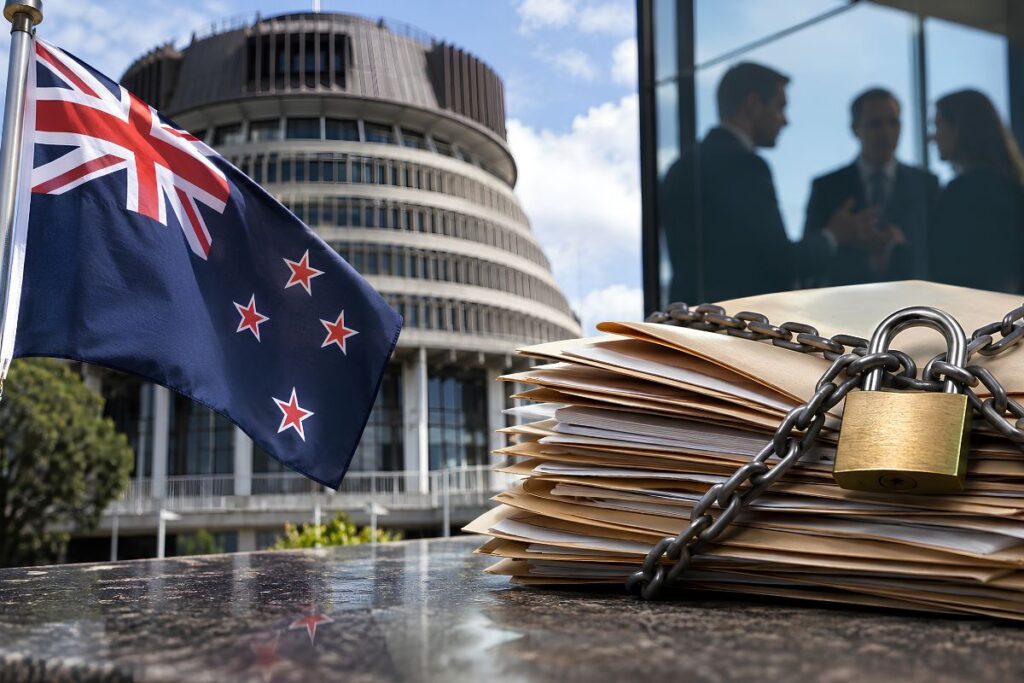
No, New Zealand coalition negotiations, draft agreements, and internal trade-off records are not subject to the Official Information Act. Under statutory definitions and confirmed legal rulings, party leaders negotiate in a private political capacity rather than as Crown ministers, placing their working documents, rejected compromise clauses, and negotiation logs entirely outside public disclosure laws.
Why Are New Zealand Coalition Talks Exempt from the Official Information Act?
Coalition talks are exempt from the Official Information Act 1982 because the statute applies only to ministers acting in their official executive capacity, not to party leaders negotiating political alliances. In New Zealand constitutional law, the Official Information Act 1982 (OIA) is the primary statute giving the public the legal right to access government records to ensure accountability.
Under Section 2 of the Official Information Act 1982, official information covers material held by government departments, state agencies, and Ministers of the Crown acting in an executive role. The statute excludes records held by members of Parliament acting solely as party caucuses or political party officials.
When party leaders negotiate after an election, the law treats them strictly as party officials rather than state executives. Even an incumbent Prime Minister negotiating a governing arrangement acts in a party capacity rather than an official ministerial role.
Because of this legal dividing line, every draft agreement, briefing paper, handwritten note, and digital message generated across the negotiating table falls outside the statutory definition of official information. The Act gives citizens, journalists, and parliamentary watchdogs no legal right to request these materials.
How Has the Ombudsman Ruled on Coalition Negotiation Documents?
The Chief Ombudsman has repeatedly confirmed that the Official Information Act has no jurisdiction over coalition negotiation documents because they are party-political property rather than Crown records. In New Zealand, the Office of the Ombudsman is the independent parliamentary agency that investigates citizen complaints against central government administrative decisions and reviews OIA refusals.
The legal boundary was tested following the 2017 general election, when public scrutiny focused on an unreleased 33-page policy document discussed during talks between the New Zealand Labour Party and New Zealand First.
In a formal Final Opinion on the coalition negotiation document, Chief Ombudsman Peter Boshier upheld the Prime Minister’s decision to refuse requests for the unreleased negotiation paper. The ruling established three principles under Section 2(1) of the Act:
- Documents created by or exchanged between negotiating teams belong to the respective political parties, not the executive branch of government.
- A political paper does not become official information simply because the person holding it is subsequently sworn in as a Cabinet Minister.
- Ministers hold distinct constitutional identities; coalition formation talks occur strictly in a party-leader capacity.
These determinations confirm that the Ombudsman has no statutory power to investigate, review, or order the disclosure of working papers generated during coalition talks. The jurisdictional bar prevents any public-interest balancing test under Section 9 of the Act from taking place.
Can Parties Legally Destroy Coalition Drafts Under the Public Records Act?
Political parties can legally shred, delete, or conceal coalition negotiation drafts because the Public Records Act 2005 classifies them as private political papers rather than public records. The Public Records Act 2005 is the statutory framework governing how New Zealand public agencies archive, manage, and preserve state records for permanent public reference.
Under the Public Records Act 2005, government departments and ministers are legally required to preserve public records for deposit with Archives New Zealand. The statute forbids the unauthorized disposal of official correspondence, agency advice, and executive decisions.
Party political records, however, are explicitly exempt from statutory preservation mandates.
According to the Cabinet Manual’s guidance on Ministers and Public Records, materials held by ministers in a party-political capacity are not public records under the law.
Because coalition working drafts, disputed clauses, and policy compromises are categorized as private party papers, negotiating teams face no legal requirement to archive them. Staff can destroy draft agreements, erase electronic communication threads, and dispose of working compromise notes once negotiators execute a final agreement.
This exemption removes preliminary negotiation records from the national archive. The public sees only the final signed agreement, leaving the historical paper trail of which public policies were offered, altered, or abandoned permanently outside public archives.
Why Was Secrecy Built into Government Formation Conventions?
Secrecy was deliberately preserved in New Zealand‘s government formation conventions to allow political parties to negotiate candid compromises without premature outside pressure disrupting multi-party stability. The Cabinet Manual is the authoritative procedural guide that sets out the constitutional conventions, executive rules, and administrative practices governing New Zealand’s executive government.
Chapter 6 of the Cabinet Manual on Elections and Government Formation details the constitutional rules governing executive transitions. Under New Zealand’s Mixed Member Proportional (MMP) system, a single party rarely wins an outright majority, requiring multi-party negotiations to form a government.
Constitutional scholars and former Cabinet Secretaries note that confidentiality protects the formation process. If early concessions were disclosed immediately, intense reactions from interest groups and party bases could prevent minor compromises. Defenders of the current rules argue that premature disclosure would stall talks, prolong caretaker governments, and destabilize coalition agreements.
The constitutional framework relies on an established boundary: confidentiality while parties negotiate, followed by public accountability when parties publish final agreements and introduce legislation in Parliament.
How Do Lobbyists Exploit the Coalition Negotiation Period?
Lobbyists can privately brief negotiation teams during coalition talks because party caucuses are completely exempt from the mandatory meeting logs and proactive diary disclosures required of executive ministers. A proactive diary release is an administrative requirement under which government ministers must publish quarterly summaries of all official meetings held with outside stakeholders and commercial entities.
Ministers of the Crown are bound by Public Service Commission guidance on ministerial diary releases, requiring proactive quarterly disclosure of meetings with commercial businesses, industry associations, and non-governmental advocacy groups.
During post-election coalition talks, those transparency rules cease to operate.
Because negotiators work as party officials rather than Crown ministers:
- Industry lobbyists, corporate executives, and trade union officials can meet directly with negotiating teams without appearing on any public register.
- Negotiators are under no statutory duty to log meetings, take formal minutes, or preserve third-party policy proposals submitted to their teams.
- Neither the Public Service Commission nor the Registrar of Pecuniary and Other Specified Interests oversees third-party access to negotiating rooms.
When a published coalition agreement changes public spending, environmental rules, or tax settings, citizens can inspect the final text. The law leaves no official record showing which commercial or industry interests influenced the terms behind closed doors.
Frequently Asked Questions
Are New Zealand coalition talks subject to the Official Information Act?
No. Under Section 2 of the Official Information Act 1982, the statute applies only to Ministers of the Crown acting in an executive capacity. Party leaders conduct coalition talks in a private party-political capacity, placing all negotiation notes and draft agreements outside the Act’s jurisdiction.
Did the Ombudsman rule that coalition draft documents can stay secret?
Yes. Chief Ombudsman Peter Boshier formally ruled that coalition negotiation documents are party-political property rather than official information. Because ministers do not hold these records in an executive capacity, the Ombudsman has no legal power to order their public release.
Do political parties have to archive coalition negotiation notes with Archives New Zealand?
No. The Public Records Act 2005 specifically excludes party-political papers from mandatory public archiving. Negotiating teams are legally permitted to shred, delete, or retain draft agreements and working notes in private party files.
Are lobbyists required to disclose meetings held during coalition negotiations?
No. Proactive diary release mandates issued by the Public Service Commission apply only to ministers conducting official state business. Party negotiating teams have no legal obligation to record or disclose meetings held with corporate lobbyists or interest groups during post-election talks.