






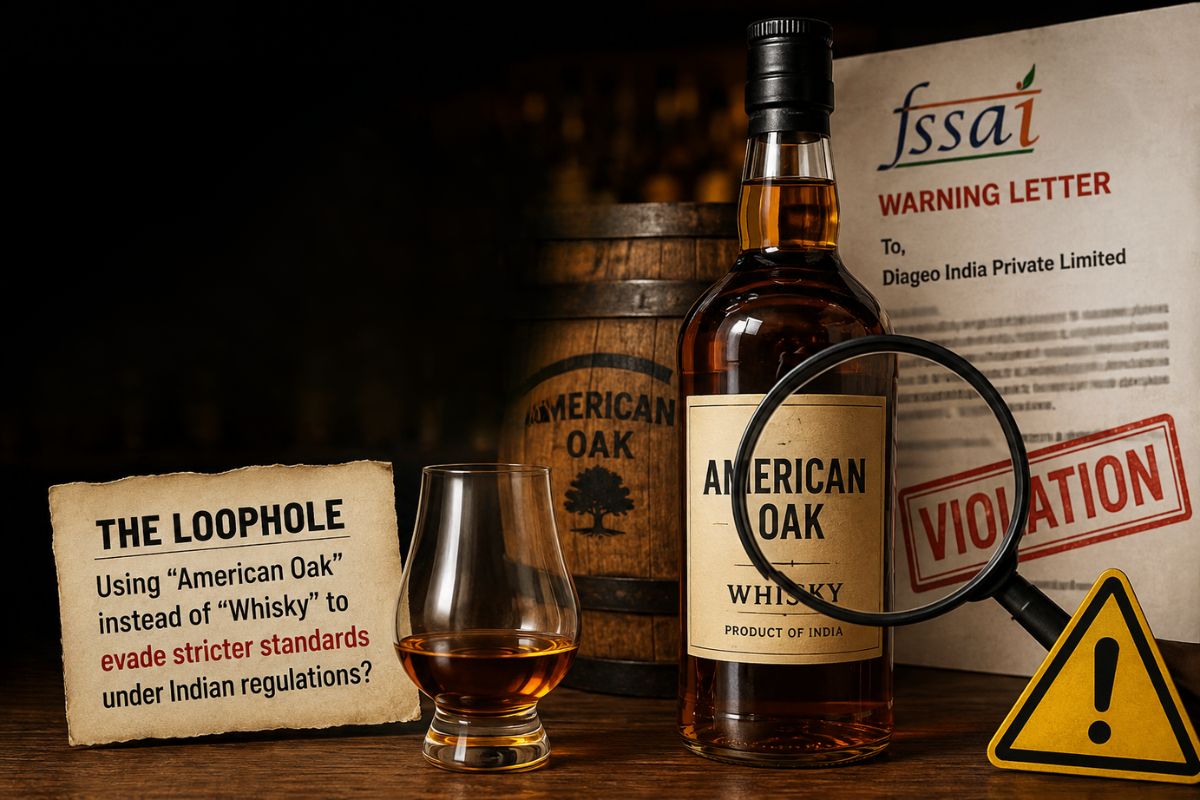
The recent Diageo FSSAI warning exposes the financial reality of Indian whisky. Distillers avoid steep capital costs by bottling unaged grain spirit instead of using real oak. Wholesale grain spirit costs just ₹60 per litre, whereas genuine American oak casks require an upfront ₹34,500 investment and trigger massive evaporation losses.
Why do Indian whisky brands avoid real American oak casks?
Most Indian Made Foreign Liquor (IMFL), the domestic regulatory category for Western-style spirits, relies on Extra Neutral Alcohol (ENA), a highly purified, unaged grain spirit. At ₹60 a litre, ENA offers a low-cost, high-volume base for distillers.
Maturing spirit in wood changes that production math entirely. A single 200-litre American White Oak cask costs between ₹14,500 for a used ex-bourbon barrel and ₹34,500 for new oak, according to IndiaMART wholesale cooperage pricing. Distillers must pay that capital outlay before a single drop of whisky enters storage.
How does India’s climate punish whisky maturation?
India’s intense heat aggressively evaporates liquid resting in barrels, creating a severe financial penalty for long-term aging. Distillers lose a fraction of aging spirit to evaporation each year, an industry metric known as the “angel’s share.”
In Scotland, cooler temperatures keep this loss around 2 percent annually, according to beverage analytics firm Spiritory. India’s climate accelerates this physical process.
A cask sitting in an Indian warehouse loses 8 to 12 percent of its volume each year, Spiritory data shows. Over a standard three-year maturation cycle, a 200-litre cask will shed up to 30 percent of its salable liquid. The combination of cask import fees and climate-driven evaporation makes genuine maturation financially unviable under current mass-market Indian whisky regulations.
What did the Diageo FSSAI warning actually say?
The Food Safety and Standards Authority of India (FSSAI) warned Diageo’s Indian unit, United Spirits, that the “matured in American oak casks” label on Royal Challenge is misleading. FSSAI’s 2018 alcoholic beverages regulations mandate that maturation claims must legally apply to the youngest spirit in a blend, rather than a fractional component.
United Spirits maintains its labels comply with state laws. The company stated it is actively engaging with FSSAI to address the labeling queries.
How does the FSSAI rule threaten IMFL profit margins?
Enforcing the “youngest drop” maturation rule challenges the core profit engine of the IMFL market, forcing brands to either finance real aging or lose their premium labels. Brands in this tier rely on the cost-efficiency of ENA, paired with premium packaging cues like “American Oak,” to protect their margins, as shown in United Spirits’ audited financial results for its “Prestige and Above” segment.
Physical bottle labels show this structure extends across the industry, with state regulatory actions recently hitting multiple competing brands over flavor and age claims. If FSSAI enforces the maturation rule universally, companies face a binary choice. They must finance physical maturation across their entire liquid volume, or they must remove the premium “whisky” and “oak” text from their packaging.
Will FSSAI force Indian whisky to rebrand as flavoured spirit?
Stripping premium labels forces a statutory product reclassification that carries immediate retail risk, legally downgrading blends from whisky to flavored spirits. Under FSSAI’s enforcement, unaged ENA blends with added flavors lose their legal definition as whisky.
Distributors face uncertainty over how state excise boards will classify and tax products forced to change their category. State excise rules, which issue the actual distribution licenses, currently govern the entire IMFL business. This sets up a direct conflict between state tax revenue models and central food labeling standards.
Frequently Asked Questions
What is Extra Neutral Alcohol (ENA) in Indian whisky? ENA is a highly purified, unaged spirit typically distilled from grain or molasses. It serves as the cheap, high-volume base for most mid-tier Indian Made Foreign Liquor, costing distillers roughly ₹60 per litre.
Why does the FSSAI consider Diageo’s American oak label misleading? The FSSAI requires that any age or maturation claim on a bottle must apply to the youngest liquid inside it. The regulator flagged Diageo’s Royal Challenge because it uses unaged spirit alongside matured components, violating the “youngest drop” rule.
How much whisky is lost to evaporation in India? Indian warehouses lose 8 to 12 percent of a cask’s volume to evaporation every year due to the hot climate. This “angel’s share” destroys up to 30 percent of the liquid over a three-year aging period, compared to just 2 percent annually in Scotland.