






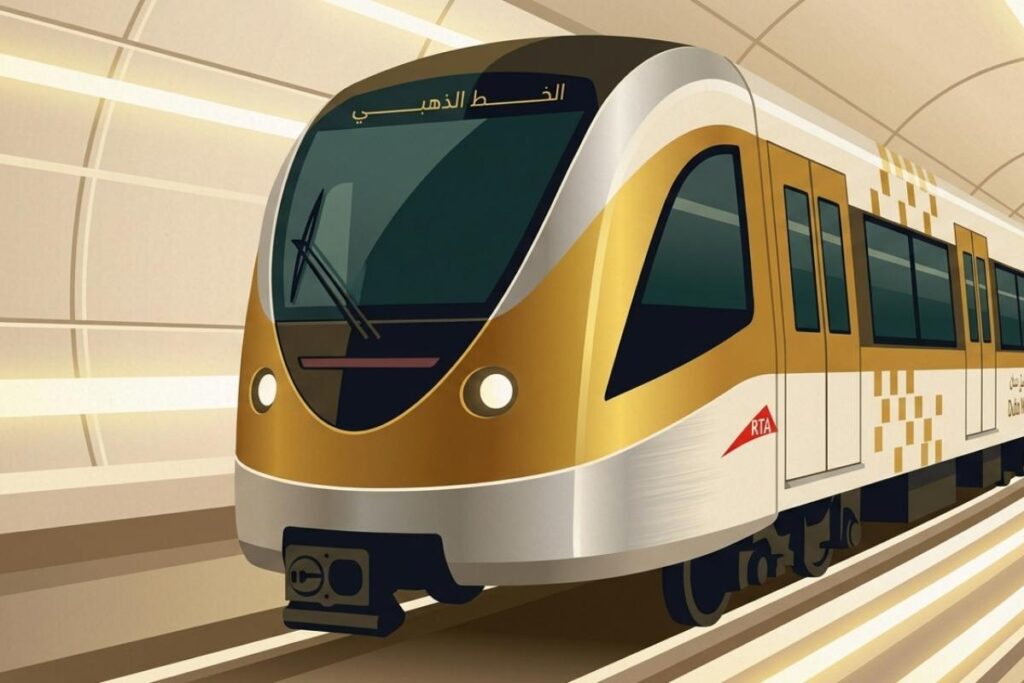
In the shadow of a sparkling skyline, tunnel boring machines are ready to carve the nation’s most expensive public transit expansion. The Dubai Metro Gold Line was recently given the go-ahead by Sheikh Mohammed bin Rashid Al Maktoum, with a commitment of AED 34 billion to a huge subterranean network. This ambitious RTA project will provide the emirate with 42 km of track and 18 new stations. Planners have set a firm opening date of September 9, 2032. This order launches an engineering sprint to reimagine the way 1.5 million residents travel back and forth each day.
The announcement comes at a pivotal moment for urban mobility in the Gulf. The density of traffic along the central arteries has compelled policymakers to look for long-term solutions. There are diminishing returns to efficiency from just going with wider highways. Crucially, the new infrastructure is a structural move away from car-dependent urban planning. The idea is to tunnel transit entirely underground, linking historic neighborhoods to new residential areas, without adding to the congestion on the surface.
The Gold Line is a sharp break from the elevated viaducts of the existing Red and Green lines. The scheme connects 15 strategic locations, including Al Ghubaiba, Business Bay,, and Jumeirah Golf Estates. The expansion adds 35 per cent to the total municipal rail network. Commuters will also have direct links to 55 key real estate developments that will be plugged into the transit grid. These stops are intentionally spaced to connect former commercial neighborhoods with recently created suburban enclaves.
The Dubai Metro Gold Line AED 34 Billion Vision
Dubai Metro Gold Line is a planned fully underground rail extension of the Dubai Metro with a cost of AED 34 billion and a distance of 42 km. It will have 18 stations and will link Al Ghubaiba to Jumeirah Golf Estates and will be completed by September 2032. The project will reduce traffic by 40 million journeys a year and link to the national Etihad Rail network.
The Gold Line is the aggressive answer to growing congestion in cities. The project blueprints envisage a network that would scrap 40 million car journeys a year. The route extends from the packed, historic corridors of Bur Dubai to the sprawling, newly constructed neighborhoods along the southern rim of the city. By 2040 planners anticipate 465,000 daily passengers. Those high-volume capabilities take the load off of private transportation.
The size of the investment is a reflection of a broader strategic mandate. This is Dubai’s biggest sustainable transport project in its operational history, with an allocation of AED 34 billion. The route weaves through high-value zones like City Walk, Mohammed Bin Rashid City, and Nad Al Sheba. This mapping reaches all the way to the corporate centers that are already there and the residential communities that are still growing. Planners know that the pace of development of modern sustainable transport is determined by a strong public transport system.
The total track length has been increased to 162 kilometers, bringing the city one step closer to its 2040 Urban Master Plan goals. Officials want to double the number of people living there, at the same time as cutting individuals’ carbon footprints dramatically. The demographic strategy is based on providing reliable high-capacity mass transit. Those living in car-reliant areas such as Jumeirah Village Circle will finally be able to access the rail network directly. So this infrastructural upgrade affects the daily rhythm of these deep-suburban neighborhoods at a fundamental level.
Building a completely underground metro system
The change from above-ground rail to an all-underground system presents enormous technical problems. The construction of a 42-kilometer tunnel, as deep as 40 meters, involves complex geological variables. The water table near Dubai Creek presents immediate engineering problems. The ground composition changes dramatically in the 15 designated districts. The crews that operate specialized tunnel boring machines must be very careful in handling these changes.
The delivery schedule is extremely aggressive for contractors. The Roads and Transport Authority intends to complete the Gold Line project 30 percent faster than the current Blue Line project. This faster timeline can be achieved only by excavating at several geographic sites simultaneously. And supply chains will need to be ready to handle the delivery of enormous boring equipment and millions of tons of concrete. In this high-stakes environment, logistics experts cannot afford long buffer periods.
The initial phase of construction will see the construction of logistical staging areas in local neighborhoods. In addition to Al Satwa, traffic management protocols are in place 24/7 in densely populated areas to clear displaced earth. Independent structural engineers say that using heavy machinery at such depths requires strict vibration mitigation. It is crucial for planners to make sure that the skyscrapers above are not compromised structurally in any way. But when the tunneling runs directly under operational financial districts, the margins of error are greatly reduced.
Economic and Real Estate Ripples
The financial models for the project are based on extraordinarily long-term dividends. The project will generate a cumulative economic return of 4percentent in 20 years, said Mattar Al Tayer, Director General of the RTA. This aggressive projection is based on a matrix of very specific metrics:
- Huge fuel savings for the daily commuter
- Fewer road deaths in the emirate
- Reduce Carbon Emissions Through Mass Transit Adoption
- Streamlined commercial commutes make for more efficient economy
The property values in the designated corridor will probably see immediate volatility. Overnight, linking 55 major real estate developments to the transit grid changes the commercial appeal of these properties. Meydan and Al Barsha South landlords now own assets directly along a major mobility artery. Financial analysts expect a surge in financial speculation as investors factor in the announcement premium. Early investors often cash in big on promises of municipal infrastructure.
The corporate construction sector is the first to feel the financial windfall. Global engineering firms will fiercely deploy resources into the emirate to vie for the lucrative developmental contracts. A frantic bidding war between multinational conglomerates kicks off in 2026 with the tendering process. This influx of capital creates a local economic boom long before the first train ever leaves the station.
Linking Local Transit to Etihad Rail
The most revolutionary aspect of the Gold Line is its integration with the Etihad Rail network. Linking the municipal metro directly to the national rail network at Meydan and Jumeirah Golf Estates alters the basic utility of the transit system. Dubai moves from a set of disconnected commuter hubs to a nexus within a national web of infrastructure. Planners knew that isolated city transit no longer served the needs of a hyper-connected national economy.
The crossing of local and federal transport breaks historic barriers for commuters between emirates. Business travelers will soon be able to switch easily from an underground city train to a high-speed national carriage. The dual connectivity increases the strategic importance of the transfer stations, practically ensuring their transformation into important commercial hubs. This deep integration makes the Dubai Metro Gold Line a cornerstone of the national economic architecture.
Commuters and investors look to the future
The next immediate step is to get into procurement and contracting. Preliminary tenders will be released by the RTA in 2026, allowing heavy construction to start in 2027. Investors should watch who wins the big boring and signaling contracts among the international consortia. These early awards will be a sign of the logistical approach and the possible reliability of the much-heralded timeline.
Changing traffic patterns will be a tough transition period for city dwellers. Long-term road diversions will be necessary from early next year as staging zones are established for the huge tunnel boring machines. The most significant disruption will be felt in neighborhoods immediately adjacent to the 18 proposed station locations. Heavy equipment mobilization changes the daily routing across the city, leaving commuters trapped in localized bottlenecks.
It is a hard deadline of September 9, 2032, for regional transport logistics. If you are a property buyer looking at long-term investments in Jumeirah Village Circle, then you need to plan your holding periods around this particular timeline. The launch inevitably looms, and corporate fleet managers may have to rethink their reliance on company cars. Over the next six years, the success of the Dubai Metro Gold Line will depend solely on the impeccable execution of the underground architecture.
Questions (FAQ)
Which stations will be on Dubai Metro Gold Line?
The line will have 18 stations, including key interchanges at Al Ghubaiba, Business Bay and Jumeirah Golf Estates, connecting with the Red and Green lines.
When is Dubai Metro Gold Line completion?
The Dubai government has an official completion date of September 9, 2032 and construction tenders will start in 2026.
How does the Gold Line connect with Etihad Rail?
Meydan and Jumeirah Golf Estates will act as strategic integration points on the Gold Line for passengers to transfer between the city metro and the national rail network.
For broader context on Dubai’s multimodal transit infrastructure, explore our guides on major Dubai arterial road upgrades, the UAE Etihad Rail passenger network, and Parkin commuter parking subscription savings.