






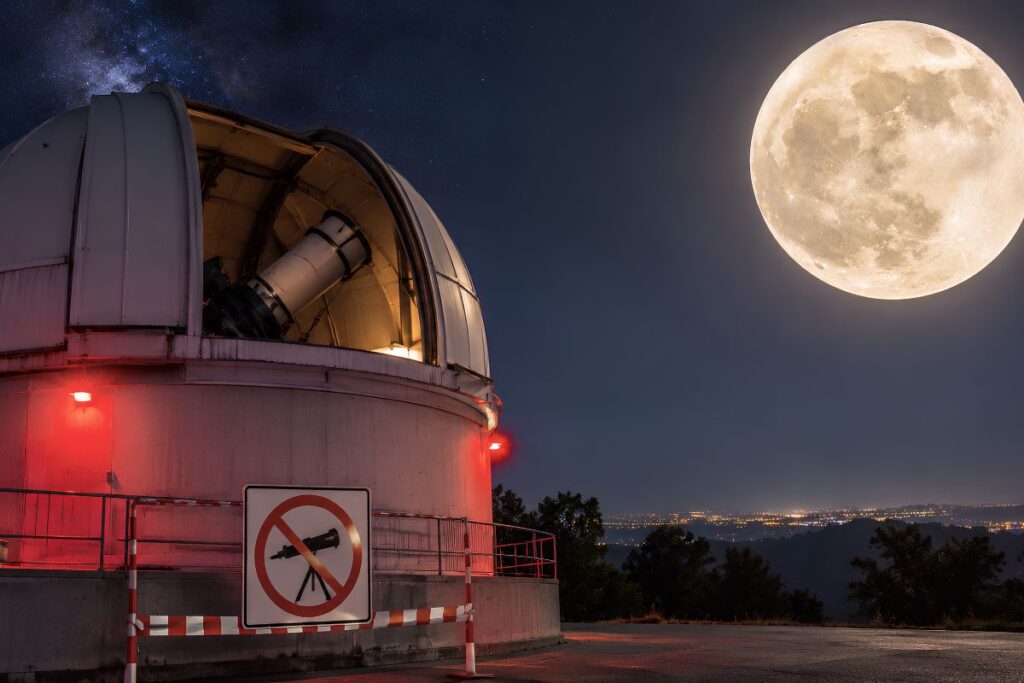
Professional observatories halt observations of distant, faint targets during a supermoon because lunar light scattered by Earth’s atmosphere drowns out deep-space signals. Rather than closing, facilities switch their schedules to bright targets, such as stars, planets, and infrared objects, that remain detectable despite the sharp increase in night-sky brightness.
Why Do Research Telescopes Restrict Deep-Space Instruments During a Supermoon?
Observatories restrict faint-target detectors during a supermoon because scattered moonlight floods sensitive sensors, risking detector degradation while yielding unusable, light-polluted data.
When the moon reaches perigee-syzygy, an astronomical alignment where a full moon coincides with its closest orbital approach to Earth, operations teams at major facilities adjust physical hardware. Under instrument protection rules outlined in ESO’s Service Mode Guidelines by the European Southern Observatory, operators must stow sensitive optical cameras or insert neutral-density attenuators.
Astronomical perigee skyglow, the diffuse illumination of the night sky caused by moonlight scattering off atmospheric molecules, creates an optical barrier. This background glow overwhelms detectors searching for faint photons that have traveled billions of light-years across space.
How Does Scattered Moonlight Degrade Sky Brightness?
Atmospheric light scattering during a supermoon brightens the optical background by roughly 0.3 magnitudes per square arcsecond, which doubles the exposure time needed to capture faint signals.
The degradation follows physical laws. Sunlight bouncing off the lunar surface enters Earth’s atmosphere, where gas molecules scatter shorter blue wavelengths through Rayleigh scattering.
When the Moon is at perigee, its reduced distance raises the total flux of reflected light reaching Earth. According to the Krisciunas and Schaefer lunar sky brightness model, this proximity brightens the zenith night sky by approximately 0.25 to 0.35 magnitudes per square arcsecond compared to an average full moon.
Because the astronomical magnitude scale is logarithmic and inverted, a smaller number marks a brighter sky. A 0.3-magnitude jump doubles the background noise floor. An exposure that typically takes 60 minutes to resolve a faint galaxy requires 120 minutes under perigee conditions, making faint-target programs mathematically unviable.
How Do Facilities Structure Telescope Bright Time Scheduling?
Observatories partition their operational calendars into three distinct lunar phases to prevent faint-light instruments from being assigned to light-polluted skies.
The European Southern Observatory and the National Optical-Infrared Astronomy Research Laboratory divide the observing year into three standard categories:
- Dark Time: Seven to ten nights centered on the new moon, reserved strictly for deep cosmological imaging.
- Grey Time: The transition phases flanking quarter moons, used for intermediate-brightness targets.
- Bright Time: Nights within four to five days of the full moon, allocated exclusively to programs unaffected by background glare.
A supermoon falls squarely within Bright Time, though its closer orbital stance produces higher background radiance than an apogee full moon.
Which Astronomical Programs Lose Time, and Which Ones Benefit?
Broadband optical filters and faint-galaxy spectrographs lose their observing windows during a supermoon, while stellar spectroscopy and infrared surveys take over the telescope time.
Broadband visible filters, specifically the standard Johnson-Cousins ultraviolet, blue, and visible (U,B,V) bands, suffer heavy degradation. According to an ESO technical report on bright-sky conditions, broadband blue filters face an operational background increase of roughly 3 full magnitudes compared to dark-sky baselines. Faint cosmological programs, including high-redshift dwarf galaxy tracking, gravitational lensing surveys, and visible-light exoplanet atmospheric transit runs, are barred from the queue.
Automated queue-scheduling systems reassign telescope mirrors to bright-sky programs:
- High-resolution stellar spectrographs measuring radial velocities and chemical compositions of nearby stars.
- Infrared imagers operating at wavelengths longer than 1 micron, where scattered moonlight drops off sharply.
- Narrowband emission-line filters centered strictly on hydrogen-alpha (H) or ionized oxygen ([OIII]), which reject out-of-band skyglow.
Astronomers studying stellar atmospheres, binary orbits, or solar system bodies receive fully productive observing sessions during these runs without competing against cosmological programs.
What Is the Financial and Logistical Cost of Moon-Driven Re-Scheduling?
Pushing faint-object programs out of the queue creates project backlogs on telescopes that cost tens of thousands of dollars per night to operate.
Operating a 4-to-10-meter ground-based optical telescope costs between $30,000 and $80,000 per night, according to operational budget audits published by the National Science Foundation and the European Southern Observatory for large optical reflecting facilities.
When orbital dynamics cause consecutive supermoons across multiple months, the annual window for deep-sky cosmology shrinks. Research teams bumped from the schedule cannot simply run the next week; once their target field sinks past the local horizon, they must wait until the following calendar year for clear, moonless skies.
Frequently Asked Questions
Do astronomical observatories close completely during a supermoon?
No. Facilities reallocate telescope time to Bright Time programs that study stars, planetary systems, and infrared objects that remain visible despite lunar skyglow.
How much brighter does the night sky get during a supermoon compared to an average full moon?
According to calculations based on the Krisciunas and Schaefer model, a supermoon increases optical sky brightness by 0.25 to 0.35 magnitudes per square arcsecond over a standard full moon.
Why can’t faint-sky telescopes simply point away from the moon?
Rayleigh scattering spreads blue wavelengths across the entire atmosphere, creating diffuse skyglow that elevates background noise across the sky, regardless of where the telescope points.
Which astronomical tools are most vulnerable to supermoon skyglow?
Broadband optical filters, particularly Johnson-Cousins ultraviolet, blue, and visible bands, suffer up to a 3-magnitude increase in background noise, making faint cosmic signal extraction impossible.