






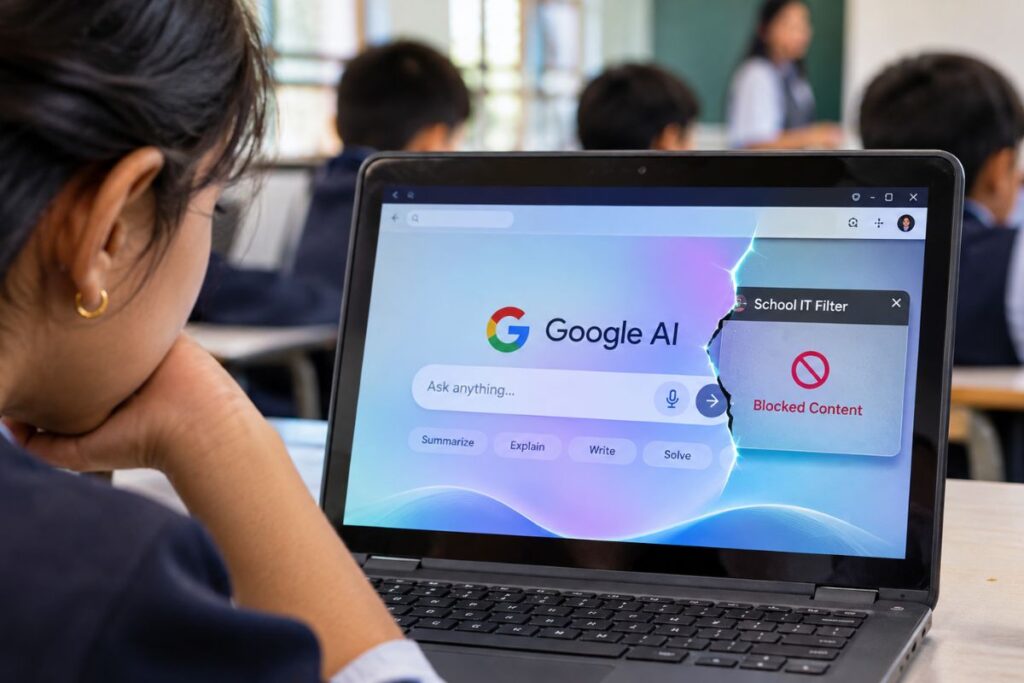
Google AI on school Chromebooks reaches students because Google classifies search-integrated generative models as consumer services rather than enterprise core applications, allowing software updates to bypass school administrative blocks. Under standard municipal technology contracts, local school districts bear legal responsibility for monitoring devices, even when Google’s software updates override local filtering controls.
How Did Google AI on School Chromebooks Bypass District Content Filters?
Google delivers artificial intelligence features to school devices by classifying search tools outside its regulated educational software tier. The enterprise software suite Google Workspace for Education, a package of cloud computing, productivity, and collaboration software developed for educational institutions, divides tools into “Core Services” and “Additional Services.”
Core Services such as Google Docs and Google Classroom remain bound by administrative controls that allow school technology directors to disable features across an entire fleet of managed hardware. General Google Search operates under separate consumer service rules. According to Google’s Educational Service Terms, administrative settings for consumer integrations function outside core classroom policy profiles, as documented in the Google Workspace Admin Console Documentation.
Because Google embedded its generative model Gemini directly into the search interface rather than as an isolated core application, the software executes outside the restricted management profile established by district administrators.
School technology directors managing thousands of mobile computers depend on centralized administrative group policies. When consumer features launch upstream within the search layer, school-assigned laptops process conversational text outside the boundary set by local district policy.
What Did the 2014 Gmail Scanning Lawsuit Reveal About School Tech Contracts?
The current dispute reproduces the institutional software conflicts litigated in California federal courts a decade ago. In 2014, public school systems adopted Google Apps for Education following marketing commitments that student accounts were isolated from commercial indexing.
During consolidated proceedings in the United States District Court for the Northern District of California, documented in In re Google Inc. Gmail Litigation, No. 13-md-02430, court records demonstrated that Google intercepted and scanned student emails sent across institutional domains to compile user advertising profiles.
The architecture in 2014 established the template seen today: Google disabled user-facing advertisement displays on classroom computer monitors, while its centralized server infrastructure continued processing data from incoming student communication channels.
In April 2014, following federal class-action hearings recorded by the International Association of Privacy Professionals, Google announced it would permanently discontinue automated data scanning of Apps for Education student accounts for commercial profiling. That litigation established that consumer feature pipelines remain active on school-issued hardware even after school administrators turn off visible front-end controls.
Why Does the Legal Doctrine of In Loco Parentis Fail to Restrict Classroom AI?
The common-law doctrine of in loco parentis, the legal doctrine holding that schools assume the rights and duties of parents in supervising minors, assumes that local school boards maintain technical control over school grounds and school-mandated tools.
Federal privacy laws fail to enforce this authority on modern computing hardware. The Family Educational Rights and Privacy Act (FERPA) of 1974 regulates access to official educational records maintained by institutions, but the statute does not address automated text generated locally on student screens.
Following the 2014 Gmail scanning controversy, software vendors created the Student Privacy Pledge, an industry self-regulatory framework administered by the Future of Privacy Forum to safeguard student personal information. The pledge relies on voluntary corporate compliance rather than statutory fines. When platform vendors introduce generative artificial intelligence into search tools on active educational devices, school boards possess no administrative inspection powers under FERPA to audit the underlying software.
Who Bears Legal Liability Under School Chromebook Procurement Contracts?
While software updates deploy from Google’s corporate servers, public school systems carry the primary legal risk under standard school Chromebook liability contracts.
Standard Master Services Agreements executed by public school boards contain indemnification clauses that assign device monitoring and student supervision to local taxpayers. Under these agreements, local school districts assume the obligation to block harmful content and enforce acceptable computer use under the Federal Communications Commission’s E-Rate and CIPA Rules, a federal program requiring public schools to deploy content filtering to receive telecommunications subsidies.
This contractual structure exposes public school risk pools to legal claims. State compulsory education laws require schools to provide students with computing hardware, while enterprise terms insulate tech companies from local supervisory failures, leaving municipal school budgets to defend resulting personal injury claims.
Google states that its software includes automated crisis helplines, content safeguards, and safety mechanisms developed with mental health professionals to stop user harm. The vendor also provides administrators with safe-search settings and network monitoring guidelines.
School network engineers point out that parsing dynamic, browser-based artificial intelligence text is structurally different from blocking known websites. Conventional firewalls cross-reference uniform resource locators (URLs) against static blacklists; they cannot inspect real-time conversational text generated inside encrypted search sessions without disabling district-wide web traffic.
How Could Product Liability Law Override Section 230 Platform Immunity?
The clash between enterprise software terms and student safety is pushing courtroom arguments beyond traditional digital platform immunity. Platform operators historically cite Section 230 of the Communications Decency Act of 1996 to shield themselves from legal liability for content posted by third-party internet users.
Plaintiffs in educational hardware lawsuits argue that conversational text generated by artificial intelligence constitutes a first-party manufactured software output rather than third-party speech. Legal scholarship detailing Section 230 and Defective Algorithmic Design indicates that courts are increasingly willing to evaluate automated digital outputs under strict product liability doctrines.
If judicial rulings determine that automated conversational text is an integrated software feature rather than publisher-hosted user speech, technology vendors will lose statutory immunity and face direct liability for physical or psychological harm caused by school-mandated devices.
Frequently Asked Questions
Why did Google AI on school Chromebooks work even after districts blocked the Gemini app?
School districts blocked the standalone Gemini web application, but Google embedded the model directly into Google Search. Because Google categorizes general search as an “Additional Service” outside the “Core Services” administrative layer in Google Workspace for Education, the feature bypassed standard district policy controls.
What was the 2014 Gmail student privacy litigation about?
In the consolidated federal lawsuit In re Google Inc. Gmail Litigation (2014), court dockets revealed that Google scanned student emails on institutional school domains for advertising data while marketing the platform as ad-free. The controversy compelled Google in April 2014 to end automated data scanning in Google Apps for Education accounts.
Who is legally liable if a student is harmed by AI on a school computer?
Under standard municipal hardware procurement agreements, local school districts bear legal liability for monitoring student device usage and filtering content under the Children’s Internet Protection Act (CIPA) requirements. Indemnification clauses protect the technology provider from local supervisory claims, shifting financial liability to municipal risk pools.
Does Section 230 protect tech companies from lawsuits involving educational AI?
Section 230 shields platforms from liability for content created by third-party users, but plaintiffs argue that generative AI text is a first-party manufactured product feature. If courts accept this design-defect argument, hardware and software vendors will face strict product liability claims rather than enjoying publisher immunity